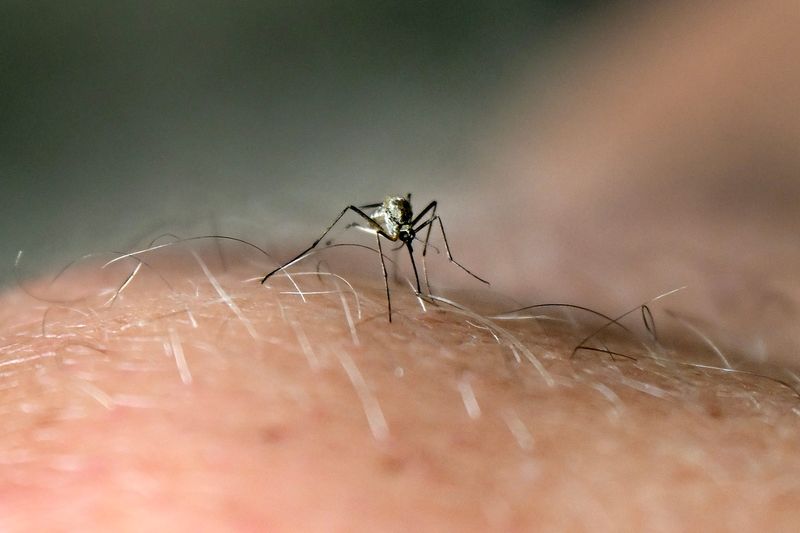
On the heels of Milwaukee’s 1,000-year flood, some residents say they are experiencing the worst-ever mosquito season they can remember.
In a Sept. 3 survey, we asked readers whether they had noticed more mosquitoes after the August floods. All 28 respondents said they had, with some like Brookfield resident Tom Disch saying it’s been difficult to even step outside.

“In my entire 78 years on this planet I have never seen this many mosquitos,” Disch said. “I tried cutting the lawn two days ago and clouds of them rose up out of the grass as the mower approached.”
The mosquitoes currently plaguing southeast Wisconsin are a species that especially thrive in the wake of floods, experts say. Aedes vexans, or inland floodwater mosquitoes, often come out in swarms in the weeks following floods — meaning they’ve especially worsened between late August and early September.
Here’s what to know about mosquito activity in greater Milwaukee and how you can best protect yourself:
Why are mosquitoes gotten so bad after the Milwaukee floods?
Inland floodwater mosquitoes are poised the thrive in the wake of heavy rainfall or flooding, according to P.J. Liesch, director of the UW-Madison Insect Diagnostic Lab.
These mosquitoes lay eggs in low-lying, or flood-prone, areas, so their eggs will hatch if and when heavy rain hits.
“Then the larvae have to feed and grow and develop, which takes a bit of time,” Liesch said, “so that’s why when we have a heavy rainfall event, it’s often 10 to 14-ish days later, and boom, the mosquitoes are out in full force.”
In 2018, Liesch said widespread flooding in the Madison area led to similar effects: the area saw rainfall upwards of 10 inches, and mosquitoes were swarming about two weeks later. Floodwater mosquitoes can also travel five to 10 miles from their breeding sites, so even if you don’t live in a heavily flooded area, the mosquitoes may reach you.
When will the floodwater mosquitoes go away in Milwaukee?
The mosquito activity will start to drop off when temperature drop to highs of 50 to 60 degrees, Liesch said.
“A little bit of a silver lining is because this flooding happened relatively late in the year, it means we don’t have to deal with the mosquitoes for a super long time,” he added. “It’s been warm this last week, but we’re getting into the later parts of September now.”
‘Mosquito war zone’: Milwaukee area residents report terrible mosquito seasons
“Relentless,” “horrible,” and “my worst nightmare” were among the terms Milwaukee area residents used to describe this mosquito season in our survey.
Some said they’ve had to routinely wear long pants and sleeves when venturing out in recent weeks, especially those living near ponds or wooded areas. Several cited Root River in Franklin — which rose from about two feet to 10 feet during the floods — as a particular mosquito hotspot.
Milwaukee resident Jamie Cain lives in a heavily flooded area and said it’s been a “mosquito war zone” over the past month.
“Instead of peaceful evenings outside, we’re sprinting from the garage to the backdoor like we’re under siege” Cain wrote. “Our poor pup only gets short bursts outside before we have to drag her back in, swatting the air like maniacs. It’s beyond frustrating.”
Menomonee Falls resident Bob Schersing said the mosquitoes have been swarming at all hours of the day.
“This season is the most mosquito bites I have received since I can remember,” Schersing wrote.
Glendale resident John Standard also said it’s been the worst mosquito season in memory.
“We have lived in the Milwaukee area for 16 years, and only a few of those have featured noticeable mosquitoes at home,” Standard wrote. “Recently, though, being in our backyard reminds us of being in northern Wisconsin!”
Floodwater mosquitoes do not increase disease risk, experts say
Some residents wrote in with concerns that increased mosquito activity will exacerbate risk of mosquito-borne illnesses, but experts say floodwater mosquitoes generally don’t pose this risk.
The mosquitoes that carry West Nile virus thrive in longstanding, stagnant water, Liesch said — meaning heavy rain and flooding events actually wash them away.
“We primarily think of [floodwater mosquitoes] as a nuisance issue,” he added. “They can be fierce fighters, they can ruin outdoor picnics, but they’re usually not playing much of a role in terms of a disease transmission.
Still, regardless of August’s historic flooding, mosquitoes are already most active in summer and early fall and choose to lay eggs in or near water, according to the Wisconsin Department of Health Services. The department conducts regular surveillance for species capable of transmitting West Nile and Eastern Equine Encephalitis viruses.
In an email to the Journal Sentinel, DHS vectorborne disease epidemiologist Rebecca Osborn said the agency has seen “some increases” in disease-causing mosquito activity after the August floods, “but these increases have not been sustained over time and their abundance has overall remained at low or moderate levels.”
In terms of West Nile cases, Osborn said there has been a statewide increase since beginning of August, but the number of cases is still “on par or slightly higher” than DHS would expect in an average year.
“To date, we have not detected an increase in WNV activity in southeastern Wisconsin where historic flooding occurred in early August,” she said.
Wisconsin’s first case of West Nile of 2025 was reported in late July in Barron County. As of Aug. 28, 14 counties across the state have reported West Nile activity in the insects and some animals, including in Milwaukee, according to state data.
No cases of EEEV have been reported in Wisconsin in 2025 thus far, according to Osborn. Two cases of Jamestown Canyon Virus have been detected in the state this year, according to U.S. Centers for Disease Control and Prevention data, but Osborn noted it is “not unusual.”
How can I protect myself from mosquitoes?
As mosquito season peaks, officials recommend taking preventive measures “until the first hard frost,” according to Osborn, which is when temperatures fall “below 28 degrees Fahrenheit for at least four straight hours.”
Here are some tips from DHS on how you can protect yourself and your home from the pests:
Prepare your home
You should drain any sources of stagnant water, like birdbaths, pet dishes and flower pots, DHS says.
Officials also recommend keeping your lawn and weeds trimmed since mosquitoes often use those areas to rest when it’s hot. You should also make sure window and door screens are intact and tightly fitted to prevent mosquitoes from getting inside.
Protect your skin and clothes
The best way to avoid illnesses from insects is to reduce your exposure, according to DHS Public Health Entomologist Xia Lee. You can apply insect repellants that contain DEET, picaridin, lemon eucalyptus oil or IR3535 to any exposed areas.
You can also treat clothes with permethrin directly, but it should not come into contact with skin, according to Lee. You should pick long-sleeved shirts, pants and socks to help reduce skin exposure.
Avoid being outdoors at dawn and dusk
Mosquitoes are typically more active at the beginning and end of each day. If you’re able, plan outdoor activities outside of those time periods and reschedule evening activities during peak season for the pests.
You can view more mosquito bite prevention tips from DHS at https://www.dhs.wisconsin.gov/mosquito/bite-prevention.htm.
This article originally appeared on Milwaukee Journal Sentinel: ‘A full-blown mosquito invasion’: Milwaukee area residents report relentless mosquitoes after floods
Reporting by Cailey Gleeson and Maia Pandey, Milwaukee Journal Sentinel / Milwaukee Journal Sentinel
USA TODAY Network via Reuters Connect