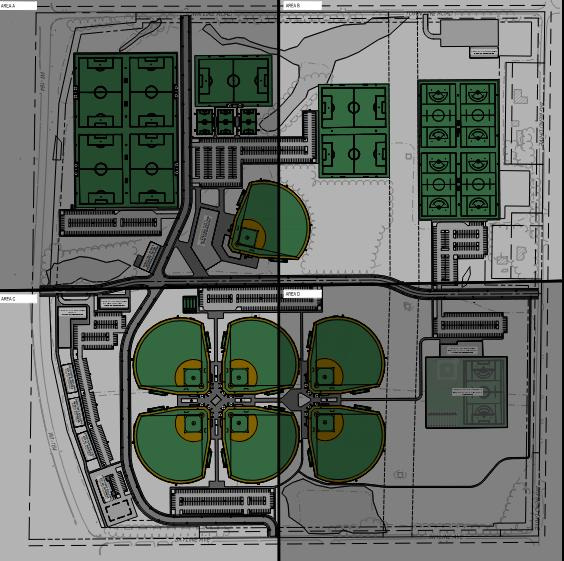
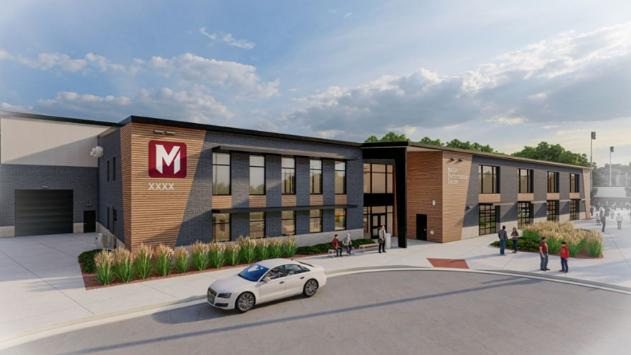
Breck Athletic Complex, the keystone of a proposed 150-acre development on Big Bend’s far-north end, has stumbled in the steep political terrain tied to the village’s rural reality and resident concerns.

The village’s Plan Commission at least temporarily bowed to widespread public opposition, including concerns about how the complex would strain Big Bend’s rural character and public resources. Village officials voted Jan. 29 to table the proposal to allow further study on more than a dozen issues.
That means that land planning and zoning requirements tied to the proposal will still require approval for the complex to remain a possibility. The question now is when.
Breck sports complex would total more than 20 fields, plus indoor facility
The complex, part of a plan valued at between $175 million and $225 million, was proposed in late 2025 by owner Eric Weishaar, listed on LinkedIn as president of Breckenridge Landscape, and planning agent Claire Roth.
It envisions a development phased over eight stages, beginning with four full-size, synthetic turf soccer fields in 2026 – the tip of the iceberg for a much more involved plan.
Additional outdoor fields, an indoor fieldhouse training facility, a restaurant and banquet facility and, eventually, a hotel would be added each year through 2030, based on a tentative timeline previously presented. In all, the complex would consist of seven baseball fields, 10 soccer fields and four lacrosse fields once fully built.
The 155,000-square-foot indoor facility would add year-round baseball, soccer and lacrosse training fields, as well as basketball courts and concessions.
Tourism is a big part of the long-term complex plan
Weishaar has pitched the proposal as an attraction that could bring in regional sports teams and tournaments, and promoted the possibility of the sports complex serving as a major tourism draw. That’s where the nonathletic commercial buildings come in.
Restaurants, a banquet hall and — something Big Bend doesn’t have — a hotel would fill out the campus, though those elements would come into play in the final stage of the development, around 2030. As previously reported, I & S Group (aka ISG Inc), a design and engineering firm working with the developer, said the overall plan takes tourism into account.
“Designed to be more than a traditional sports complex, the Breck Athletic Complex is envisioned as a destination where local residents, tenants, customers, and the general public are drawn to experience all that it offers,” ISG said in the plan. “Whether visitors are walking the sidewalks, paths, or trails while enjoying a cup of coffee as their child plays baseball, or dining at a restaurant designed to overlook the fields, the Breck Athletic Complex is intended to meet community needs and deliver a memorable, engaging experience.”
Retail businesses, including a gas station, could also emerge within the development, ISG indicated.
Opposition comes from residents who favor rural ideals
To accommodate the plan, 42 acres of a 150-acre parcel — in the northeast quadrant of Skyline Avenue and Highway 164 — must be redesignated from medium-density residential to commercial and business land uses. The entire 15-acre parcel would also need what’s known as a planned-unit development district overlay, offering the developer flexibility in a mixed-use development.
As it stands today, the land is almost entirely farm fields. And that’s the way some prefer it.
The majority of residents who spoke, often emotionally, at the Jan. 29 joint Village Board and Plan Commission public hearing, asked officials to reject the plan outright or at least delay action until its impact can be studied. That includes concerns about police and fire services, traffic, flooding and various infrastructure costs.
“This needs some kind of a referendum,” village resident Larry Wirth said.
Some residents said they preferred the village’s reliance on private wells for residential water supplies. Some said they did not want treated water as their source, a reality tied to the Breck plan. Still others noted that Franklin’s experience with The Rock, a decade-old sports complex, has produced numerous noise complaints from residents there over the years, a concern they feel would arise in Big Bend, as well.
Almost all said the sports complex simply doesn’t fit the neighborhood and felt the prospect was concealed by village officials for too long.
“We saw them probing the land mid-December and we thought maybe there was McMansions coming,” said Diana Bauer, whose Townline Road home would be near the complex. “We thought maybe there’s going to be new houses coming, new neighbors coming. But we didn’t think this neighbor was coming.”
The crowd at the Jan. 29 hearing was so large, numbering more than 100, that the village was forced to stream it in another room. Another 132 people, at its peak, streamed it online on the village’s YouTube channel. The feed, however, repeatedly failed, going silent for nearly an hour at one point.
Vernon official questions value of sports complex against other options
The villages of Vernon and Waukesha, whose lands both border the property, previously indicated they wanted input into the development. One neighboring village official who spoke at the hearing warned Big Bend leaders of the pitfalls of the current plan.
“I would like you to consider are you guys setting a precedent for future development?” asked Vernon Village President Jeff Millies, noting that Vernon officials are unanimously not in favor of the Breck development.
“You have a lot of vacant land along the [Highway] 164 corridor,” Millies said. “This project does not quite fit into your zoning and rules and regulations, so you’re doing a PUD. What’s going to happen when the next developer comes in and says ‘Hey, I want to do [something] that’s out of the ordinary. You let [the Breck plan] go through, why won’t you let my project go through?’ So you may be opening yourself up for future problems if you allow this development to take place.”
Beyond that, Millies said the village, in the long run, could benefit more from the development of businesses on the 150-acre parcel rather than a sports complex dominated by open spaces.
“I heard this project is going to bring in a value in excess of a hundred million,” he noted. “Well, if you have sewer and water, businesses will come, and you’ll probably get development worth more than that. Instead of having soccer fields back there, you could have multifamily housing, like townhomes. Soccer fields are not a high tax dollar item.”
Village officials give no timetable for further consideration
The proposal isn’t dead. But the plan, for now, also can’t proceed.
Village officials identified 13 points of study, including potential safety issues, stormwater management, traffic studies and noise concerns. Some of the answers will involve discussions with other municipalities involved in major developments, they acknowledged.
The Village Board meets again on Feb. 19. It wasn’t immediately known if village staff will provide any updates at that time.
Contact reporter Jim Riccioli at james.riccioli@jrn.com.
This article originally appeared on Milwaukee Journal Sentinel: 150-acre sports complex delayed after outcry from Wisconsin residents
Reporting by Jim Riccioli, Milwaukee Journal Sentinel / Milwaukee Journal Sentinel
USA TODAY Network via Reuters Connect