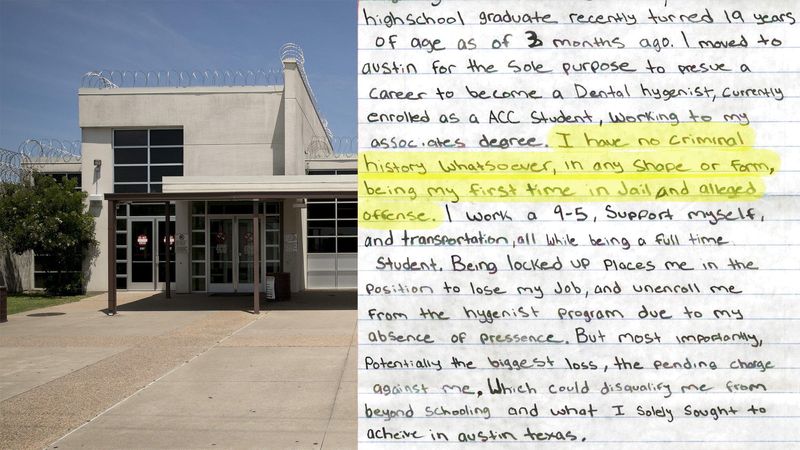
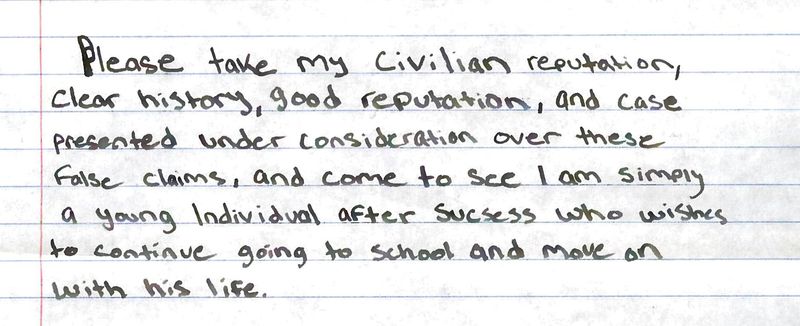
The 19-year-old Austin Community College student had spent 35 days in a cinder block cell at the Travis County Correctional Complex when he penned a letter.

In clearly printed handwriting, he explained to the judge assigned to his case that being locked up for so long posed a threat to his future. He was currently enrolled in dental hygiene school, he explained, and worried he would be kicked out for missing too many classes. Most importantly, he said that having a criminal record would hinder his ultimate goal of joining the military.
“I am simply a young individual after success who wishes to continue going to school and to move on with his life,” he wrote on May 30, 2024.
He had been arrested and charged with felony burglary of a habitation after an altercation with his father, but had yet to be indicted more than a month into his jail stay and had no idea where his case stood.
More than two months went by before he was finally released after a 112-day stay. In the end, Travis County prosecutors dropped the case.
The American-Statesman is not identifying the young man, who requested anonymity as he tries to put the incident behind him and prepares to seek an expungement of his record.
He was among more than 180 suspects who sat behind bars for longer than 90 days last year without being indicted, an investigation by the Statesman and KVUE-TV found. Under state law, prosecutors are given 90 days to indict felony suspects or they must be released on bail.
His case exemplifies one of the more extreme outcomes of the dysfunction that has gripped the Travis County felony criminal courts under the tenure of District Attorney Jose Garza, a Democrat and vocal advocate of criminal justice reform who for years has decried the disproportionately high number of individuals held in jail awaiting trial.
Earlier this year, the Statesman and KVUE revealed that Garza’s office had routinely failed to indict suspects in custody within 90 days, leading to potentially unconstitutional delays for those being held, the release of violent offenders on dramatically reduced bail and opening up Travis County to potential legal liability. Texas Republican leaders who have long had Garza in their sights pounced on the news, accusing him of compromising community safety by freeing dangerous criminals and sexual predators. They have since proposed legislation and enacted rule changes to address the issue.
But how often Garza’s office was missing this deadline — and what kind of suspects were being held for too long or released too soon — has remained unclear as no agency records that data.
Garza gave some insight in a February interview when — in defending his office’s approach — he cited a list of 2024 cases he said he had reviewed in which defendants remained in jail past the deadline and found “that the overwhelming majority were appropriate not to be indicted” within 90 days. His office refused to provide that list to the Statesman and KVUE, saying it contained privileged material, but the news organizations obtained the case records from another county agency and has spent months analyzing them.
The analysis found that the 181 defendants faced 263 separate charges.
All of the defendants were eventually released, and most were eventually indicted.
The analysis showed that 70 of the charges were violent or sexual in nature and that 61 defendants later had their cases rejected, dismissed or no-billed by a grand jury.
The latter figure raises the most concerns for criminal justice advocates who have already deemed Garza’s missed deadlines an affront to swift justice.
“It’s pretty astonishing, and it’s a bad name and a bad look for our criminal justice system,” said Natasha Malik, a criminal justice policy attorney for the nonprofit Texas Appleseed. “It makes you wonder: What evidence did you have? It must have been weak or you didn’t have any at all.”
Garza’s explanation for the missed deadlines has evolved dramatically in recent months. At first, he blamed one of his prosecutors. Then, he suggested that prosecutors had no deadline to act within 90 days and that the law is designed only to give attorneys a mechanism to get their clients out of jail.
Most recently, he has said his office takes seriously the timely presentation of cases to grand juries and that he had put “in place additional oversight measures to ensure that instances where cases are unindicted remain a rare occurrence.” But he also has said that the issue underscores broader justice system complexities and that the cases represent a tiny fraction of new cases his office received in 2024.
To be sure, the Statesman and KVUE found that lapses in oversight and at times blatant inattention by other parties — including judges and defense attorneys — have contributed to defendants remaining in jail much longer than 90 days without being indicted.
Nate Fennell, a policy attorney at the Deason Criminal Justice Reform Center at Southern Methodist University, said players in all corners of the courtroom have “parallel responsibilities and obligations.”
“If the question is who is responsible for deciding when a person gets charged with a crime, that is on a prosecutor,” he said. “But if the question is who is responsible for a person being detained longer than they legally can, that is on the county, the courts and the defense lawyers.”
‘He really did suffer’
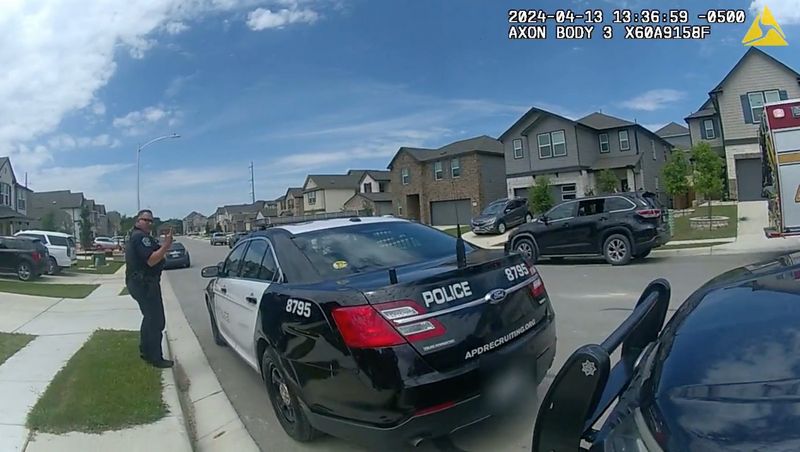
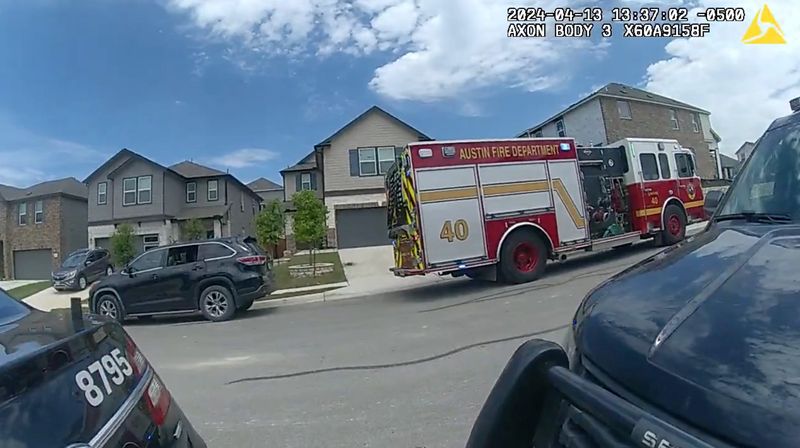
On a warm spring day in April 2024, Austin police responded to a 911 call for a family disturbance at a two-story limestone house in Northeast Austin.
A father told officers that his 19-year-old son had become “angry and violent” during a dispute so he locked him out of the house. The young man then broke through the back door and assaulted his father, according to an arrest affidavit.
The father told the Statesman that he mostly wanted the police to help diffuse the volatile episode but realized his son might be arrested on what he assumed would be a low-level misdemeanor. He said he was shocked when officers charged his son with a felony and a judge set his bail at $40,000.
“My point was not to get him to stay in jail like that, no,” he said. “I was stuck in the middle of no outcome, not knowing what to do.”
The father, who the Statesman is also not identifying because he shares a last name with his son, said he recalled one phone call from a prosecutor soon after his son’s arrest to inform him that he had been transferred from the jail in Williamson County, where he was arrested, to Travis County.
As his son spent months behind bars, the father says he recalls trying to reach the prosecutor assigned to the case to say he no longer wanted to press felony charges.
“I left messages, and he never called me back,” he said. “I became so desperate because I hated that (he) was there.”
Garza’s office said in a statement that it was “in communication” with the father and that he asked prosecutors to proceed on a misdemeanor charge. But the statement did not say when those talks occurred or why the office did not pursue a lesser charge. Garza’s office did not respond to follow-up questions.
While behind bars, the 19-year-old got a tooth knocked out in a fight, according to his attorney, the second lawyer on his case who was appointed in late May 2024.
“In the case of that particular client, the 90-plus days he spent in jail were very hard on him,” the attorney, Claire Carter, said. “It is fair and it is accurate to say that he really did suffer.”
The young man finally got out of jail, but not until he stayed three weeks longer than Texas law allows.
What the data shows
The 19-year-old was among 61 defendants in Travis County in 2024 whose cases were never indicted on the charges that landed them in jail — but only after they spent 90 days or longer behind bars.
Forty-six of those defendants had their cases rejected by prosecutors and 10 had their cases dismissed. In some instances, defendants were prosecuted in other cases, likely extending their time in jail and delaying their eligibility for release. Additionally, some of the dismissals came after defendants completed pretrial diversion programs.
Austin attorney Kristin Etter, who has worked in the region as a defense attorney for nearly 25 years, said it was not unusual for her to negotiate with prosecutors in some cases for her client to remain in jail with a promise that they would drop the matter after an agreed upon duration.
“It is something I would have talked to the client about up front,” she said. “There would be a strategic reason why we would do it.”
She added that she would often try to deter prosecutors from indicting a case because “it is harder to unwind” as more people get invested in the prosecution.
In other instances, however, prosecutors dismissed the cases for insufficient evidence, because they needed further investigation or because witnesses could not be found.
Grand juries declined to indict five cases that prosecutors presented in 2024.
Criminal justice reformers said they particularly question cases that went nowhere because those defendants may have remained in jail without strong evidence against them.
It’s unclear how many of these people lost housing, jobs or transportation while they languished in jail.
But Malik, of Texas Appleseed, said defendants in general face “immediate impacts” from being behind bars — even for just one day.
“It has horrible implications for people’s lives,” she said.
Prosecutors eventually secured indictments in the other 141 cases after defendants spent an average of 130 days in jail.
The defendants often were released after intervention from their lawyers. Although many did so informally, attorneys in 53 cases filed formal motions with the court that cited prosecutorial delay and a missed 90-day deadline.
In the February interview with the Statesman and KVUE, Garza said that his review of the 2024 cases found “that the overwhelming majority were appropriate not to be indicted” within 90 days.
Garza did not respond to an inquiry about whether he still believes the cases were handled correctly. But he reiterated in a recent statement that it is not always appropriate to indict or dismiss some cases within 90 days as prosecutors take time to “thoroughly evaluate cases, which may include waiting to receive evidence or locating necessary witnesses.”
It is unclear whether and how often Garza’s office did not seek indictments within 90 days earlier in his administration. He took office in 2021.
The Statesman and KVUE obtained the 2024 case list through an open records request to the Travis County Office of Court Administration.
Citing the need for transparency, two lawmakers filed bills this legislative session to require prosecutors to formally report how often they do not indict defendants within 90 days.
Sen. Joan Huffman, R-Houston, who proposed a measure in the Senate, said in a statement that it would “provide Texans with vital information about prosecutorial performance to make informed decisions when voting for their county or district attorney.”
Rep. Jeff Leach, R-Plano, who carried a similar measure in the House, said the bill would help the public “better understand prosecutorial decision-making and its impact on the justice system and public safety statewide.”
Attorney General Ken Paxton, a fierce Garza critic, has also put new rules in place requiring Texas prosecutors to report the types of crimes they enforce to show if they are “engaging in selective prosecution” and “turning dangerous criminals back into the community.”
“District and County Attorneys have a duty to protect the communities they serve by upholding the law and vigorously prosecuting dangerous criminals,” Paxton said.
Garza last week sued Paxton over the rules.
‘Help! I’m being attacked!’
On a frosty night in January 2024, Emily Norris was on her way to her girlfriend’s house just before midnight when she whipped into a Whataburger drive-through in North Austin.
As the 24-year-old baker lowered the window of her Honda SUV to place her order, a man dove feet-first into the car and started whaling on Norris’ face.
“Help! I’m being attacked!” she screamed several times.
As the man attempted to press the gas pedal, Norris pushed hard on the brake and the engine revved.
“Let go, [expletive],” the man yelled.
The microphone on the drive-thru speaker picked up the attack. Customers and employees ran out to help Norris, who was bruised and badly shaken.
Security camera footage showed the attack lasted a harrowing 30 seconds before the man crawled back out the window and scurried into the night.
Luckily, he left an easy-to-follow clue: His cell phone had fallen out of his pocket. Police linked the device to 21-year-old Jayderson Gabriel Paz and arrested him on a robbery charge three weeks later.
A detective informed Norris, who felt instant relief that her suspected assailant was behind bars.
Months passed by with no updates, and Norris wondered how the case was progressing but didn’t follow up.
“I feel uncomfortable begging a police department or district attorney to move their butts along,” she said.
Paz spent 99 days in jail without an indictment before his lawyer intervened.
Attorney Alfonso Carlos Hernandez cited a delay in the case and asked a judge to release him on a personal bond, meaning he had to pay no money.
The next day, Paz was freed. Police arrested him in February in connection to a 2023 burglary.
The next call Norris received regarding the case came from the Statesman and KVUE about 15 months after she had been violently attacked.
“It is such an airtight case,” Norris said. “You had everything right there in front of you. That is the biggest issue that I have. It was so easy for them to move forward.”
Four days after the Statesman and KVUE asked Garza about the case, one of his attorneys called Norris and left a voicemail, saying that she planned to take the case to a grand jury the following week. Garza’s office described the timing of the follow-up as a coincidence, saying it was “not related to the inquiry from the Statesman” and suggested the delay was due to the inaction of a former prosecutor whom he has previously blamed for missed deadlines in two murder cases earlier this year.
A few days after Norris got her first phone call, a prosecutor called to report that a grand jury indicted Paz on a Class A misdemeanor of assault causing bodily injury for “striking her in the head with his hand,” the indictment read.
Norris said movement on the case is what she had wanted all along, and if possible, for Paz to be rehabilitated. More importantly, she said, she wanted to feel like what happened to her mattered to those in power in the justice system.
“I am so upset that it took this long,” she said. “It feels like they weren’t really focused, in their own world. It is good they are finally moving.”
A shared responsibility
Garza’s office said in a statement that the issue of defendants remaining in jail past 90 days without indictment has been unfairly oversimplified as the district attorney’s fault, asserting that the matter is far more complex.
To be sure, experts say other parties share in the responsibility.
Pam Metzger, a law professor and executive director of the Deason Criminal Justice Reform Center, said judges could require prosecutors and defense attorneys to explain why a defendant has not been indicted or released within 90 days.
“That is part of their case management responsibilities,” she said. “It is more than simply managing workload. It is part of their oversight of justice.”
Each of the county’s nine criminal district courts operate independently and develop their own practices. Although some judges say they are not alarmed at the frequency of the missed deadlines in their own courts, several others said they have enacted strategies to ensure timely indictments. That includes sending notices to both prosecutors and defense attorneys when the 90-day window is looming.
State District Judge Chantal Eldridge said that her staff schedules a hearing for any case involving a person who has been in jail for longer than 180 days “just so we can discuss it” and to make sure a defendant has not been overlooked and “to find out if there are issues which prevent its timely disposition.”
Although defense attorneys often sought the release of defendants in the 2024 cases after 90 days in jail, those working within the justice system expressed concern that certain lawyers delayed taking action until significantly later, waiting weeks or even months in some cases.
“My concern is always: What was happening in those 90 days? And why did we get to a point where a person remained in jail 90 days without an indictment or another resolution?,” said Bradley Hargis, executive director of the Capital Area Private Defender Service.
Defense attorneys across Texas have occasionally faced malpractice lawsuits if they did not act to free their jailed clients after a missed deadline. In one case in Tyler, a jury awarded a man $450,000 after he stayed in jail 115 days without an indictment and alleged no action by his lawyer.
Travis County Chief Public Defender Adeola Ogunkeyede said attorneys in her office are trained to act well before the 90-day indictment deadline.
“For us, zealous defense means that attorneys should be raising requests for release whether the 90 day date has approached or not,” she said.
‘Interest of justice’
Even when defense attorneys have sought their clients’ release, they have still faced hurdles.
A year ago, soon after Carter was appointed to represent the 19-year-old, she sought his release on a personal bond.
There is no record of the decision but Carter said a judge in the case would not release the young man because he had nowhere to go. Before his arrest, she said he had been renting a room with his dad’s support but had since lost his housing.
Carter’s move posed a clear opportunity for Garza’s office to make a decision on how it would proceed with the case — either send it to a grand jury or drop it.
Instead, the 19-year-old stayed in jail.
Once the 90-day mark hit, Carter tried again to get her client out of jail on a personal bond in a new court. But that judge also would not release him without a place to go, extending his time in jail by several days, as Carter worked to help find housing.
Thirteen days later, Garza’s office finally made a decision: It was dropping the charges against the young man, in part because his father did not want to pursue the case.
“The District Attorney’s Office has reviewed the evidence in the case and determined that no felony charges will be filed at this time,” a prosecutor wrote. “For the reason: In the interest of justice.”
About this story
The American-Statesman, in partnership with KVUE-TV, has spent months investigating missed deadlines by Travis County prosecutors in felony cases. In addition to an analysis of 263 cases, investigative reporter Tony Plohetski conducted extensive interviews with more than 40 people, including legal scholars and attorneys who specialize in the Sixth Amendment; multiple judges in Travis County felony district courts; more than a dozen defense attorneys who practice in Travis County and former prosecutors in the Travis County District Attorney’s Office, among others. KVUE executive investigative producer Joe Ellis contributed to this report.
This article originally appeared on Austin American-Statesman: Travis County prosecutors have 90 days to indict or release. They missed that deadline 263 times in 2024.
Reporting by Tony Plohetski, Austin American-Statesman / Austin American-Statesman
USA TODAY Network via Reuters Connect