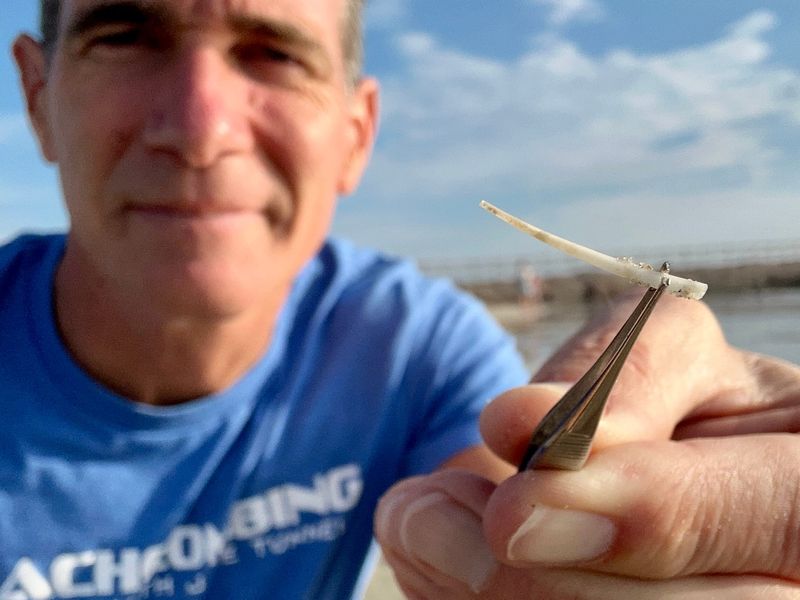
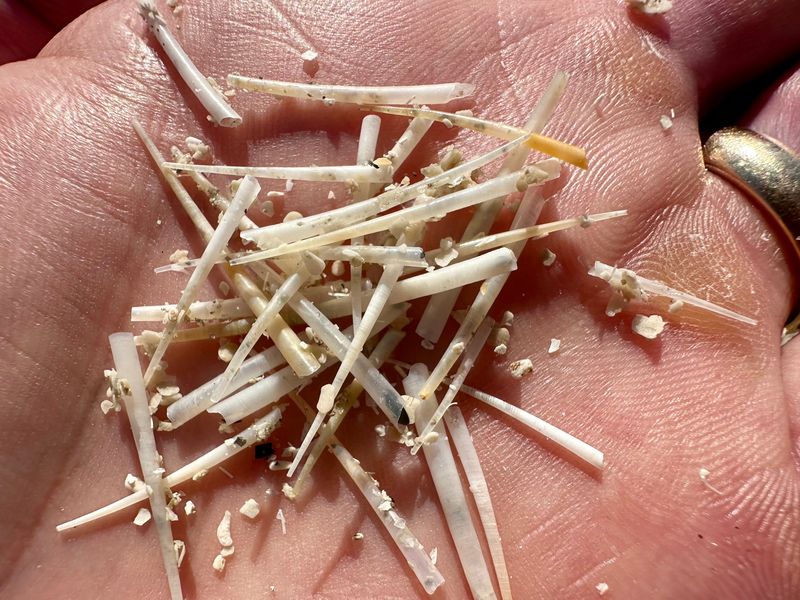
They didn’t look like much at first, just a scatter of white slivers along the tide line.
At a glance, they could’ve passed for fish bones or bits of plastic, the kind of debris beachcombers often overlook. But a closer look revealed something far more interesting: ivory tusk shells.

Within minutes, I had gathered nearly 40 of them from a short stretch of beach. Meanwhile, people walked all around me, completely unaware of what lay at their feet. A few stopped to ask what I was picking up, surprised to learn these curious fragments were actually the shells of marine animals.
Ivory tusk shells, also known as tooth shells, belong to a group of mollusks called scaphopods. There are around 350 species worldwide, living both in shallow coastal waters and the deep sea.
Their smooth, white shells resemble miniature elephant tusks, gently curved and open at both ends. Most only grow to about 2.5 inches long.
Unlike most mollusks, tusk snails have no gills and no eyes. Instead, they rely on tiny hair-like structures called cilia to pull water in through the narrow end of the shell and push it back out after extracting oxygen. Their head and foot extend from the wider end, where delicate tentacles capture microscopic prey, primarily foraminiferans, single-celled organisms drifting in the sediment.
These animals spend nearly their entire lives buried in sand or mud, making them rarely seen alive. Over time, the shell grows at the larger end while the narrow tip gradually wears away.
Though easy to miss, tusk shells have a rich history. Indigenous peoples of the Pacific Northwest once used them as currency and for jewelry. Storms and shifting currents likely unearthed these shells offshore and delivered them to the tide line, where wave action sorted and concentrated them into tidy drifts at low tide.
Next time you’re scanning the shoreline, take a closer look. You might just spot one of the ocean’s most overlooked treasures.
Jace Tunnell is the director of community engagement for the Harte Research Institute at Texas A&M University-Corpus Christi. His Beachcombing series appears on YouTube (@HarteResearch), Facebook (facebook.com/harteresearch) and Instagram (@harteresearch).
This article originally appeared on Corpus Christi Caller Times: The shells of these sea snails look like miniature elephant tusks
Reporting by Jace Tunnell, Harte Research Institute / Corpus Christi Caller Times
USA TODAY Network via Reuters Connect