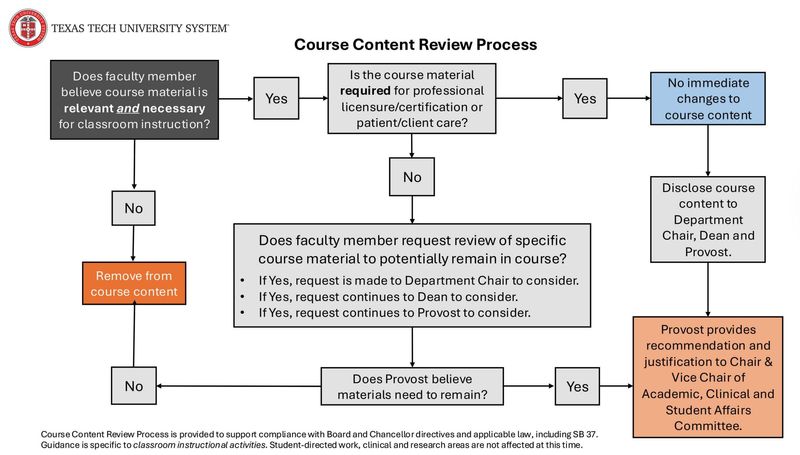
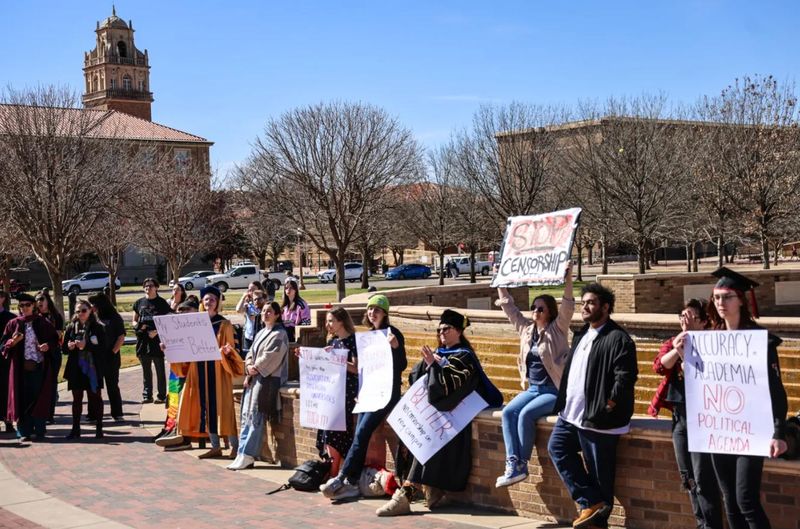
The Texas Tech University System has concluded its course content review related to sexual orientation, gender identity and other diversity, equity and inclusion issues, sparking backlash from some in the TTU and Lubbock community.
The results concluded that each of the system’s five component universities had until June 15 to freeze admissions or allow students to declare majors in identified programs, which the system deemed to violate state and federal laws. It was not immediately clear which specific classes and programs are to be shuttered on this date.

This comes after the passage of Senate Bill 37 during the 89th Texas Legislative Session — which was authored by then-Sen. Brandon Creighton, who is now the chancellor of the TTU System.
The bill empowers politically appointed governing boards, like the Board of Regents of the TTU System, to review course material to see if it’s in compliance with recent bans on diversity, equity and inclusion and gender identity topics.
On Dec. 1, 2025, the system issued the protocol for conducting to the system’s five university presidents, outlining how they should conduct the review process.
In a memo on April 9, Chancellor Creighton laid out the phase out process for academic programs “centered on” Sexual Orientation and Gender Identity (SOGI), including undergraduate majors, minors, certificates and graduate degrees. Students currently enrolled in the phased-out programs will be able to complete their degrees.
In the memo, the system also established the following:
“To uphold institutional objectivity, this framework requires the legal recognition of only two human sexes and strictly prohibits the endorsement of a gender spectrum or fluid gender identities as empirical biological science,” the memo reads.
In doing so, professors can not assign materials “centered on” or that “include” SOGI material defined as:
In an April 10 news release, the system announced the review was conducted by the System’s Board of Regents’ Academic, Clinical and Student Affairs Committee, which is chaired by Regent Shelley Sweatt with Don Sinclair as vice chair.
All nine regents of the board are members of the committee — including the Board’s Chair Cody Campbell, vice chair Dustin Womble and the system’s student regent Eli Heath.
During the review, 1,403 courses were initially identified with potentially related course content. Of those courses:
Some Texas Tech, Lubbock community advocates condemn the system’s action
Immediately following the system’s announcements of the closing of certain unnamed programs and degree programs, the Texas Tech chapter of the American Association of University Professors issued a statement condemning the system’s actions.
“The policy handed down in today’s memo is shocking in its brazen disregard for our commitment to delivering a meaningful, complete, and truthful education, and finally demonstrates the true agenda: the accusations of ‘indoctrination’ were nothing but an excuse to inflict a preferred indoctrination. If this policy stands, politicians and the monied interests who support them will have effectively taken over the curriculum of our institutions in the TTU System, whose credibility will be indefinitely and irreversibly harmed,” said Andrew Martin, Texas Tech AAUP chapter president. “Any thought of Texas Tech University rising to the status of membership in the prestigious American Association of Universities is now obliterated.”
For context, Texas Tech over the past few years, has drafted a formal plan to join the AAU by 2035.
If achieved, TTU would be among the ranks of Johns Hopkins, Harvard, Yale, and other institutions in being a leader in academic research in the nation.
Also joining AAUP in condemning the system’s recent action was the Texas Tech PRIDE Alumni Network (TTPAN) — a former chapter of the official Texas Tech Alumni Association.
However, in August 2025, the group announced its official separation from the university.
“As alumni, we are proud of the education and community we found at Texas Tech,” read TTPAN’s statement. “We are deeply concerned about the students who will come next, students who may now be denied the same opportunities for connection, understanding, and affirmation. LGBTQ students and alumni are part of Texas Tech’s history, present, and future. Erasing us will not strengthen this institution; it will only diminish it.”
The statement adds that the memo’s implication that LGBTQ-focused study is expendable undermines the mission of higher education, stating that universities exist to challenge assumptions, expand perspectives, and prepare graduates to engage with a diverse society.
The condemnation of the system’s action reached further than the campus community, with one coming from a longtime LGBTQ advocacy group in Lubbock — PFLAG.
“PFLAG Lubbock emphasizes that research on sexual orientation and gender identity is essential — not abstract,” reads a statement from PFLAG. “These areas of study contribute to improved mental health outcomes, informed public policy, and safer, more supportive environments for LGBTQ+ people. Removing them jeopardizes the well-being of students who rely on inclusive academic spaces for affirmation, understanding, and community.”
The organization also stated that it was concerned about the impact on LGBTQ+ students at Texas Tech. In 2023, the university quietly closed its Diversity, Equity and Inclusion Office, closing its Black Cultural Center and canceling plans to build a Hispanic/Latino Cultural Center and an Intercultural Center.
“No student should feel erased or unwelcome at their own university,” the organization stated.
Mateo Rosiles is a reporter for the Lubbock Avalanche-Journal and USA TODAY Network in Texas. Got a news tip for him? Email him: mrosiles@usatodayco.com.
This article originally appeared on Lubbock Avalanche-Journal: Texas Tech, Lubbock advocates react to cancellation of DEI, LGBT degrees
Reporting by Mateo Rosiles, Lubbock Avalanche-Journal / Lubbock Avalanche-Journal
USA TODAY Network via Reuters Connect