The United States recently announced its decision to reopen cattle crossings along the U.S.-Mexico border.
Those cattle crossings have been closed for just over a year by the U.S. Department of Agriculture because of the spread of the flesh-eating New World screwworm in Mexico.

On July 24, USDA officials announced that cattle ports of entry along the southern border would reopen in phases, beginning Aug. 24 in Douglas, Arizona. Reopening the cattle ports in New Mexico is to follow after an assessment of the Arizona reopening, according to the USDA statement.
Cattle crossing at the Santa Teresa Livestock Port of Entry is expected to reopen by the end of September.The New Mexico Border Authority, an executive branch state agency, reports on its website that “the Santa Teresa Port of Entry typically handles around 500,000 head of cattle from Mexico annually during normal operating years, making it the largest and busiest livestock crossing on the U.S.–Mexico border.”
First opened in 1991 the port of entry can process 5,000 livestock per day. Union Ganadera Regional de Chihuahua operates the Santa Teresa crossing. The union is a cooperative comprised of livestock producers throughout Chihuahua.
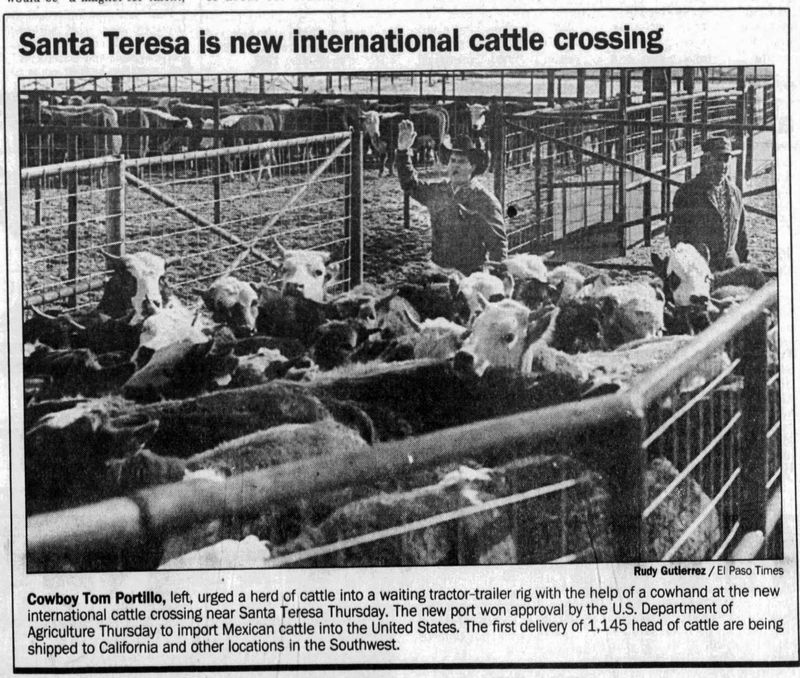
From the archive is this article on the need for a cattle port of entry and the expected prosperity for Santa Teresa:
Nov. 18, 1991, El Paso Times
Mexican ranchers eager to mooove to new port of entry
Chihuahua ranchers are expected to begin bringing their cattle into the United States through a new Santa Teresa port of entry in two weeks, bypassing a crowded and inefficient central Juárez inspection site.
About 135,000 head probably will be herded through the Santa Teresa site in its first year, port veterinarian Dr. Walter Howe said.
That’s about how many cattle were imported last year through the Juárez site, about five miles southwest of the Bridge of the Americas.
The entire $2 million price tag for Santa Teresa’s cattle pens and inspection facilities is being picked up by Union Regional Ganadera de Chihuahua, a Mexican ranchers association that wants an alternative to the Juárez site.
The Juárez port has been criticized by ranchers — who are eager to get their lean, range-fed Chihuahua cattle to the United States — because of the crowded conditions, border consultant Ray Sadler of Las Cruces said.
In Juárez, the U.S.-bound cattle have to be unloaded several times for cleaning, weighing and inspection, which is time-consuming and increases the risk of diseases and injuries. The risk increases further when truckloads of cattle sit through traffic jams along the Bridge of the Americas.
It’s a 40-mile detour for Mexico’s trucks to get to the Santa Teresa port via the Casas Grandes Highway, and three miles of dirt road still separate the Santa Teresa port from Interstate 10. But the importing process is expected to go much more smoothly than in Juárez.
At Santa Teresa, cattle will be unloaded on the Mexican side and weighed, cleaned and inspected all at once as they walk through a network of cattle pens.
All cattle entering the United States must be dipped in chemicals to protect against diseases and weighed and inspected by the U.S. Department of Agriculture.
The opening of Santa Teresa initially is expected to replace just the Juárez inspection site, but New Mexico also hopes to lure Mexican ranchers who use crossings at Columbus, N.M., Presidio, Texas, and other sites.
Chihuahua leads the states of Mexico in cattle production.
The planned cattle crossing represents New Mexico’s first large-scale shot at tapping into the overflow commercial growth of the El Paso-Juárez area. Plans to attract industries have been sidetracked by a lack of public services such as roads, power lines and sewerage in Santa Teresa.
Still, state leaders with border interests predict overflow commercial traffic could make Santa Teresa a prosperous area in the next few years.
Trish Long may be reached at tlong@elpasotimes.com.
This article originally appeared on El Paso Times: Santa Teresa, largest cattle crossing on US–Mexico border, opened in 1991
Reporting by Trish Long, El Paso Times / El Paso Times
USA TODAY Network via Reuters Connect
By Trish Long, El Paso Times | USA TODAY Network