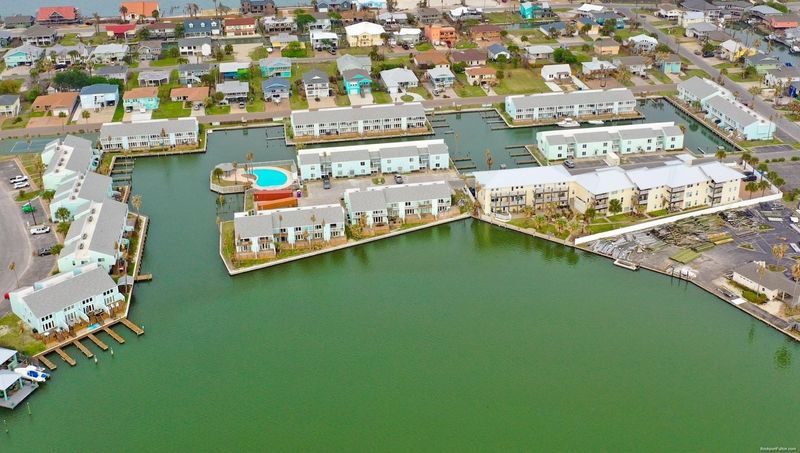
A condominium company in Rockport has won a $23 million payment for damages, attorney’s fees and expenses incurred from construction defects that were made to its property by a contractor after Hurricane Harvey.
The American Arbitration Association ordered the contractor to pay $23.3 million to Key Allegro Condominiums in a case that dates to late 2021, according to a Jan. 8 news release from Hoffman Forde and co-counsel Poli, Moon & Zane.

The law firms represented the condominium company when they went into arbitration with Progressive Fire & Flood Inc., a Houston-based company doing business as Roadrunner Restoration. The final evidentiary hearing in the case was held in November 2025.
Roadrunner Restoration did not respond to a request for comment about the arbitration.
Incomplete and deficient work, according to condo officials
Key Allegro Condominiums hired Roadrunner Restoration to rebuild its properties in August 2017 after Hurricane Harvey destroyed 94 of the 100 units in the complex, according to Gayle Connolly, the property’s general manager.
Roadrunner Restoration went to work immediately on the repairs. However, the contractor’s work was inconsistent and incorrect from the start, Connolly said.
The property manager and condominium association found structural deficiencies and sealing issues in the condominiums, including leaking roofs, water intrusion, improperly installed decks and failures in weatherproofing, according to a copy of the final award.
“There were still units and buildings that were incomplete,” said Patti Smith, the current board president of the Key Allegro Condo Association.
In 2020, Roadrunner Restoration stopped working on the project and said it wouldn’t continue unless the condominium association paid it $1 million, Connolly said.
Although the company claimed to have completed most of the project, the condominium association discovered, after hiring a third-party inspector, that much work still needed to be done on the property.
At that point, the condominium association had paid the contractors about $12 million through insurance money provided by the Texas Windstorm Insurance Association.
The inspector wrote a report, and the condominium association consulted with Poli, Moon & Zane law firm to negotiate a supplemental agreement requiring the contractor to correct defective work, including repairs to the building’s exterior, roofs, transitions, siding and related components.
Roadrunner Restoration agreed to it, and both parties signed on March 7, 2021.
Key Allegro Condominiums agreed to pay the restoration company $1.68 million through the agreement, paid out in periodic payments as work was completed, according to Michael Dicks, a construction defect attorney whom the condo association hired in 2023.
Operating under a new name
In September 2021, a separate entity called Roadrunner Restoration Co. LLC acquired assets from the original contractor and continued to do business under the same name, personnel and project identity, the arbitrator in the case found.
The condominium association was not aware of the acquisition, Dicks said.
According to a copy of the final award, Roadrunner Restoration Co. LLC did not disclose to Key Allegro that it believed it had not assumed the duty to repair systemic issues with the building.
By October 2021, the condominium association had paid $1 million of the $1.68 million total in the supplemental agreement.
But in March 2022, Roadrunner Restoration Co. LLC left the project site and refused to complete it unless the condominium owners paid the remaining $600,000, according to Connolly.
The project was close to three years behind schedule since the general contractor had estimated that the repairs would be finished in 18 to 24 months, by August 2019, Connolly said.
“We believe they left the project and refused to do the rest of the work because they found out the problems were huge,” Dicks said.
When the association refused to pay the remaining contract amount, the restoration company sued it for $900,000.
In 2024, Dicks assembled a team that included engineers, contractors and insurance company representatives, who found that the new buildings, roofing, siding and weatherproofing systems were defective.
Dicks, along with the co-counsel Poli, Moon & Zane, assisted the condominium association in filing a counterclaim against the restoration company.
The supplemental agreement served as a cornerstone for prevailing in the case, Dicks said.
The arbitrator ultimately found Roadrunner Restoration Co. LLC to be responsible for the ongoing contractual obligations, noting that it breached its duty to make the repairs correctly.
“What we proved is that Roadrunner II was really the same as Roadrunner I and made all the same promises and essentially adopted the original contract and the supplemental contract and hence were held responsible for the entire project,” Dicks said.
Key Allegro Condominiums expects to collect the money from Roadrunner Restoration Co. LLC in the next nine months.
The condominium company will go into arbitration this August to pursue money on insurance claims from Roadrunner Restoration, the original company, Dicks said.
“There are a lot more legal steps we have to take, but this arbitration ruling has astounded us,” Smith said.
Navigating the perfect storm
Smith pointed out that the board president of the association at the time hired the contractor in difficult conditions due to the devastating impact of Hurricane Harvey on the 1970s-era properties.
“It’s a unique situation after a natural disaster,” Dicks said. “You’re at your most vulnerable. You have to appreciate that they were in shock post-Harvey and asked to sign a contract, and the contract was offered on a take-it-or-leave-it basis.”
A separate attorney advised that the condominiums risked losing their insurance money to the contractor if they fired the contractor, Connolly said.
“Multiple lawyers and firms told us we had no case,” Connolly said. “Because of a bad contract, which was heavily skewed to the benefit of the contractor, we could not fire them, which meant we were forced to work with a contractor that ultimately left us with poor workmanship and code violations.”
She said the incident provides an opportunity for people to be informed of their rights as homeowners.
“The problem is that these cases are so difficult,” she said. “We think that this will help, you know, our neighbors and the people in our area understand what they can do for themselves when they find themselves in a catastrophe or having already been taken by a predatory contractor.”
This article originally appeared on Corpus Christi Caller Times: Rockport condo complex awarded $23 million after hurricane repairs
Reporting by Katie Nickas, Corpus Christi Caller Times / Corpus Christi Caller Times
USA TODAY Network via Reuters Connect