This story has been updated with additonal information
An internal policy directive that has raised concern from Sheriff Brian Thomas prohibiting sheriff’s office employees from speaking with Commissioner John Coffee about county business has escalated tensions at the top of Potter County government, with questions raised over transparency, accountability, and the legal risks of silencing elected communication.

The directive was issued May 14 — two days after a tense commissioners court meeting where Coffee again questioned the county’s push for a $51 million jail expansion. At the same time, the Potter County Detention Center had just failed a compliance inspection by the Texas Commission on Jail Standards (TCJS), prompting further scrutiny.
Verbatim text of the sheriff’s directive:
DIRECTIVE TO ALL PERSONNEL OF POTTER COUNTY SHERIFF’S OFFICE
To: All Potter County Sheriff’s Office Employees
Re: Communications with and requests from Potter County Precinct 3 Commissioner John Coffee
From: Sheriff Brian Thomas
Effective Date: May 14, 2025
All Potter County Sheriff’s Office employees are not to answer any questions or have any correspondence, written or verbal, with Potter County Precinct 3 Commissioner John Coffee related to ANY business whatsoever of the Potter County Sheriff’s Office.
Any request from Commissioner Coffee is to be routed through the Sheriff’s Office chain of command to Executive Administrative Assistant Leah Orcutt, the Chief, or one of two Captains.
Should you get a request from Commissioner Coffee, you are to immediately forward that request via email to Leah Orcutt and include either the Sheriff, the Chief, or one of the two Captains. Upon receiving that information or request, a response to such information will be delivered to Commissioner Coffee via county email by the Sheriff, the Chief, or one of the two Captains.
The Chief Deputy and two Captains will be briefed by the Sheriff as to the request from Commissioner Coffee.
This directive will remain in force until cancelled by the Sheriff.
Failure to adhere to this directive will result in administrative action up to and including termination from the Potter County Sheriff’s Office.
Additionally, you are not to discuss positively or negatively, regarding this directive to anyone.
Coffee: ‘This is troubling and chilling’
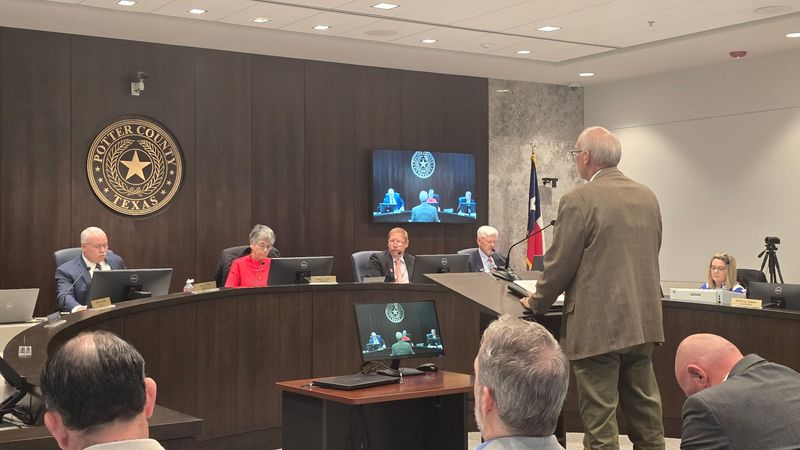
During the meeting Tuesday, May 27, Coffee publicly challenged the directive, saying it creates a chilling effect that puts public employees in a difficult position and may infringe on their constitutional rights.
“This kind of action distracts from the core issue: responsibly addressing jail overcrowding without rushing into an expensive, taxpayer-funded expansion,” Coffee said. “It also creates a chilling atmosphere that discourages open communication between county employees and their elected representatives.”
Coffee read a lengthy statement and questions to the court:
“We were friends for 50 years. But based on what you’ve put out, I think the court needs to be aware of it,” Coffee said to Thomas. “Sheriff Thomas, despite our personal differences and recent tension, I remain committed to working with you as a public servant. These questions are not offered by me personally, but concerned citizens and county employees seeking clarity and reassurance. I’m respectfully asking that you provide reasoning for the sake of public trust.”
When Thomas refused to answer, Coffee read the questions anyway:
“I was disappointed for my constituents,” Coffee said later about the questions raised regarding the directive at the meeting. “He wasn’t willing to answer any of my questions. I guess he’s of the idea that we don’t need a consultant.”
He continued, “I think it is unfortunate. This is quite embarrassing for me. I think it’s embarrassing for everybody. I think the sheriff ought to be embarrassed for this action. It’s unwarranted. But I’m still going to do my job. I’ll continue to show up, ask hard questions, and represent the people who elected me.”
Later, Coffee emphasized how the directive specifically named him. “The problem is, that directive was only written to me. Why would you write something like that to me and no one else?” he asked. “Are you trying to disenfranchise my constituents? Is your intent to discredit or embarrass me?”
Thomas elaborated further during public comment: “You’re gonna keep asking until I get up here and tell you, I’ll tell you exactly what that is. That’s a policy directive, just like what we have with the rest of them in a binder an inch thick. That is a policy that just says if you want to call, you can talk to one of the four people — me, the chief, or one of the two captains. Every employee does not need to discuss that with you at all.”
In an interview following the meeting, Thomas reiterated that the directive was not meant to gag communication, but rather to ensure proper channels are followed in official matters. “If [employees] live in the county and he’s their Commissioner, go ahead and reach out to him,” Thomas said. “But if he’s calling my office about county business, then the call needs to be referred to the appropriate command staff. That’s our policy. It’s about structure — not politics.”
He added, “They can reach out to you on their own. That’s their commissioner — giddy up and go.”
Coffee, for his part, said he never reached out directly to jail employees but was instead contacted by constituents seeking answers.
Tanner and Brumley acknowledge potential constitutional concerns
Following the meeting, County Judge Nancy Tanner expressed concern over the sheriff’s directive, saying she would not have issued such a policy herself. “I hate to say yes or no on that, but I wouldn’t do it. I’ll put it that way,” Tanner said, acknowledging potential First Amendment concerns.
During the meeting, County Attorney Scott Brumley was also asked to weigh in,, stating that while the directive is likely within the sheriff’s authority, it could still face a legal challenge. “The document itself is enforceable. The sheriff has the ability to issue directives to his staff, particularly about communication within the chain of command,” Brumley said. “That said, does it potentially create First Amendment risks? Yes. So right now, the best answer I can give is a conditional yes.”
Coble: ‘This puts us in a bad position’
Commissioner Warren Coble also expressed concern about the directive and the chilling effect it could have.
“I’m not a legal mind, sure,” he said. “But I know that in the recent past, within the last year and a half, the county might have found itself in a bad place — possibly litigation. If employees can’t trust us and come to us about issues, how are we supposed to make good decisions?”
He added, “We had an employee drinking on the job, and another employee had to give us that information. We have to be accessible. This directive puts us in a bad position.”
Coble also noted that constituents had contacted him about jail concerns and he believed commissioners must remain approachable. “At the end of the day, we’re the ones who have to make the decisions. That hampers my decision-making,” he said.
Jail expansion debate grows amid failed inspection
There was also confusion during the meeting about whether the jail had officially passed or failed the most recent Texas Commission on Jail Standards inspection. Both Commissioner Coffee and County Judge Nancy Tanner initially believed the county was in compliance. Sheriff Thomas clarified that the jail had indeed failed due to overcrowding and that the state had outlined specific next steps the county must take.
“We had 101 days that we were overpopulated — sometimes by just one inmate,” Thomas said. “That still counts as a failure. Now we have to submit daily reports and create an action plan. If we don’t show progress, the state will come back and possibly reduce our allowable bed count, which only worsens the situation.”
Sheriff Thomas warned the court that overcrowding at the detention center had already triggered a failed inspection. “One person may not sound like a lot, but that’s one person sleeping on the floor. That’s how we failed,” Thomas said.
He added that the jail’s status is now under daily review by the state, and if no improvements are shown within 30 days, he and his command staff could be summoned to Austin for a disciplinary hearing.
“If we don’t correct it, the next step is the Commission may reduce our bed space,” Thomas said. “That makes absolutely no sense — you’re already overcrowded, and then they reduce how many inmates you can house.”
Thomas expressed frustration with delays in moving forward with the architect previously discussed, noting that he also provided consulting services at a lower cost.
“They didn’t think about that. But he does consulting. For $45,000, he would have provided that,” Thomas said. “Now they want to pay for a separate consultant, and that may cost five times as much — and take two to three years. We don’t have that long.”
The county has already spent over $500,000 housing inmates in other counties, he said, not counting fuel, overtime, or transport costs.
“We’re going broke,” Thomas said. “We live in a crazy county, and I say that because it’s my county too. We’ve got I-40, 287, both hospitals, homeless shelters, and all the big box stores. That’s why crime and arrests are so high.”
He credited the District Attorney’s Office for working hard to reduce jail populations and emphasized the difficulty in placing inmates with other counties. “They don’t want violent offenders or people with mental health issues. But that’s who we have,” he said.
At the time of the meeting, 67 inmates were “paper ready” to be transferred to the Texas Department of Criminal Justice, with more expected in the coming weeks.
County leaders now face difficult decisions on how to address chronic overcrowding at the jail — whether to proceed with an architect already identified, seek an outside consultant for a long-range plan, or explore other options to ensure the facility meets state compliance standards and public safety expectations.
This article originally appeared on Amarillo Globe-News: Potter County official criticizes sheriff’s directive set amid ongoing jail concerns
Reporting by Michael Cuviello, Amarillo Globe-News / Amarillo Globe-News
USA TODAY Network via Reuters Connect