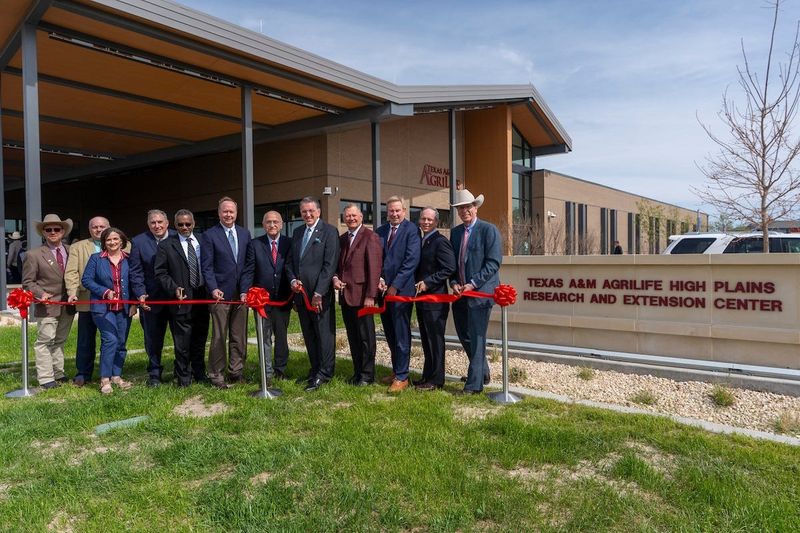
Texas A&M AgriLife’s new home on the West Texas A&M University campus in Canyon officially opened its doors to the community this week.
The Texas A&M AgriLife High Plains Research and Extension Center, located at 3211 Russell Long Blvd., is a part of the Texas A&M University System’s Charles W. “Doc” Graham ’53 DVM Complex on the WT campus. This complex includes the Texas A&M Veterinary Education, Research and Outreach (VERO) and the Texas A&M Veterinary Medical Diagnostic Laboratory, according to a news release.

The new center celebrated its opening with a ribbon cutting ceremony on Tuesday morning, April 7.
It is replacing the former Texas A&M Agrilife Extension building on West Amarillo Boulevard near the medical district in Amarillo.
Long-term commitment to this region
Regent John Bellinger of The Texas A&M University System Board of Regents said the ribbon cutting isn’t just about a building.
“The High Plains generates more than $20 billion annually in agricultural economic activity, and what happens here reaches far beyond this region,” Bellinger said. “This facility represents a long-term commitment to this region and to the people who depend on this work every day.”
The $30 million multi-use facility will provide office space to support about 60 faculty and staff for the Texas A&M AgriLife Research and Texas A&M AgriLife Extension Service agencies. In addition, it serves as the district hub for AgriLife Extension and its programming in the 22 surrounding counties.
The public meeting spaces incorporated into the facilities will support educational outreach and community events, and the modern laboratories support applied, solutions-oriented research by agency faculty.
Signature programs include beef cattle and dairy; wheat breeding and genetics; irrigation water management; water-limited forage systems; plant physiology, pathology and disease diagnostics; entomology; agronomy and soil science; sustainable livestock systems engineering; agricultural law and economics; gerontology and human nutrition.
What it looks like when a building brings people together
Texas A&M AgriLife works across the entire state of Texas, but Jeffrey W. Savell, Ph.D., vice chancellor and dean for Agriculture and Life Sciences, said that doesn’t mean it offers cookie-cutter solutions.
“Local work — paired with the power of our statewide mission — will focus on the opportunities and challenges that matter here,” Savell said. “When scientists, Extension professionals, partners and students work side by side, ideas move faster. Solutions become more practical. That’s what it looks like when a building brings people together.”
The Texas A&M AgriLife High Plains Research and Extension Center on the WT campus is a visible, tangible commitment to something important: partnership, said WT President Dr. Walter Wendler.
This region is home to key commodities like fed beef, corn, sorghum, cotton, dairy and wheat, among many others. High Plains producers generate more agricultural production than that of most states.
“The science we generate here will build new and strengthened trust among our partners, in our ability to produce translational solutions across the region’s most important commodity systems,” said G. Cliff Lamb, Ph.D., director of AgriLife Research. “This center will be an integral part of a rapidly emerging paradigm around intelligent agricultural systems, which are critical to supporting healthy lives and livelihoods into the future.”
Long-term investment in place and purpose
The new center is an investment in both place and purpose, providing a home that inspires learning, leadership and service for youth, families and communities, said Rick Avery, Ph.D., AgriLife Extension director.
This center serves communities across the High Plains and every family and agricultural operation across the Golden Spread, said Brent Auvermann, Ph.D., Texas A&M AgriLife High Plains Research and Extension Center director.
He said the new center will also serve as an embassy for Texas A&M AgriLife.
“We stand on the shoulders of the men and women whose very livelihoods have depended on the land since the pioneer days,” Auvermann said. “Today, we herald a new era in our long tradition of science, outreach, education and service to every resident of the Texas High Plains.”
This article originally appeared on Amarillo Globe-News: New High Plains Research & Extension Center opens doors on WT campus
Reporting by Nell Williams, Amarillo Globe-News / Amarillo Globe-News
USA TODAY Network via Reuters Connect