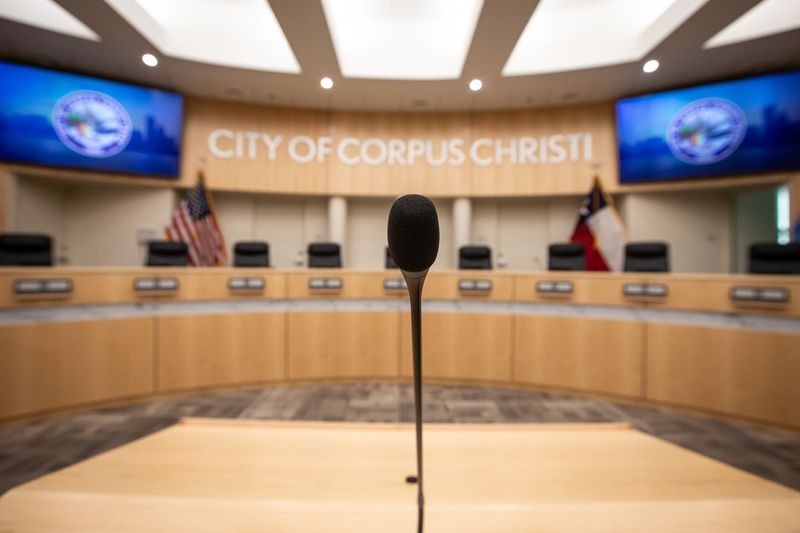
As the city of Corpus Christi confronts one of its most difficult challenges in recent times, its residents are plagued not only by concerns over a lack of water but also by a lack of action and decision-making from their elected officials. The City Council has spent inordinate amounts of time staging forms of political theater — with passionate performances by members of the public. It’s time to consider an alternative approach to deliberation and public participation — a real conversation with people whose stake in the outcome is deepest.
While more than 100 residents took to City Hall recently to share their perspectives on how the City Council should address the city’s water crisis, thousands more feel disenfranchised and unheard. All those with a stake in a particular decision should not have to spend hours waiting for the chance to give a very brief speech on a contentious topic in front of a large crowd and on a live broadcast. Very few members of the public have the time or courage to do that. This process also completely leaves all organizational stakeholders without a meaningful way to engage (i.e., environmental advocacy organizations, large industrial water users). These parties have a major say in what happens, and without their participation, a major perspective is lost.

Additionally, City Council members would understandably struggle both to remain attentive after so many speeches and to make prudent decisions based on input given right before their vote. A public hearing gives the City Council a narrow slice of the community’s sentiments while, potentially, raising hopes that a few dozen speakers can make council members change their minds.
The city needs to think more creatively and inclusively about its approach to public engagement. This can serve to give the public a clearer understanding of the challenges the city is facing; a chance to influence the outcome before the “11th hour,” as pressure mounts; and an array of options for how to participate, for those less inclined or able to deliver a speech. Other cities such as Austin and Fort Worth have hosted televised town hall meetings that allow residents to call in or text their thoughts in English and Spanish, with real-time polling results. Specialized and moderated online discussions, such as those featured on SpeakUpAustin.org, where interested parties can contribute their thoughts whenever they have time, can also help the city better understand the community’s views. This particular issue, with vast financial ramifications and impacts on day-to-day life, would also benefit from an online tool such as “Balancing Act” that lets residents grapple with tradeoffs associated with various solutions.
Beyond the need for rethinking how the public can participate in such consequential decisions, the City Council needs to reconsider how it makes decisions once it has heard from the public. The rigidity and formality of Robert’s Rules of Order and parliamentary procedure, while perhaps helpful in certain circumstances, confuse the public and create a stultified environment for real dialogue. While it may simplify or streamline the process of determining the contents of a final policy, it limits the City Council from having a thoughtful, transparent deliberation in which they seek to understand each other’s views, rather than simply to persuade each other of their idea’s superiority. Furthermore, no matter how ingrained the notion of “majority rules” for voting may seem as a way to make a final decision, a city council can also consider a consensus process. Council members can offer proposals, to which other members respond with either “red,” “yellow,” or “green” — indicating firm opposition, potential support with questions, or full support.
As a way to combine inclusive and meaningful public participation with productive public deliberation, the City Council could convene what some practitioners and scholars call a “facilitated deliberation.” It’s a fancy way of describing a meeting that would include representatives of all major stakeholders and a neutral, third-party facilitator meant to keep the group on task and topic and maximize productivity and civility. The meeting emphasizes giving all parties a chance to share their views and develop solutions that meet the group’s collective interests. If well designed and executed, the parties can leave the conversation knowing that they can live with the group’s decisions and will avoid actively opposing the decisions in the future.
These kinds of deliberations have been common across the world — from cities as large as Paris to as small as Iowa City. City councils seldom surrender their ultimate decision-making authority to the public. By sharing power and the metaphorical podium to discuss, rather than debate, the Corpus Christi City Council could produce the best possible outcome for the community in a timely fashion.
Larry Schooler is an assistant professor of communication studies at the University of Texas at Austin and a senior fellow at the Annette Strauss Institute for Civic Life and the National Civic League.
This article originally appeared on Corpus Christi Caller Times: Many feel unheard by Corpus Christi leaders in public comment | Opinion
Reporting by Larry Schooler, Opinion contributor / Corpus Christi Caller Times
USA TODAY Network via Reuters Connect
By Larry Schooler, Opinion contributor | USA TODAY Network