One of the big news stories this March besides the war in Iran was a Los Angeles jury finding Meta, the company behind Instagram and Facebook, and Google, the owner of YouTube, negligent for purposely designing their social media platforms in ways that harm the mental health of young people.
Meta was declared liable for $4.2 million in compensatory and punitive damages and Google for $1.8 million. Those are small amounts for such huge companies, but a precedent was set that might restrain such online giants in their attempts to create tapping, clicking and scrolling addicts.

Another jury in New Mexico the same week ordered Meta to pay $375 million in damages — much more than in the Meta-Google case — for failing to protect young users from child predators.
Houston lawyer Mark Lanier, the lead trial attorney for a 20-year-old woman who was the focus of the California lawsuit, told reporters, “I would’ve thought it was likely we would have gotten a bigger number.” But he said, “I trust the system and trust people to assess what’s right and best.”
The 65-year-old certainly knows about large dollar amounts; several of his winning lawsuits have brought judgments in the billions. He won $4.69 billion for his clients in a trial linking baby powder and asbestos to ovarian cancer. The New York Times called him “one of the top civil trial lawyers in America.”
His wife, Becky, also is an attorney, and their daughters Rachel and Sarah assisted in the landmark social media lawsuit as two of the Lanier Law Firm’s 58 attorneys. (Another is Kevin Parker, a former Amarillo resident.)
Lanier isn’t just a legal eagle, however.
The day the California verdict was announced, I had read a daily devotional based on Paul’s words in I Corinthians 8:9: “But take care that this right of yours does not somehow become a stumbling block to the weak.” The writer of the book — “New Testament Letters for Living: Daily Prayers, Wisdom and Guidance” — asked, “Are we to live our lives exercising our own freedoms, without regard to how we affect others?”
The author of the devotional collection is Mark Lanier.
It’s the fifth such book the attorney — and Sunday school teacher — and part-time pastor — and biblical languages scholar — has published in the past decade in addition to apologetics books “Christianity on Trial,” “Atheism on Trial” and “Religions on Trial.”
I’ve written about Lanier before, in part because of his books and in part because of the Lanier Theological Library and Learning Center that opened in 2010 near his Houston home. The library provides 17,000 feet of elegant space for biblical research and theological study plus Christian items on display such as a Dead Sea Scrolls fragment of the book of Amos and signed letters by C.S. Lewis.
On the grounds is the Stone Chapel, a replica of a 500 A.D. Byzantine church in modern Turkey. Speakers and panelists at the Stone Chapel have included the late U.S. Supreme Court Justice Antonin Scalia, Christianity Today President Nicole Martin and scholars N.T. Wright, Alister McGrath, Janet Seifert, John Piper, Ben Witherington III and, in Spanish, Pablo Deiros.
The Laniers don’t forget the city where they grew up. They fund the Mark and Becky Lanier Raider/Mustang Scholarship for graduates of Mackenzie Middle School and Lubbock Coronado High School, both of which Mark attended. They gave $6 million to the Texas Tech University School of Law, where Mark earned his law degree, to create the Mark and Becky Lanier Professional Development Center.
Obviously, Lanier is a “go-getter,” as my mother would say. In 2003, he started the Christian Trial Lawyers Association. His Sunday classes at Champion Forest Baptist Church draw hundreds. In 2020, he established the Lanier Center for Archaeology at his alma mater, Lipscomb University in Nashville, from where students and professors work at digs worldwide, including Israel and Egypt. He sponsors the Lanier Theological Library Lectures at Lubbock Christian University.
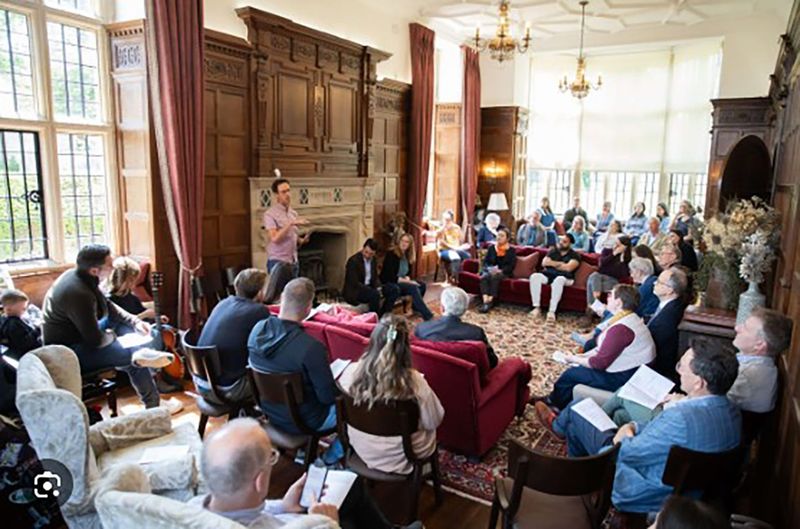
Then in 2021, the Lanier Foundation went a couple of steps further than the Oxford-style architecture of the library in Houston and bought Yarnton Manor, a “great house” built in 1611 (the year the King James Bible first was published) a few miles from Oxford, England. After careful renovation, it opened in 2025 to serve Christian scholars, church workers and permanent residents.
I’ve read some of Lanier’s books. My wife, Kathy, and I have attended a lecture and panel discussion at the Stone Chapel and toured the Lanier Library. Now my wish list includes visiting Yarnton to see firsthand a physical Christian presence planted in a mostly secular kingdom.
In another of his daily devotionals about I Corinthians, the prosperous lawyer wrote, “Experiencing God and his love gave Paul the drive to live under the conviction that faith is true.” Seeing how Mark Lanier and his wife spend their time and money convinces me that they have that same conviction.
Mike Haynes taught journalism at Amarillo College from 1991 to 2016 and has written for the Faith section since 1997. He can be reached at haynescolumn@gmail.com. Go to www.haynescolumn.blogspot.com or his Facebook page for more of his columns.
This article originally appeared on Amarillo Globe-News: Lawyer who won Meta lawsuit is also a religious scholar | Faith column
Reporting by By Mike Haynes, Special to the Amarillo Globe-News / Amarillo Globe-News
USA TODAY Network via Reuters Connect