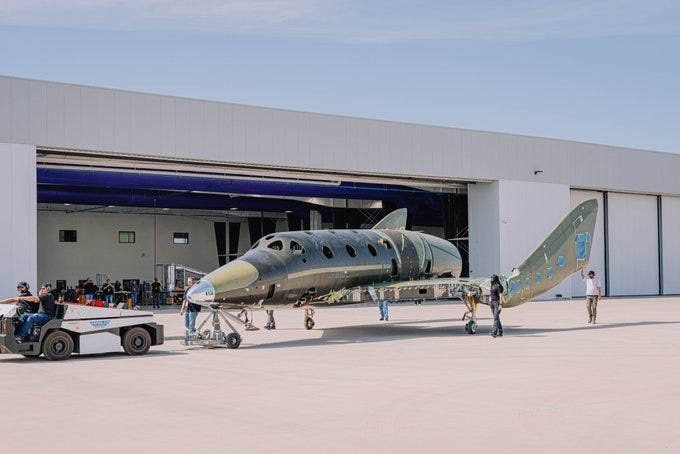
Virgin Galactic rolled out its new spaceplane amid plans for ground tests in Arizona, offering one of the earliest looks at a vehicle that could be taking paying customers beyond Earth’s atmosphere before 2026 comes to an end.
The commercial suborbital spaceflight company, founded by billionaire Richard Branson, hasn’t flown a mission in nearly two years after completing 12 flights to the edge of space. But that’s on the verge of changing as Virgin Galactic puts the finishing touches on its new-and-improved spaceplane designed to fly more often from the company’s takeoff site in New Mexico, not far from El Paso.

Virgin Galactic is set to resume its commercial spaceflights in a rather fortuitous position. Billionaire Jeff Bezos’ Blue Origin – one of the company’s main competitors – recently suspended its own space tourism program, leaving the market wide open for Virgin Galactic
Here’s what to know about Virgin Galactic’s suborbital spaceflight program, as well as a look at its new spaceplane.
What is Virgin Galactic? What to know about Richard Branson’s company
Virgin Galactic is an aerospace and space travel company that is part of British billionaire Richard Branson’s Virgin Group conglomerate.
Like its competitor Blue Origin, founded by billionaire Jeff Bezos, Virgin Galactic specializes in transporting paying customers on brief flights to the edge of space. The market is one Blue Origin recently took a hiatus from as it turns its focus instead to developing a lunar lander for NASA’s Artemis moon missions.
A tenant of Spaceport America in New Mexico – about 100 miles north of El Paso – Virgin Galactic has flown 32 people to space across 12 missions.
Virgin Galactic unveils 1st look at new spaceplane
Virgin Galactic recently shared a first look of its new spaceplane that later in 2026 is due to begin taking paying customers to the edge of space.
Developed to be reused for faster turnaround time between missions, the vehicle is an upgraded design from Virgin Galactic’s previous spaceplane, according to the company’s most recent financial report. Officially dubbed “SpaceShip,” the spaceplane has undergone assembly and ground tests at the company’s factory in Arizona as Virgin Galactic prepares to transport it later this summer to Spaceport America so that flight tests can begin.
The fourth-generation “Delta class” spaceship can seat six passengers and would replace the now-retired VSS Unity spaceplane. Each Delta vehicle is estimated to be capable of flying up to eight space missions per month, according to Virgin Galactic.
When will Virgin Galactic missions resume?
Virgin Galactic’s introduction of its new spaceplane comes as the company prepares to resume its commercial spaceflight program toward the end of 2026.
Nearly two years have elapsed since Virgin Galactic last flew civilian passengers to space in June 2024 before pausing its spaceflight program.
Virgin Galactic has even announced the crew for its next research mission, which would precede commercial trips. In a June 2024 press release, the company revealed that three research astronauts, including a return passenger named Kellie Gerardi, will take part in a scientific mission in partnership with the International Institute for Astronautical Sciences.
Another suborbital mission with students at Purdue University is planned for the beginning of 2027, the company announced in September.
What happens during a Virgin Galactic spaceflight?
Spaceflights led by Virgin Galactic resemble a traditional commercial aircraft takeoff on a runway as the company deploys an air-launch strategy to get its vehicles to the edge of space. That’s a sharp difference from its competitor Blue Origin, which used a standard vertical launching system to get its New Shepard off the ground for trips above the Kármán Line – the 62-mile-high internationally recognized boundary of space.
The VMS Eve, what’s known as the mothership, is a four-engine, duel fuselage jet carrier aircraft that transports the spaceplane to what Virgin Galactic refers to as “release altitude.” There, the VSS Unity separates from the aircraft to continue to suborbital space using its hybrid propulsion system.
When in service, Unity traveled about 54 miles high, which is still within range of what the U.S. military and NASA define as the beginning of space.
Full Virgin Galactic missions have lasted more than an hour, during which passengers on Unity have been treated to views of Earth and the thin blue line of our planet’s atmosphere while experiencing a few minutes of weightlessness. When the missions end, Unity comes back down to Earth to land on the same runway from which it took off.
How much does a Virgin Galactic trip cost?
Virgin Galactic had previously been selling seats for about $600,000, according to reporting from Bloomberg. But the company has made good on its plans to raise prices to $750,000 now that ticket sales have resumed.
Eric Lagatta is the Space Connect reporter for the USA TODAY Network. Reach him at elagatta@usatodayco.com
This article originally appeared on El Paso Times: Virgin Galactic unveils new ‘SpaceShip’ ahead of civilian spaceflights
Reporting by Eric Lagatta, USA TODAY NETWORK / El Paso Times
USA TODAY Network via Reuters Connect