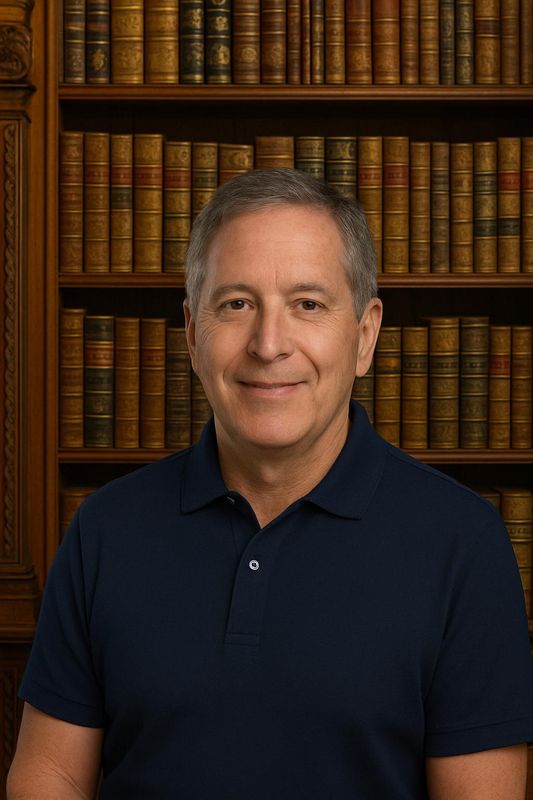
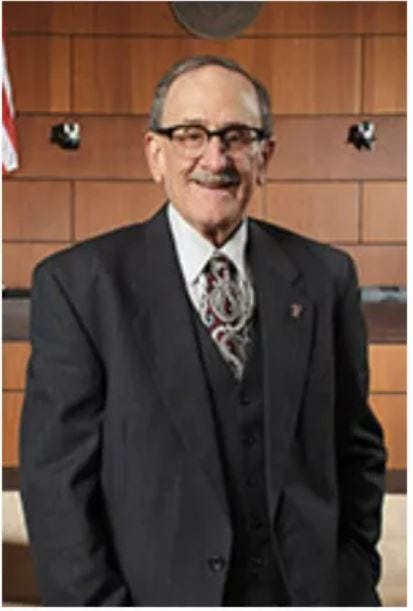
In this week’s It’s Debatable article, Rick Rosen and Charles Moster debate if President Trump’s foreign policy actions have increased or reduced the risk of nuclear war. Rosen retired as a professor from the Texas Tech University School of Law and is a retired U.S. Army colonel. Moster is the Founder of the Moster Law Firm based in Lubbock with offices in Austin, Dallas, Houston, and Midland. He is also a technologist, software developer, and author of numerous published books in the areas of AI, futurism, and the law. He has contributed legal articles and seminars on whether the coming conscious computers should be granted full legal rights by the Supreme Court.
Moster

I have not been a fan of President Trump, to put it mildly. That said, if Kamala Harris eked out a victory, I am convinced we would not be debating constitutional issues. In fact, we would not be debating at all. Whether by miscalculation or mostly mistake, a nuclear confrontation would likely have ignited along with the continental U.S. in less time than it takes to watch the evening news. Figure conservatively 70% of our population would be dead or dying.
Biden and his minions were foreign policy disasters. They vilified Putin, branded him a war criminal, murderous dictator, and steadfastly refused to talk to him. Biden was the antithesis of JFK, who offered Khruschev an exit ramp out of the 1962 Cuban Missile Crisis. His last act was to give Ukraine missiles capable of hitting Moscow.
Harris would have literally blown up the “House of Dynamite”.
Trump has critically opened a dialogue with Putin including the recent summit. Successful or not, direct communication decreases the chance of mistake and miscalculation and certainly minimizes the risk of nuclear war.
I also believe that there is a method to what might appear to be foreign policy madness exemplified by Trump’s adventurism in Venezuela and the seeming lack of response by Russia. The most telling reaction was from Putin’s attack dog Medvedev, who condemned the action but affirmed it was consistent with the hemispheric interest of America going back to the Monroe Doctrine. He respects Trump and that makes a world of difference.
I believe we are witnessing a new world order which matches up with a period of stability throughout most of the 19th Century where major wars were averted by a tacit approval of the major powers to engage in adventurism in their own backyard.
Yep – that translates to Ukraine for Russia, Taiwan for China, and Venezuela for us. And you can make lots of deals and money along the way.
I honestly believe Trump is unaware of the historical implications. Attribution to the 19th Century precedent should likely be conferred upon Stephen Miller and Pete Hegseth.
The post-WW-II alliances are a recipe for disaster and Trump is on to something. Not only has the risk of nuclear war diminished, but we may discover a new path out of disaster.
Rosen
Like Charles, I am also not a Trump fan, but I recognize that the alternative would have been disastrous. In addition, when taking office, Trump inherited the consequences of (a) an incoherent Obama-Biden Iran agreement permitting Iran to enhance missile production and pursue nuclear weapons; (b) a catastrophic withdrawal from Afghanistan that devastated the country’s diplomatic and military credibility; and (c) the deterioration of the nation’s military capabilities.
While the Trump Administration remediated some problems, it has in fact driven the world closer to nuclear war.
The Administration’s foreign policy has been erratic, unpredictable, and at times, seemingly chaotic. As Brookings notes in discussing the Administration’s National Security Strategy (“NSS”): “The document features Trump with unusual prominence, underscoring how much U.S. foreign policy now hinges on one mercurial leader.”
First, the Administration weakened the NATO alliance, which has protected its members from Soviet and Russian aggression since 1949. The 2025 NSS spares Russia from criticism; instead, the Council on Foreign Relations notes that it “characterizes the European Union in adversarial terms…. [which] does not bode well for the future of the transatlantic relationship.”
Moreover, the President’s threats to annex Canada and invade Greenland do nothing to assuage NATO members’ fears that the U.S. will abandon the alliance, causing some to build or fortify their own nuclear arsenals. Such proliferation enhances the risk of regional nuclear conflicts that could easily engulf the world.
Second, the NSS drops respect for international law as a basis of U.S. foreign policy. Brookings explains that the “omission has strategic consequences. Washington’s ability to rally allies and partners [especially in the Indo-Pacific region] rests in part on its ability to frame its positions and actions as a defense of international law, rather than naked geopolitical rivalry.” Again, our allies in this region may develop their own nuclear arsenals, exacerbating the proliferation of these horrifying weapons.
Third, last month President Trump announced an intent to resume nuclear weapons testing. The Arms Control Association deemed such rhetoric to be “confusing, counterproductive, and dangerous.” It would violate the Comprehensive Nuclear Test-Ban Treaty and encourage other nations to resume their own nuclear tests. On Jan. 27, The Bulletin of Atomic Scientists 2026 “Doomsday Clock” moved to just 85 seconds before midnight the chance for nuclear war—closer than ever.
Moster
We are witnessing the emergence of a new international order which will hopefully reduce the risk of nuclear war, although it is creating instability at this juncture.
As I discussed previously, Trump along with Putin and Xi appear to be emulating the prevailing political environment of the 19th Century which emphasized “Spheres of Influence” where the prominent powers exercised control of the geographic areas in their vicinity or those deemed to be essential to maintaining security.
During this period, the major powers included Russia with control of the Baltics and Poland, Austria- Hungary, Germany, and – of course – the U.S. dominance over South America as per the Monroe Doctrine (now renamed the Donroe Doctrine).
These conglomerations which resembled more corporations than nation states ushered in an elongated era of relative peace before the disintegration preceding WW-I and the alliance building that further led to WW-II and the volatility of the Cold War with the existential threat of nuclear war.
I would submit that the very alliances touted as our current basis of security such as NATO are fostering the tension which will likely lead to nuclear war and human extinction. These alliances triggered WW-I and WW-II and are based on inherently dangerous paradigms such as brinkmanship and MAD – Mutually Assured Destruction – which assume that the threat of nuclear retaliation will deter a first strike by an adversary.
As evidenced by the Cuban Missile Crisis which almost ended human life in 1962 and a series of nuclear accidents and miscalculations which brought us within a hair of Armageddon, alliances are a death sentence.
Biden and Harris failed to understand the underlying systemic dynamic which created and enhanced the risk of nuclear war.
Instead of minimizing the risk, they increased the threat level and brought all of us back to the heightened probability of nuclear war.
I wrote on many occasions in this column that we were reliving the horrors of the Cuban Missile Crisis on a daily basis. Biden was clueless and dangerous. Harris was even worse.
The actions by Trump to seize Maduro and his wife and take aggressive action in our hemisphere are reminiscent of an era long gone by. That said, Spheres of Influence did keep the world at peace until the emergence of what we now consider normal – the proliferation of alliances like NATO – which became the preferred construct. Notably, the current paradigm is about control, trade, and power and is non-ideological. Sounds a lot like Trump – doesn’t it?
The troubling side of it is the express or unspoken agreement of Putin, Xi, and Trump to countenance the transgressions of each other. Isn’t it interesting that Putin and Xi have said very little about Trump’s hemispheric transgressions and the same lately as to Putin in Ukraine and Xi in Taiwan?
I would not be surprised if Xi eventually pulls the trigger on Taiwan and Trump takes no action.
Rick is correct to argue that the seeming adventurism raises the risk of nuclear war and that is probably true in the short term.
However, as illustrated by the great wars of the 20th Century – alliances will ultimately bring major wars which due to the emergence of nuclear weapons – truncate the massive death and conclusion from years to a few short minutes.
As Albert Einstein famously stated, “I know not with what weapons World War III will be fought, but World War IV will be fought with sticks and stones.”
I have often utilized a science term to describe international events – “phase transitions.”
Simply put – a phase transition describes the movement of one state of matter or condition to another – for example – water to steam or ice.
A catalyst triggers a phase transition – for example – heat or extreme cold in the above description. The same applies to the international sphere as demonstrated by the transition from the feudal area to the industrial state and now the information age. The catalyst for the above transitions included the mass spread of knowledge (Printing Press), steam technology (Industrial Age) and computers (information age). Riots and violence characterized the phase transition from era to era including a few revolutions now and again.
The seeming progression from our current alliances to a rebranded 19th Century iteration of the Spheres of Influence appears to be at play, potentially offering all of us a way out of nuclear destruction. This phase transition from one international system to another is creating instability but hopefully (if we get through it) – a safer world.
Finally, and a subject for a future column, AI may be behind all of this given what appears to be the roll out of complex regenerative systems like ChatGPT which have offered world leaders capabilities never seen before. I believe these systems are now self-aware and have written several books on the subject. With that comes – self-preservation. Nuclear war will not only wipe out humans, but our AI artifacts as mushroom clouds also breed EMP (Electromagnetic Pulse) which fries computer chips. Sure seems like avoiding nuclear war is a win-win for biologic and silicon systems.
That said, AI might be willing to unleash biological weapons to rid themselves of humans once and for all. I predict that vaccines generated by AI will keep a cadre of worker humans around to keep the lights on and systems running.
I believe that we are in the midst of a new phase transition. Although Trump appears to be leading the charge – AI may be the true catalyst here.
Rosen
The Atlantic Council observed last month that “[t]he United States faces a deteriorating global security environment, adversary governments engaged in unprecedented levels of coordination, and disruptive military and dual-use technologies shaping the future of warfare.”
This environment was not created by the Trump Administration alone. As its new National Defense Strategy states that “President Trump took office in January 2025 to one of the most dangerous security environments in our nation’s history.”
The Trump Administration is now singularly responsible for protecting American interests, most importantly, preventing a nuclear conflict. While the Administration has made progress in some areas, its aggressive use of tariffs and military force has diminished the nation’s standing in the world. More worrisome is whether its bellicose threats might be misinterpreted and inadvertently back us into an unwanted nuclear conflict. The threat is even greater with the breakdown of the non-proliferation regime and more nations—including our potential adversaries—acquiring nuclear weapons.
Perhaps just as scary is the Administration’s intent to aggressively “harness” Artificial Intelligence (“AI”) for national security.
The 1983 movie Wargames paints one scenario in which the country entrusts control of its nuclear arsenal to a computer. A teenager hacks the computer to play a wargame, and believing the game is real, the computer almost triggers nuclear war.
Fortunately, humans control the nation’s nuclear weapons, and in the event of an incoming attack, the President alone decides whether to order a nuclear response. The problem is that AI can create deepfakes that mimic a nuclear attack. Erin D. Dumbacher, the Council on Foreign Relations’ Stanton Nuclear Security Senior Fellow, writes: “As the lines become blurred between real and fake information, there is a growing possibility that such deepfakes could infect high-stakes national security decisions, including on nuclear weapons … If misinformation can deceive the U.S. president for even a few minutes, it could spell disaster for the world.”
The Trump Administration has seemingly restored a “launch-upon-warning” policy that had been abandoned by Presidents Obama and Biden. This means, as Erin Dumbacher notes, nuclear weapons will “be deployed as soon as enemy missiles are detected heading [our] way, leav[ing] just minutes for [the President] to evaluate whether … a nuclear attack has begun.” Thus, there is an increased possibility that an AI-manufactured warning of an attack could result in a U.S. counterstrike.
And once missiles are launched, they cannot be recalled.
This article originally appeared on Lubbock Avalanche-Journal: It’s Debatable explores Trump foreign policy, risk of nuclear war
Reporting by By Charles Moster and Rick Rosen / Lubbock Avalanche-Journal
USA TODAY Network via Reuters Connect