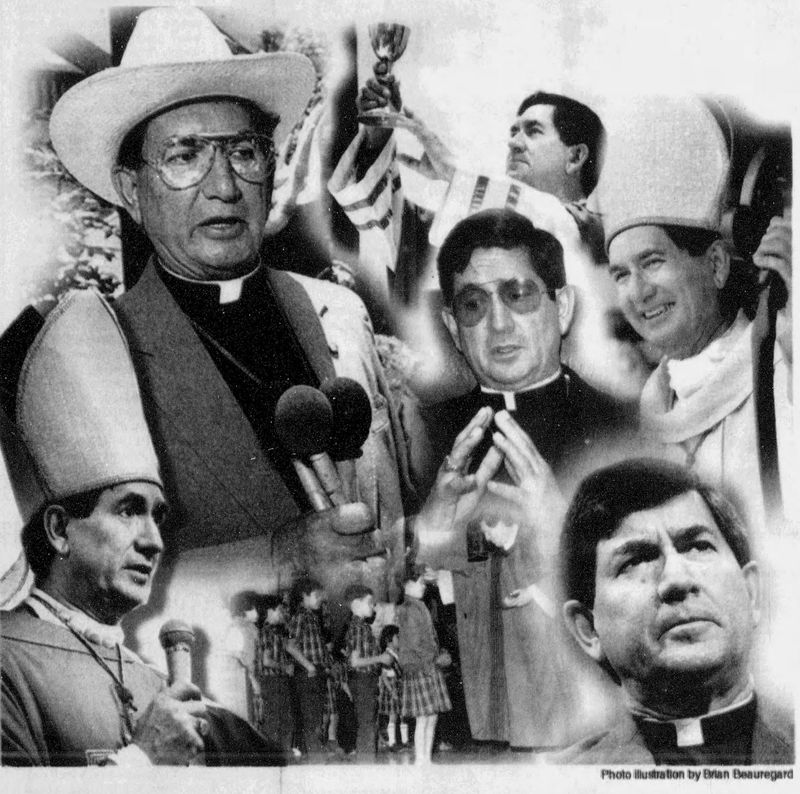
During his years as head of the Diocese of Corpus Christi, Bishop Emeritus René Henry Gracida was an outspoken advocate for Catholic teachings.
The retired bishop, who died May 1 at the age of 102, was known for his strong convictions and public voice.

From the time he called for a Madonna-related boycott of Pepsi to his anti-abortion activism, Gracida frequently made headlines, not just in Corpus Christi but in national media as well.
The Caller-Times archives reveal that Gracida was deeply engaged in issues at the local, national and international levels.
Articles indicate that one of the defining periods of his life was World War II. Gracida served in the U.S. Air Force.
Gracida opposed abortion, the death penalty and nuclear proliferation.
In 1984, he told a group of local business leaders that his top priority was “promotion of the dignity and sanctity of human life in every way possible,” according to prior Caller-Times reporting. This is a statement he stayed true to during his time as a leader in Corpus Christi.
Early life and career
According to 1983 articles, Gracida’s paternal family fled Oaxaca, Mexico, during the revolution of 1910, settling in New Orleans. His father was Enrique J. Gracida Carrizosa. His mother, Mathilde Derbes, was a fifth-generation French American.
A 1983 supplement to the Corpus Christi Caller-Times by South Texas Catholic described his life before coming to Corpus Christi.
Gracida lived in New Orleans until he was 10 years old, when he moved to Texas. He lived in Houston and Texas City. As a child, he enjoyed fishing and crabbing on Galveston Bay. According to a news release from the Diocese of Corpus Christi, he was an avid hunter and fisher later in life.
He was valedictorian of his 1941 graduating class at Central High School in Texas City.
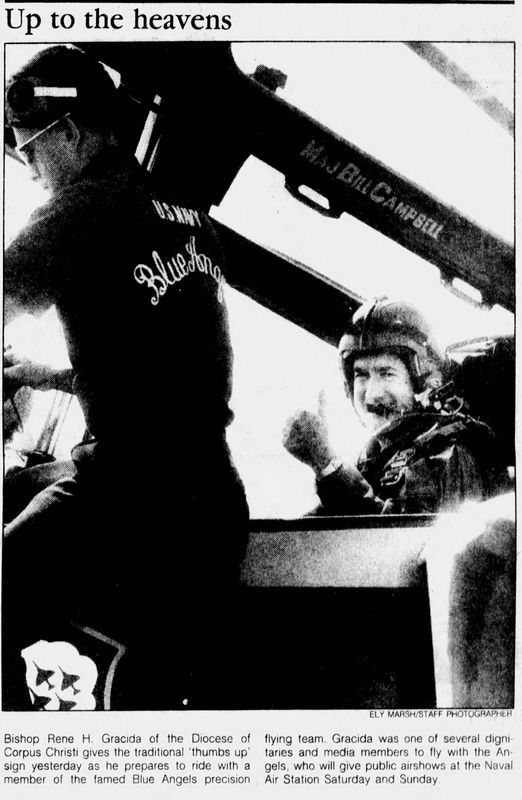
During World War II, he served in Europe. He was attending Rice University when he entered the U.S. Air Force. He flew 32 combat missions.
His family told the South Texas Catholic that they believed the war influenced his religious vocation.
“That terrible war had a lot to do with it,” the bishop’s mother, Mathilde Gracida, said in 1983. “Oh Lord, what he must have gone through. It would be enough to make anyone turn to God forever.”
He ultimately received a degree in architecture from the University of Houston. He was a practicing architect when he entered seminary.
He joined a Benedictine monastery in 1951.
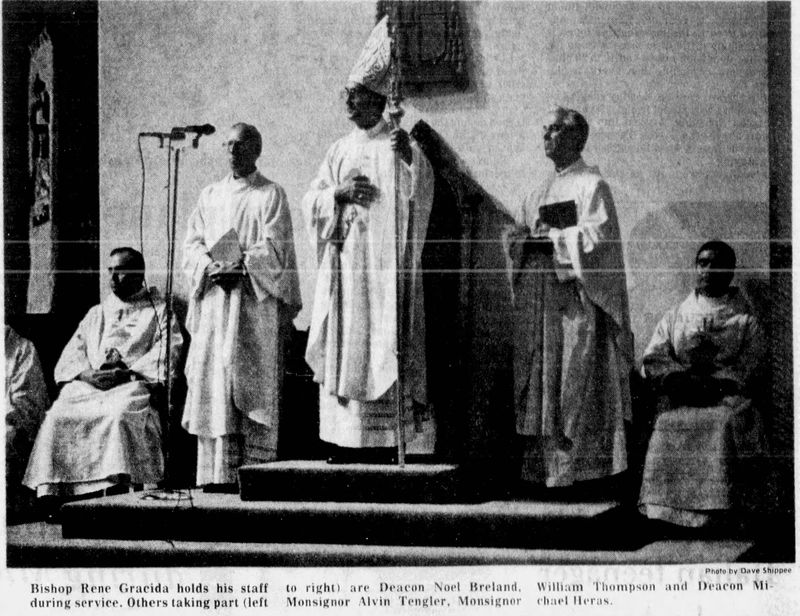
He was ordained in 1959. He served in parishes in Florida until 1971, when he was consecrated as a bishop and served as auxiliary to the bishop of Miami. In 1975, he was appointed the first bishop of the new Diocese of Pensacola-Tallahassee.
At his bishop’s house in Tallahassee, he reportedly kept chickens, dogs and “all kinds of pets,” according to an interview with his mother by the South Texas Catholic.
Decades later, Gracida would spend his retirement ranching, according to a 2003 Caller-Times article.
Upon his appointment as bishop of the Diocese of Corpus Christi in 1983, the Corpus Christi Times reported that Gracida would be installed on the feast of St. Benedict, which had special significance for the new bishop who had studies in a Benedictine seminary.
Gracida was the second Hispanic bishop appointed to lead the Diocese of Corpus Christi.
Civic and political life
Before coming to Corpus Christi, Gracida had worked with the Apostleship of the Sea, which provides for mariners and those who travel on the sea. He headed the National Council of Catholic Bishops’ committee on migration and refugees.
Amidst tensions between American and Vietnamese fishermen along the Florida Gulf in 1981, he wrote an anti-racism pastoral letter.
Gracida frequently commented on important issues of the time.
In Corpus Christi in 1983, Gracida told a local group opposed to nuclear armaments that his turn to pacifism began after he learned about the magnitude of the bombing of Dresden, which he participated in during the war.
He encouraged residents to participate in civic and political life, directing priests to place voter registration booths outside of Mass in the 1980s. He also spoke in 1986 about the need for a four-year university in Corpus Christi, going as far as to host a conference with regional educational leaders on the topic in 1987.
Gracida visited Nicaragua with several other bishops in 1985 on a fact-finding mission. They also visited El Salvador, meeting war refugees. After the visit, Gracida was invited to testify before congressional staff.
Later that year, Gracida was in Mexico City touring areas impacted by the 1985 earthquake.
He spoke frequently about migrant and Latin American issues, including on the topic of the Contras and Sandinistas in Nicaragua and U.S. actions in the country.
In 1988, Gracida helped provide refuge to a San Diego family whose child had been harassed after becoming a key witness in a gang rape case, according to Caller-Times reporting.
While bishop, he called for a weeklong boycott of Pepsi products after the company featured the Madonna song “Like a Prayer” in a commercial. Gracida reportedly found the song offensive. He lifted the boycott after speaking with the company.
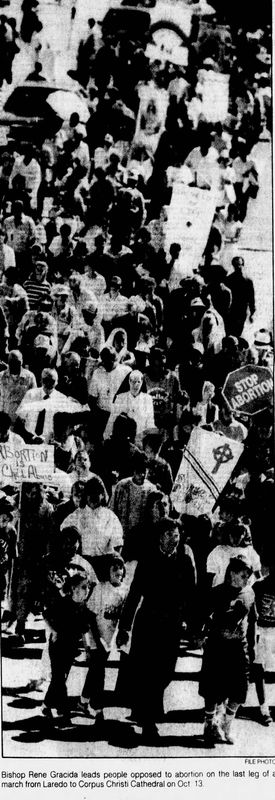
Gracida opposed abortion, attending a protest as an observer and in 1990 leading an anti-abortion march. He spoke on the topic at Mass and took out ads on the topic in the Caller-Times. In 1990, Gracida was photographed by the Caller-Times signing a petition supporting language in the Corpus Christi city charter stating that human life begins at conception.
Controversially, Gracida excommunicated two clinic managers and a local obstetrician who performed abortions. He promised financial support to pregnant women.
The Caller-Times named Gracida the Newsmaker of the Year for 1990 for his statements and actions on the issue of abortion.
Gracida established an adult religious education program, supporting diocesan efforts to prepare lay people for church ministry.
He retired in 1997.
On his 100th birthday in 2023, 300 people attended his celebration in Corpus Christi.
During the event, he told the story of a time he flew his own plane from California to Washington, D.C., but ran into bad weather and needed to make an instrument landing to refuel.
“I tell you that story … because it says something about life,” Gracida said in 2023. “Keep your eye on Jesus Christ. … Be close to our Lord Jesus Christ. He will be like the detail on the instrument panel in my airplane, guiding you to a safe landing in whatever is coming.”
‘Good and humble servant’
On May 1, the Diocese of Corpus Christi shared a news release detailing Gracida’s biography, including that he guided the establishment of a diocesan radio station, a youth camp and retreat houses in Laredo and Corpus Christi.
“May God welcome his good and humble servant to his eternal home,” the news release states. “We are thankful for his service and keep him and his family in our prayers.”
Current Bishop Mario Avilés spoke about Gracida’s death in a Facebook video May 1, noting the “important work” Gracida did for the diocese.
“Being a bishop in today’s world is one of the most difficult jobs in the world,” Rev. Msgr. Thomas McGettrick said in a 1997 Caller-Times article. McGettrick died in 2020. “And I think Bishop Gracida has been a bright light in the Catholic church for the past 25 years as a bishop. He’s a very staunch upholder of gospel values in a world that, as you know, very often rejects such values.”
Funeral arrangements had not been announced as of May 4.
This article originally appeared on Corpus Christi Caller Times: See how Bishop Emeritus René Gracida shaped Corpus Christi diocese
Reporting by Olivia Garrett, Corpus Christi Caller Times / Corpus Christi Caller Times
USA TODAY Network via Reuters Connect