As temperatures begin to warm in Texas, more critters will be out and about, basking in the sun.
The Lone Star State is possibly the most diverse when it comes to bugs — Texas is home to nearly 30,000 species of insects, nearly a third of all in the nation. While most of these creepy crawlers are completely harmless, some can inflict a painful, venomous bite.

To find the most poisonous in the state, we’ve dug through the archives of the Houston Museum of Natural Science and Texas A&M University, and complied a list of the most intimidating insects to watch out for, especially during the summer months.
Black Widow
The dreaded Black Widow is is a potentially dangerous spider, as its venom is neurotoxic — meaning it could be harmful to the nervous system.
There’s some good news: these lanky creatures are usually shy, and will not attack unless cornered or feel threatened, according to Texas A&M University.
Black Widows are jet-black, have a globular abdomen with a reddish or yellowish hourglass on the underside. They are found both indoors and outdoors, and prefer to nest in a sheltered areas like under tables, chairs, latrines, eaves or plants.
The severity of a victim’s reaction to any spider bite depends on the area of the body bitten, the amount of venom injected, depth of the bite, the victim’s age, and other factors, according to the Texas Department of Health and Human Services.
Some of the symptoms associated with Black Widow bites are abdominal cramping, headache, profuse sweating, vomiting and tremors.
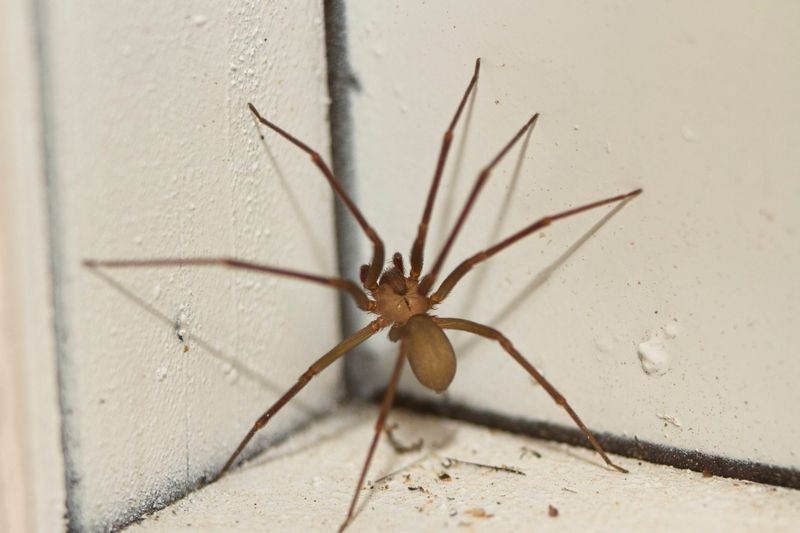
Brown Recluse
The golden brown critter known for its fiddle-shaped marking is common in basements, and undisturbed areas like piles of boards, firewood and rocks.
The spider is rarely aggressive (hence the name recluse), but can attack when accidently trapped or when feeling disturbed or threatened. Its bite contains hemotoxic venom, which impacts red blood cells and tissues, and a small number of brown recluse bites do result in necrosis, or the death of cells.
Symptoms of a recluse spider bite are chills, fever, nausea, a red and blue lesion at the bite site and weakness, according to DSHS. Sometimes a reaction could be delayed for days, and healing could take months.
Striped Bark Scorpion
There are 18 species of scorpions found in Texas, according to the Houston Museum of Natural Science, and the Striped Bar Scorpion is the most commonly spotted.
While none of the scorpions in the state are considered deadly, the predatory arachnid carries neurotoxins in its venom that causes pain and localized swelling.
The Striped Bar Scorpion is brown with black stripes, and found underneath rocks, and climbing up trees and homes — usually at night.
Texas Red-Headed Centipede
While centipedes are most common in Central Texas, the Texas Red-Headed Centipede can also be found in the southwestern part of the United States and northern Mexico.
The nocturnal predator can reach up to 8 inches and the pinch from its jaw and legs causes sharp pain and swelling.
Symptoms from a bite include nausea, headache, and skin necrosis.
Here’s another interesting tidbit about centipedes from Texas A&M University: the first pair of “legs” is actually a pair of hollow fangs with a venom gland at the base.
Kissing Bugs
While the kissing bug might sound pleasant, the insect was named for its bite, which often happens near a human’s mouth or eyes. The bite is slightly painful, but there is potential for transmission of the parasite that causes Chagas disease, which could turn life threatening if left untreated, according to the World Health Organization.
While Texas, New Mexico, and Arizona have the most different species and most findings of kissing bugs, about half are infected with the Chagas parasite, cites Texas A&M University.
To keep kissing bugs away, secure your home by not having any gaps around doors and baseboards, don’t leave windows open without screens and turn off lights at night, if safe.
Kissing bugs fly towards light.
Asp Caterpillar
This caterpillar’s looks are deceiving; while it appears to have a soft coat, the insect contains stinging venomous spines.
The ASP caterpillar is yellow or gray to reddish-brown and at the larval stage of the Southern Flannel Moth. It can be found in oaks, elms, and other garden plants.
If you get a bite from these critters, Texas A&M recommends placing an ice pack at the site of the sting, and oral antihistamines can be administered to help relieve the itching and burning sensations.
If an allergic reaction occurs, seek medical help.
Eastern Velvet Ants
Despite the name, the Eastern Velvet Ant is actually a wingless wasp, though these colorful insects look a lot like ants.
The black and orange-red bug with a long ovipositor, or stinger, is also known as a “cow killer” because of its extremely painful sting, even more agonizing than a bee sting. Even so, medical treatment is rarely required, usually in the case of an allergic reaction.
The Eastern Velvet Ant is usually seen across Texas in the summertime, and is found in both rural and urban areas in the state.
Natassia Paloma may be reached at npaloma@gannett.com, @NatassiaPaloma on Twitter; natassia_paloma on Instagram, and Natassia Paloma Thompson on Facebook.
This article originally appeared on El Paso Times: Here are 7 intimidating insects in Texas to watch out for this summer
Reporting by Natassia Paloma, El Paso Times / El Paso Times
USA TODAY Network via Reuters Connect