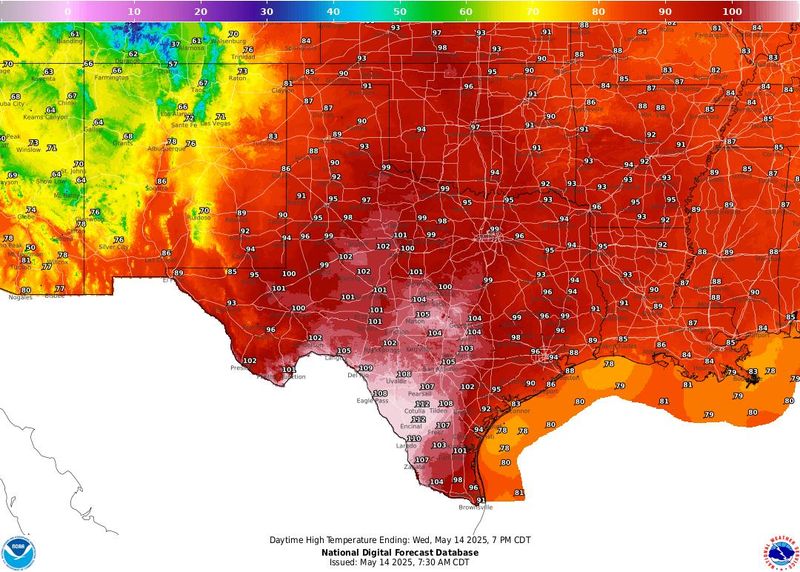
The Texas-Mexico border is scorching under a record-setting heat wave, with temperatures soaring past 110 degrees, making it the hottest place on the planet Wednesday.
While cities just inside the border of northern Mexico are likely to get a few degrees hotter on Wednesday, Cotulla and Encinal in South Texas are expected to be the hottest cities in the United States, each forecast to reach 112 degrees this afternoon, according to the National Oceanic and Atmospheric Administration.

These temperatures will surpass those of some of the world’s hottest regions today — including the Sahara Desert in northern Africa, the Lut Desert in Iran and Dallol, Ethiopia, which historically has the highest average yearly temperatures.
The oppressive heat is part of a broader weather pattern moving eastward, pushing unseasonably high temperatures from Texas all the way to New York, where highs in the upper 80s and 90s are expected.
How hot will temperatures in Texas get?
No part of Texas will get relief from this week’s heat wave, which will bring extreme heat through the weekend.
Forecasters warn that temperatures could climb up to 20 degrees above normal in some areas. Triple-digit highs are expected from Waco to San Antonio, extending west through the Permian Basin and into the Abilene region.
Coastal cities like Houston and Corpus Christi will be slightly cooler, with highs in the upper 80s to mid-90s. The coolest spot in Texas is forecast to be Pine Springs — roughly halfway between Odessa and El Paso — with a high of 85 degrees.
Through the first week of June, temperatures are likely to remain above normal, meaning much of Texas will record its first triple-digit days three to five weeks earlier than usual.
What was the hottest temperature ever recorded on Earth?
Death Valley, California, is often cited for the world record for the highest temperature ever recorded, reaching 134 degrees in 1913. However, some experts dispute this record, arguing that such a temperature was unlikely based on the region’s typical conditions.
If that record is contested, Kebil, Tunisia, in the Sahara Desert, claims the hottest temperature ever recorded, reaching 131 degrees in 1931.
Still, Death Valley holds the record for the hottest temperature ever recorded in the U.S., hitting 130 degrees in 2021, according to AccuWeather. Today, however, it’s experiencing a relatively mild day with a low of 61 degrees and a high of 84.
What’s the difference between temperature and heat index?
The temperature is the actual air reading — what a thermometer records in the shade. The heat index, on the other hand, represents what it feels like to the human body when both temperature and humidity are factored in, according to the National Weather Service.
When humidity is high, sweat doesn’t evaporate as easily, making it harder for your body to cool down. That’s why the heat index is often higher than the air temperature, and why it’s used to gauge the risk of heat-related illness.
What are the symptoms of heat-related illness?
Extreme heat is the deadliest weather-related hazard in the United States, claiming more lives each year than hurricanes, floods or tornadoes.
Experts urge Texans to take precautions: stay hydrated, avoid outdoor activity during peak afternoon hours, wear light clothing and check on vulnerable neighbors, including the elderly and those without air conditioning, throughout these next couple of weeks and into the summer.
According to the Centers for Disease Control, there are multiple types of heat-related illnesses. Heat cramps and heat rash can be treated by staying indoors and getting hydrated. But some others are more serious.
Heat exhaustion symptoms
Heat exhaustion is a mild heat-related illness that occurs in hot temperatures, especially when you’re not drinking enough water or other non-alcoholic fluids. People most at risk for heat exhaustion are the elderly, those with high blood pressure, and individuals working or exercising in the heat.
Symptoms of heat exhaustion include:
If you or anyone you’re with experiences these symptoms, move to a shaded or air-conditioned area, use a fan, or immerse in cool water. Also, drink cool, non-alcoholic beverages like water or sports drinks with electrolytes.
Heat stroke symptoms
Heat exhaustion can escalate into heat stroke, a serious, life-threatening condition. Heat stroke occurs when the body’s temperature rises rapidly, and it can no longer cool itself down.
Early symptoms of heat stroke are similar to heat exhaustion but progress to more severe signs, including:
Heat stroke is a medical emergency. If you suspect someone is experiencing it, seek immediate medical attention. Without emergency treatment, heat stroke can cause death or permanent disability.
This article originally appeared on Austin American-Statesman: Heat wave makes Texas-Mexico border the hottest spot on the planet. How hot will it get?
Reporting by Brandi D. Addison, Austin American-Statesman / Austin American-Statesman
USA TODAY Network via Reuters Connect