Advocates are one step closer to potentially putting on the November ballot an amendment that, if approved, would eliminate drought surcharge exemptions for all large-volume users of Corpus Christi water.
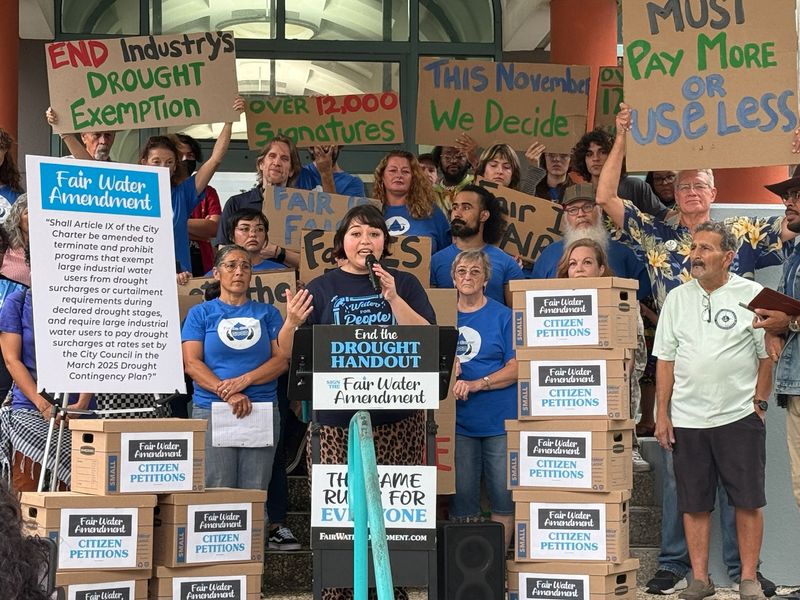
A petition for the proposal, with signatures numbering more than 12,700, was submitted to the City Secretary’s Office, organizers announced June 15.

That is expected to prompt review to verify the petition, and if verified, it will be sent to the City Council for inclusion on the November ballot, according to a news release.
The proposal, if passed in an election, would end a program — in place since 2018 — that allows participating large-volume users to pay a fee in exchange for exemption from drought surcharges, if implemented by the City Council.
As part of the voluntary program, participating large-volume users — a category primarily comprising heavy industry — pay 31 cents per every 1,000 gallons of water used each month, regardless of whether the city is in drought conditions.
About 10 companies had agreements on the drought surcharge exemption fee as of April, according to city officials.
Similar programs are not available to other Corpus Christi Water customers, such as residents.
Critics have said the program disproportionately puts the cost burdens of water needs on residents instead of wealthy corporations that use a high volume of water in their operations.
Amendment efforts were spearheaded by nonprofits Texas Campaign for the Environment and For the Greater Good.
In a news release, For the Greater Good co-founder Isabel Araiza said that the “council could have voted at any time to repeal the exemption fee program and end this ‘drought handout’ for wealthy corporations.”
“But they’ve refused, year after year,” she said in the release. “Their inaction forced the community to take the matter into our own hands. Our successful petition drive means that the decision to end this deeply unfair policy will now be in the hands of Corpus Christi voters.”
The program
The existing ordinance calls for revenue collected under the program to be set aside for “development of a drought-resistant water supply.”
The funding totaled about $30 million as of December, according to city officials.
Bob Paulison, executive director of the Coastal Bend Industry Association, declined to comment in a June 15 message to the Caller-Times.
However, he has previously described the program as “a win for the city.”
“That money is collected, it’s invested by the city, it continues to grow through investment and interest returns,” he told the Caller-Times in February. “It’s available … for capital to bring on long-term water supply projects, which we felt for quite some time is critically important for the city to do.”
Surcharge changes
Under a newly approved Drought Contingency Plan, assessing surcharges to all customers — from residential and commercial to industrial and wholesale — would be an option to the City Council under a water emergency.
Included in the existing 2025 plan, and adopted 2026 plan, are guidelines for surcharges for non-exempt large-volume users.
The plan shows that under Stage 2 drought, that would be a $3 surcharge for every 1,000 gallons of water used over about 12.8 million gallons of water per month.
Under Stage 3 drought, that would be a $6 surcharge, according to the document.
In the 2025 plan, non-exempt large-volume users would pay a $12 surcharge per 1,000 gallons of water used over about 12.84 million gallons of water per month.
City officials had earlier this year said that the program would remain in effect during a water emergency, but later reversed course.
The Drought Contingency Plan, updated in June, amends the surcharges that would apply in a water emergency.
In the new plan, all large-volume customers would be subject to surcharges, regardless of participation in the fee program.
The new guidelines established for a water emergency are uniform across residential, commercial, industrial and wholesale customers — $4 for every 1,000 gallons of water used per month over an assigned baseline and $8 per 1,000 gallons of water used per month exceeding the allocation.
Industrial companies have individual baselines.
A potential election
Based on the proposed ballot language, the city would be required to assess surcharges to all large-volume customers, using the rates established under the Drought Contingency Plan that has been adopted in 2025, the news release shows.
Provisions in the Drought Contingency Plan require that existing agreements include five years’ notice prior to termination.
Should an amendment be passed, it would go into effect in 2031, according to organization representatives.
Kirsten Crow covers city government and water news. Have a story idea? Contact her at kirsten.crow@caller.com.
Consider supporting local journalism with a subscription to the Caller-Times.
This article originally appeared on Corpus Christi Caller Times: Amendment would eliminate benefit to industry in Corpus Christi drought
Reporting by Kirsten Crow, Corpus Christi Caller Times / Corpus Christi Caller Times
USA TODAY Network via Reuters Connect
By Kirsten Crow, Corpus Christi Caller Times | USA TODAY Network