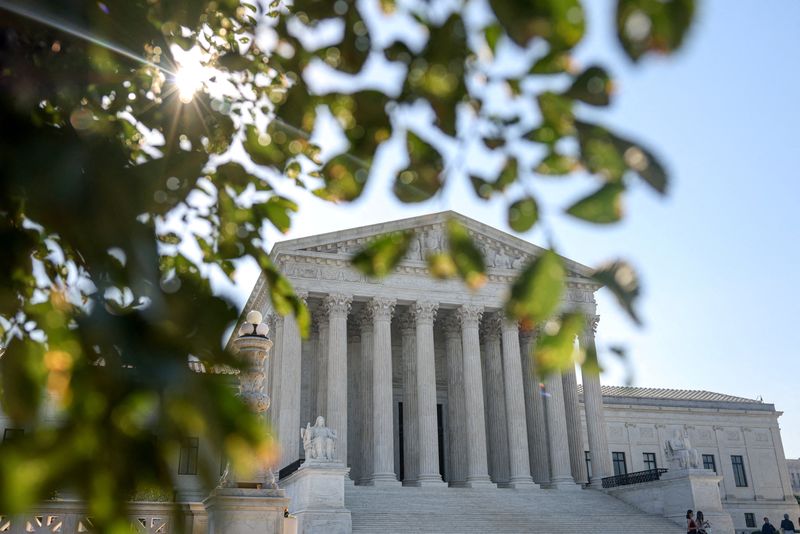
By Jan Wolfe
WASHINGTON, May 20 (Reuters) – President Donald Trump was incensed on February 20 when the U.S. Supreme Court struck down his sweeping global tariffs, an integral part of his economic and foreign policy strategy. That may not be the last disappointment for Trump during the court’s current term.

Four more major cases involving Trump are due to be decided by the top U.S. judicial body by around the end of next month. They involve his effort to restrict birthright citizenship, fire a member of the U.S. Federal Reserve Board of Governors, oust a Federal Trade Commission member and end protected status for hundreds of thousands of immigrants from Haiti and Syria.
The Supreme Court, whose 6-3 conservative majority includes three justices he appointed during his first term as president, has backed Trump in a series of decisions issued on an emergency basis since he returned to office last year. But, based on questions posed by the justices during arguments in the cases, Trump may lose on birthright citizenship and the Fed firing.
The court next issues rulings on Thursday.
“There are going to be a series of losses for the Trump administration, but I think they pale in comparison to the number of wins that the administration will get,” Georgia State University law professor Anthony Michael Kreis said.
AN EXECUTIVE ORDER
On the first day of his second term as president, Trump signed an executive order that instructed U.S. agencies not to recognize the citizenship of children born in the United States if neither parent is an American citizen or legal permanent resident, also called a “green card” holder. The directive is a central element of the Republican president’s hardline approach toward immigration.
During arguments in the case on April 1, most of the justices signaled skepticism about the legality of Trump’s directive. At issue is whether Trump’s order violated citizenship language in the U.S. Constitution’s 14th Amendment as well as a federal law codifying birthright citizenship rights.
None of the three Trump appointees – Brett Kavanaugh, Neil Gorsuch and Amy Coney Barrett – seemed enthusiastic about the president’s legal positions during the arguments, Kreis said.
“The Trump administration is probably looking at a 7-2 loss,” Kreis said.
University of Pennsylvania political science professor Rogers Smith said a majority of Americans has long supported current birthright citizenship policies.
“There is a reason that repeated Republican efforts since the 1990s to change birthright citizenship rules have never made it out of committee in Congress, even when Republicans controlled both legislative chambers,” Smith said. “Most members of Congress know that most of their constituents do not favor changing current policies.”
THE LISA COOK CASE
Since the Fed was created in 1913, no president until Trump had tried to oust a central bank official. When Trump last year moved to fire Federal Reserve Governor Lisa Cook, he cited unproven claims made by one of his appointees that Cook had engaged in mortgage fraud, though she said the allegations were a mere pretext to oust her over monetary policy differences.
During January 21 arguments in the case, most of the justices expressed unease about the ramifications for the Fed’s cherished independence from political influence if they were to endorse Trump’s arguments that he acted within his powers in seeking to remove Cook.
When the Supreme Court decided last October to hear the Cook case, it opted to leave her in the post while the legal dispute played out. It did not do so with Federal Trade Commission member Rebecca Slaughter, allowing Trump to remove her while her legal challenge proceeded.
When the court heard arguments on December 8, the conservative justices signaled they would uphold Trump’s firing of Slaughter. The Justice Department has asked the court to use the case to overturn its 1935 precedent that has constrained presidential power by protecting the heads of independent agencies from removal.
A 1914 law passed by Congress permits a president to oust FTC commissioners only for cause – such as inefficiency, neglect of duty or malfeasance in office – but not for policy differences to guard against political interference. Similar protections cover officials at more than two dozen other independent agencies.
The conservative justices appeared to embrace the Trump administration’s arguments that such tenure protections encroached on presidential power under the Constitution.
“A decision in favor of Trump in the Slaughter case will strip power away from Congress and give much more to the president,” University of Minnesota political science professor Timothy Johnson said.
Bradley University political science professor Taraleigh Davis said that it seemed clear during the arguments in the Cook case that the justices want to protect the Fed.
“But I didn’t hear an answer to what legal principle actually distinguishes the Fed from the FTC,” Davis said.
TEMPORARY PROTECTED STATUS
The court heard arguments on April 29 over the Trump administration’s move to strip 350,000 immigrants from Haiti and 6,100 from Syria of temporary humanitarian protections provided years ago by the U.S. government. The court traditionally has deferred to presidents on matters of immigration, national security and foreign policy.
Trump’s administration has moved to rescind designations under the government’s Temporary Protected Status program that lets migrants from nations stricken by war, natural disaster or other catastrophes live and work in the United States while it is unsafe for them to return to their home countries.
(Reporting by Jan Wolfe; Editing by Will Dunham)