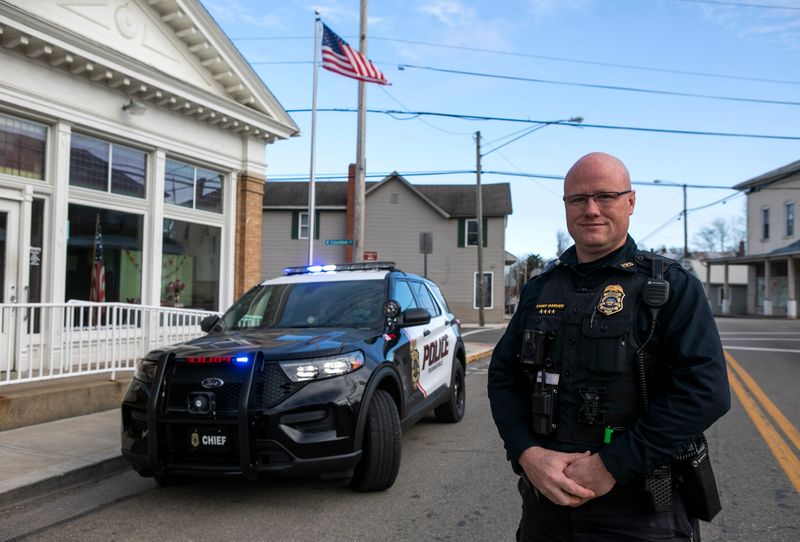
“Park the cars. Cease patrols immediately,” the Pleasantville solicitor wrote to other officials of the Fairfield County village in a letter advising that the village police department was not established properly, and did not have the legal authority to issue citations or even operate.
Village solicitor Jon Browning also advised Pleasantville officials in the April 5 letter to terminate all police personnel, recover any equipment and records provided to them, dismiss pending traffic citations, take down the police department’s YouTube channel, and notify a variety of outside agencies that the department had ceased operations.

An ordinance passed by the Pleasantville council on April 15 abolished the police department, village administrator Sam McCreery confirmed to The Dispatch. Village Police Chief Nick Garver resigned on April 10, the Friday before the meeting.
Browning said in the April 5 letter, obtained by The Dispatch, that the police department did not have proper legal authority because it was established under an ordinance that was not properly enacted. The village also may have entered into illegal agreements with Garver’s private security company, Garver Asset Protection, LLC, he wrote.
In an email, Garver said he and his company did not profit from the agreements, and absorbed some of the department’s costs.
“It is curious that the same village that honored our service just months ago is now using three-year-old clerical errors to disband a successful department,” Garver said.
Ordinance establishing Pleasantville police enacted improperly
Under Ohio law, all village ordinances must be read at three separate meetings before they are enacted. When the village established the police department, the council voted on the ordinance at their Dec. 14, 2023, meeting, where it was first read, according to the letter.
Villages may get around the “three-reading rule” if three-fourths of council members vote to suspend the rule, or if the village council declares a state of emergency. But Pleasantville’s council did not properly do either of those things, Browning wrote, making the ordinance establishing the police department “void and unenforceable.”
A section of the ordinance did state it was “hereby declared to be an emergency,” but did not provide any reason for the emergency, according to the solicitor’s letter. The minutes for the meeting did not note any actions by council members to suspend the “three-reading rule” or record any discussion on the ordinance.
Browning wrote that the village “faces extreme risk of civil lawsuits” for its officers’ actions since the department was not lawfully created. He noted they were wearing police uniforms and badges, driving marked cruisers and stopping motorists, yet did not legally have police authority. The village’s insurance might not cover a lawsuit filed against the village for the officers’ actions, he said.
Browning said the officers may also be personally liable, or even criminally liable.
“Frankly, an individual who is acting without the authority of being a police officer may be guilty of the crimes of kidnapping, assault, impersonating a police officer,” Browning wrote.
Garver said it is a “legal reach” to suggest the police department is invalid because of an initial clerical error. He said the officers were considered “de facto officers” under state law and their actions were legitimate.
Garver said that under his leadership, the department saw declines in drug complaints and petty theft reports, and officers were able to respond swiftly to violent crime.
Ethical concerns over the police chief’s private security company
Another document provided to The Dispatch raised ethical concerns about the purchase of a police cruiser and a truck from Garver Asset Management, Garver’s private security company. It also raised concerns about a council member who had voted on ordinances involving both the police department and Garver Asset Management despite being an employee at the company.
Attorney Bradley Nicodemus, who served as the village’s solicitor at the time, informed the village in a March 3 letter that the purchases and the council member’s votes may have been conflicts of interest that violated state law.
Nicodemus also informed the village in a second March 3 letter that he intended to withdraw from his position as village solicitor after 30 days. He did not say exactly why he was withdrawing from the position.
On Jan. 11, 2024, the council entered into a lease with Garver Asset Protection for a 2020 Ford Expedition police cruiser for $24,000, according to Nicodemus’ letter. On Nov. 13, 2025, the village purchased a 2008 Ford F-250 pickup truck for $11,000 from the company.
Garver was both the police chief and the owner of Garver Asset Protection at the time, Nicodemus noted. He wrote that Garver could not enter into any contracts with the city with a few exceptions, and none of the exceptions seemed to apply.
Garver said the vehicles were sold to the city below their market value, and the village “had no other options that would meet their budget.” He said he and his officers worked for free for the first 15 months, and his company absorbed $10,000-$15,000 in expenses for the K9 unit.
Garver said the village has also failed to return or reimburse thousands of dollars worth of his company’s equipment.
Nicodemus also wrote that Councilmember Katie Henry was an employee of Garver Asset Protection – and therefore Garver himself – but voted in favor of the police department several times rather than ethically abstaining, according to the letter. Henry was appointed to the council in April 2024, after the police department was established and while Garver was already operating as chief.
Henry voted on 11 ordinances related to the police department at eight council meetings, according to the letter. She participated in the unanimous vote to permanently appoint Garver as chief, and voted on ordinances related to police funding and equipment. Nicodemus wrote that these votes likely violated Ohio ethics law.
Next steps uncertain for Village of Pleasantville
The village could start over with new ordinances, enact them properly, and reinstate the police department, Browning wrote in his April 5 letter. He encouraged the council not to do so.
“The legal hurdles presented here are too great, too many shortcuts were taken, too many rules were glossed over, too many discussions may have been made that were not fully disclosed to the members of council before the members voted, to defend,” he wrote.
Browning wrote that he believed it would be best for the village to have its own police department, but he believed keeping the department as-is posed too great a risk. If the village were to be sued for police misconduct, and a jury heard about the issues associated with the police department, the village would likely lose the case, he wrote.
“The good news is this council could fix these issues,” Browning wrote. “No one’s gotten hurt, no one has sued yet. We have time.”
McCreery said previously that the village is unsure what will happen to citations written by Pleasantville police officers. State agencies are investigating, and it may be months before the village knows what to do, she said.
The Ohio Office of the Auditor confirmed it received a complaint about the Village of Pleasantville and is looking into the matter. The Dispatch has filed a public records request for that complaint.
Public Safety and Breaking News Reporter Bailey Gallion can be reached at bagallion@dispatch.com.
This article originally appeared on The Columbus Dispatch: Why was a small Ohio village police department disbanded? Records shed new light
Reporting by Bailey Gallion, Columbus Dispatch / The Columbus Dispatch
USA TODAY Network via Reuters Connect