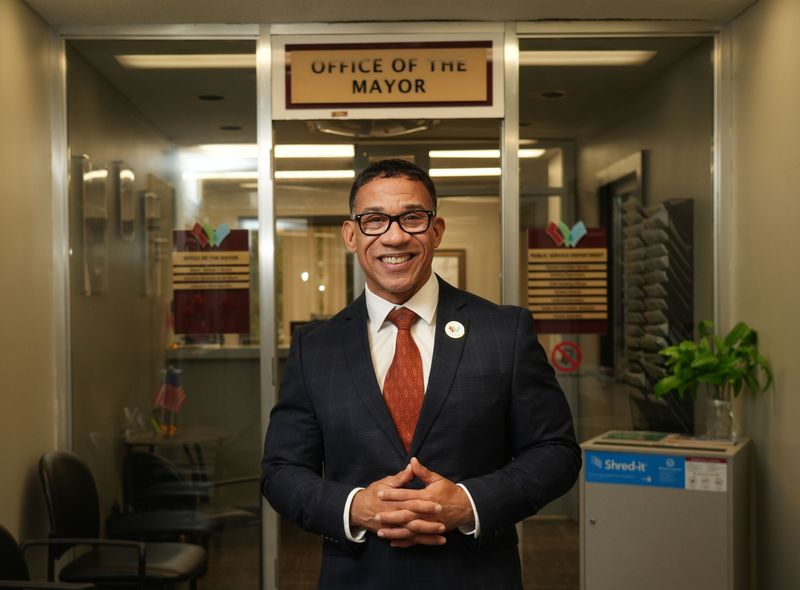
Whitehall voters will decide the fate of the city’s mayor and two council members in a recall election scheduled for May 28, barring intervention by the Ohio Supreme Court.
City Council members voted 4-3 on April 14 during a special meeting to hold the recall election on Thursday, May 28, just two days before the deadline to conduct the petition-initiated recall election.

May 28 was selected despite recommendations from the Franklin County Board of Elections as well as other city council members who wanted to have the election on May 26 because elections in Ohio and the U.S. are held on Tuesdays.
Whitehall voters will decide if Whitehall Mayor Michael Bivens and Council members Lori Elmore and Amy Harcar should hold their seats or be removed from their respective positions.
Council members Biran McCann, Gerald Dixon, Larry Morrison, and Mike Adkins voted in favor of the resolution, while Council members Devin Brown, Elmore, and Harcar voted against it.
In the middle of the vote, Elmore assailed Holly Stein, the primary driver of the recall attempt. Elmore accused Stein of nursing a personal vendetta against Elmore for being thrown off of the November 2025 ballot for city council because the courts determined she did not meet the residency requirements as required by the Whitehall City Charter.
Elmore also criticized the decision to have the election on May 28, calling the Thursday election an attempt to confuse voters since elections are normally held on Tuesdays.
The official date for the special recall election comes after City Council argued over the date at their previous meeting, but did not take a vote. At that meeting, Elmore and Brown advocated for having the election on May 26 because it falls on a Tuesday and that’s when elections in the United States are normally held.
The recall attempt has sharply divided residents. Those opposed to the recall have repeatedly said that racism is the motivating factor behind the recall attempt and pointed specifically to racist and anti-immigrant comments made on Facebook pages supporting the recall. Bivens and Elmore are Black, Harcar is white but works with the immigrant community as part of her job.
Harcar said during the April 14 meeting that she was being targeted because of her work with Whitehall’s immigrant community and other vulnerable populations.
“If you want to recall me for the work that I do, then just be transparent,” said Harcar. “The majority of people who signed that petition, that’s their issue with me.” She also said that those seeking to unseat her, Bivens and Elmore could’ve run against either of the three in the previous election or waited until the trio were up for reelection.
Whitehall for All, the group leading the recall attempt have repeatedly cited without evidence that fraud, favoritism, and fiscal irresponsibility is rampant on City Council.
Elmore has been the most vocal against the accusations, saying that the claims are baseless and without merit. Council members as well as the public have also directly called out Brian Steel and the Fraternal Order of Police Capital City Lodge No. 9 for running a “smear campaign” against Bivens, Elmore and Harcar and providing material support for the recall attempt.
Steel told The Dispatch previously that FOP members in Whitehall have played a role in advocating for the recall.
Challenge to recall signatures pending in Ohio Supreme Court
While a date for the special recall election has been set, a challenge in the Ohio Supreme Court seeking to toss out the signatures that initiated the recall is still ongoing.
Former Whitehall City Attorney Michael Shannon filed a lawsuit April 8 seeking to toss out the hundreds of signatures gathered to initiate the recall. Shannon argued in court filings that the petitions did not have the required number of valid signatures, alleging that Clerk of Council Julie Ogg certified the recall petitions even though they did not have the required number of valid signatures.
According to the court filing, 3,913 voters participated in the November 2023 regular municipal election, in which Bivens, Elmore and Harcar were elected. The Whitehall City Charter states that in order to initiate a recall petition, sponsors must secure signatures representing 15% of the total number of electors who voted for mayor.
But Shannon alleged in the lawsuit that Whitehall For All used the wrong voter total to calculate the threshold, estimating that the 2,827 signatures the group used was below the threshold. Using that number, it determined that roughly 425 signatures were needed. The group collected 444 signatures for the petition targeting Bivens and 447 signatures for petitions targeting Elmore and Harcar.
Shannon alleged in the lawsuit that the correct number of valid signatures needed is 587. He is demanding that Ogg rule the number of signatures to be insufficient under Whitehall City Charter and to notify the circulators of the petitions that the signatures are invalid.
“The recall petitions do not meet the minimum signature requirement in the Whitehall City Charter,” Shannon wrote in the complaint. “[Ogg] clearly disregarded applicable legal provisions and/or abused her discretion in finding that the petitions contained sufficient valid signatures and her failure to notify the person who filed the petition of its deficiencies.”
Reporter Shahid Meighan can be reached at smeighan@dispatch.com, at ShahidMeighan on X, and at shahidthereporter.dispatch.com on Bluesky.
This article originally appeared on The Columbus Dispatch: Whitehall sets recall election date for mayor, 2 council members
Reporting by Shahid Meighan, Columbus Dispatch / The Columbus Dispatch
USA TODAY Network via Reuters Connect