Big Ten pooh-bahs huddled for spring meetings this week in swanky Rancho Palos Verdes, California, to discuss, among other things, the conference’s preference to double the College Football Playoff from 12 to 24 teams.
If it happens and conferences go with a “Two-Doz” expansion – the jury remains out as the Southeastern Conference prefers a 16-team format; deadline for a decision is Dec. 1 – expect the Ohio State-Michigan game to get bruised. The contusion won’t immediately become obvious, may not even turn deep black and blue for a decade or more, but eventually it will be hard to hide.

A trustworthy saying: The lower the stakes, the lower the intensity associated with those stakes. If Ohio State can lose to Michigan and still make the playoff? Lose to the Wolverines and still win a national title? What does that do to the rivalry?
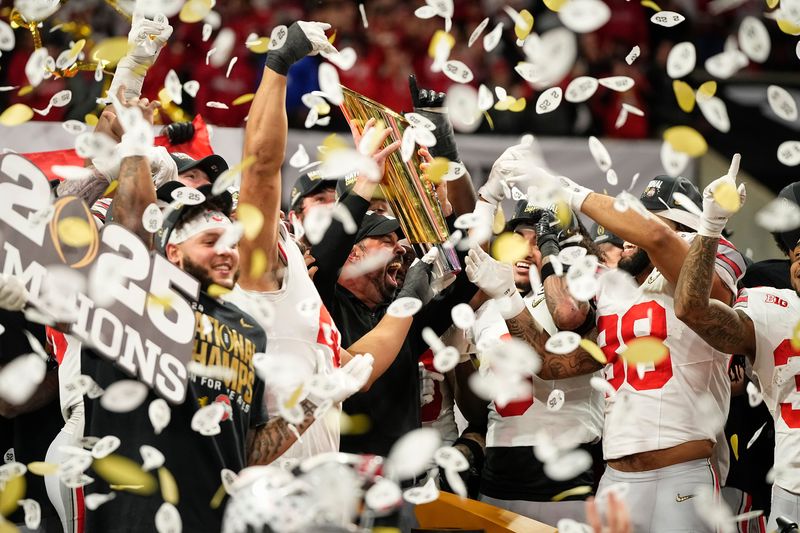
We already know. A precedent was established in 2024 when unranked UM stunned No. 6 OSU in Columbus. The Buckeyes licked their wounds, regrouped after an emotional team meeting and won their next four playoff games to capture the CFP championship. The Michigan loss bruised the season, but did not bury it.
If falling to Michigan did not cost two-loss Ohio State a playoff berth in 2024, what are the chances a two, three or possibly even four-loss OSU gets shut out of a 24-team playoff?
Slim, say hello to none.
Will Ohio State-Michigan matter as much in 24-team playoff?
Will the Michigan game still matter in a 24-field format? Of course. The Game will always be special. Just a little less so. Measuring passion is an inexact science, but there is no doubt that over the long haul, when less is on the line, the highs will be lower and lows higher.
Don’t take just my word for it.
“The 12-team [playoff] showed that The Game doesn’t matter as much anymore in the grand scheme of things,” said Michael Jenkins, a key piece of OSU’s 2002 national championship team that defeated Miami in the two-team “playoff” that defined the BCS era.
Another OSU 2002 champion, Ben Hartsock, put words to what many are feeling.
“Maintaining The Game’s importance while removing the stakes cannot coexist,” Hartsock said. “But it will take generations or more to feel it. Fans who grew up before the stakes were removed [four-team era and prior] will demand that The Game be treated as special, regardless of the stakes.
“But the fans who are coming of age now will never understand why it’s such a big deal, because they never experienced playing your most bitter rival in a game where the winner competed for the title and loser a consolation bowl. They will point to the true goal being the [national] title. Eventually, we die off, and The Game is reduced to a side quest.”
Preach.
Of less concern is the worry voiced by some that a 24-team playoff will negatively impact rivalry games, including Ohio State-Michigan, as coaches begin sitting star players to rest them for an expanded playoff. Could it happen? Sure, but unlikely.
College fans differ from their NFL brethren in that rivalry games can frame an entire season. The numbers may be dwindling as older OSU fans fade out, but there still exist younger fans who consider the whole season ruined if the Buckeyes lose to the Wolverines. Knowing that, college coaches would hesitate to rest their stars over the high risk of doing so.
As former Ohio State tight end John Lumpkin put it, “The first coach in a rivalry game who decides to sit players because playoffs are down the road, and then he gets beat, will get fired. Mark that down. Can you imagine not playing [Jeremiah] Smith? Don’t even get on the plane back.”
“Nobody sits their starters in a rivalry game because the playoffs are next week, because the games are too important to these fans and these programs,” Lumpkin continued. “Let’s say we’re good and Michigan isn’t and we sit guys out and lose. Man, our fanbase would be livid. And vice versa.”
Could players sit out OSU-UM game to prevent injury?
But what if the player is the one who opts to sit? That would have been unimaginable 25 years ago, but less so now as players choose to protect their NFL prospects. Maybe a projected top-10 draft pick would not sit out a playoff game, knowing NFL teams might consider it a bad look. But a regular-season rivalry game? Hmm.
I’m not a huge fan of a 24-team playoff, but that’s not to say it doesn’t hold some positives. For starters, the more early-round games played on the higher seed’s home field, the better. And the TV viewing would be heaven.
Negatives, beyond risking watering down rivalries? Asking fans to travel hither and yon means more corporate types and fewer frothing-at-the-mouth fans at the neutral site games.
The biggest positive that the Big Ten, Big 12 and Atlantic Coast Conference see with a 24-team playoff is opportunity. More schools will have a chance to compete for a national championship.
My counter? How many of those title chances are legitimate? Yes, NIL has created a bit more parity, and Indiana proved an A+ coach (Curt Cignetti) and billionaire donor (Mark Cuban) can turn the middle class into a 1 percenter, but it is mostly false hope to think that a Rutgers or Purdue can pull the same trick.
“I think 12 is a good number,” Lumpkin said. “And 16 is better than 24, but if it’s 24, some things need to change.”
I’m with Lump that no conference should get more than 4-5 teams in.
“At the end of the day, do we really want a bunch of seventh, eighth and ninth-best teams out of the Power 4 conferences playing?” Lumpkin said. “People complain about the Group of 5 getting in, like James Madison, because they’ll get killed. Well, [weaker] Power 4 teams are going to get killed, too. If you’re going to 24 just so you can get all the Power 4 schools in there, so they can get their heads beat in by the top ones, what’s the point?”
The point is money. More playoff teams mean more cash in conference pockets. But even on that topic, Lumpkin, who is a vice president of wealth management at Morgan Stanley, issued a warning.
“You have to follow the money,” he said. “Once they do all the metrics on who is going to make what, they’ll make their decision, but it’s getting to the point of diminishing returns. What you will end up with is having the same issue the FCS teams have, which is that those early [playoff] games end up costing you money.”
Heaven forbid the conference millionaires lose money. They would consider that worse than losing the intensity of a rivalry game. A shame.
Sports columnist Rob Oller can be reached at roller@dispatch.com and on X.com at @rollerCD.
This article originally appeared on The Columbus Dispatch: Heated Ohio State-Michigan rivalry risks cooling with 24-team playoff
Reporting by Rob Oller, Columbus Dispatch / The Columbus Dispatch
USA TODAY Network via Reuters Connect