NORTH CANTON − Brittany Neal isn’t an engineer, a carpenter or a diesel mechanic like her husband, Brandon.

But she’s a busy mom of two who discovered a better way to transport a disabled daughter Stormi, courtesy of a 3D printer she owns.
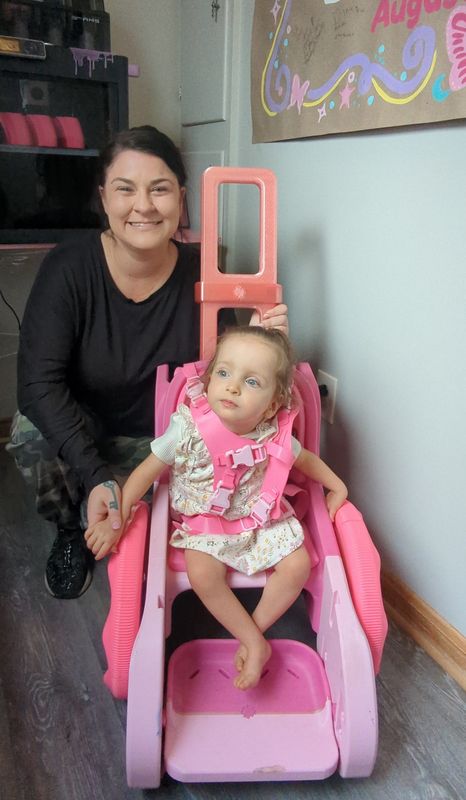
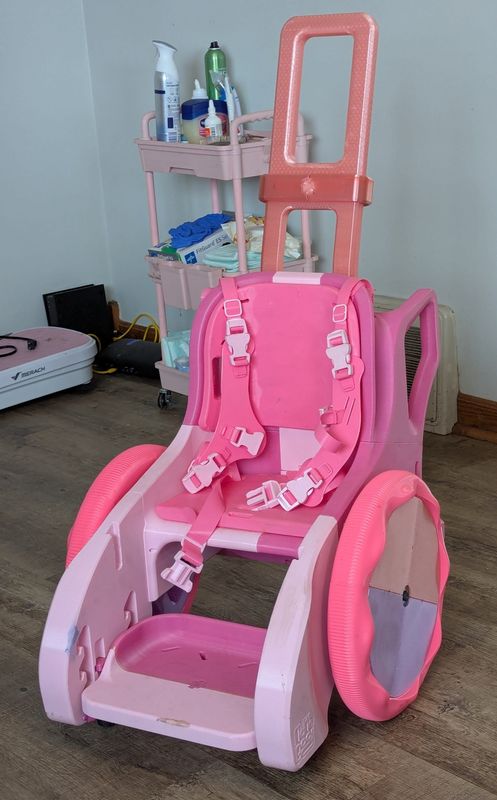
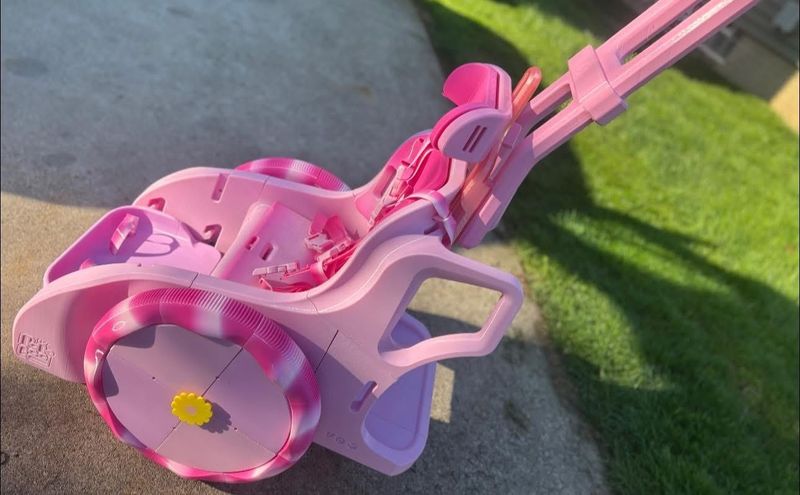
Neal printed a “Toddler Mobility Trainer,” a lightweight stroller based on a design from MakeGood, a nonprofit dedicated to designing and producing open-sourced devices to improve independence for children with disabilities.
MakeGood offers its patterns free of charge regardless of income, insurance or location.
“It popped up one day on my social media feed,” Neal said.
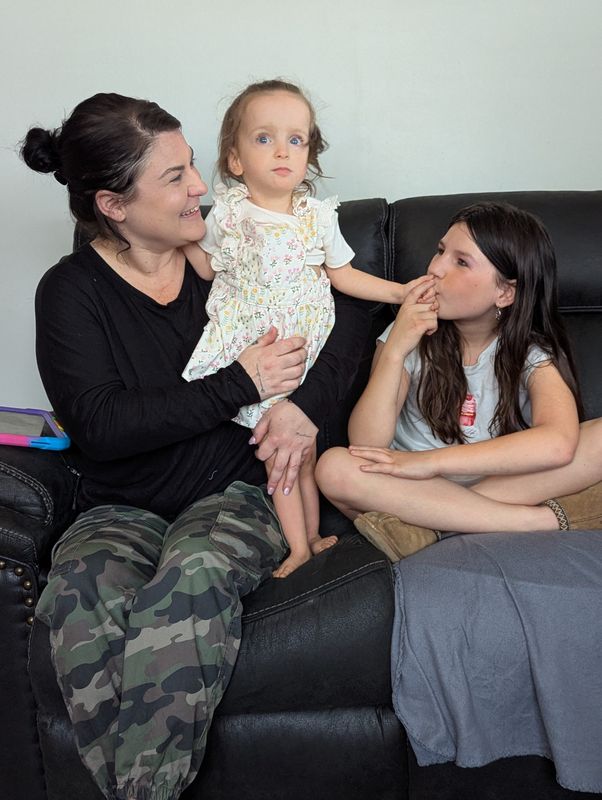
Stormi was born with Bainbridge-Ropers syndrome, a genetic disability so rare the toddler and her birth mother are among just 300 people in the world who have it, Neal said.
The toddler requires around-the-clock care and is unable to walk on her own. She is nonverbal and relies on a feeding tube and oxygen to counter her sleep apnea.
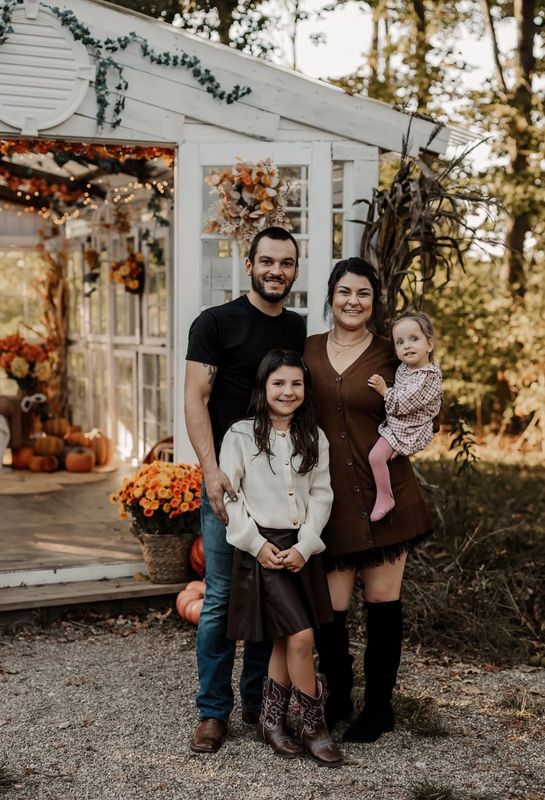
Neal and her husband, who have been foster parents since 2023 through Summit County Children Services, adopted Stormi, 3, last summer.
The couple also are in the process of adopting Stormi’s big sister, Madison, 11, this year.
“People say she can’t talk, but I can understand her,” Madison said of her little sister.
What is MakeGood?
MakeGood was founded by Noam Platt of New Orleans, an award-winning health care facility architect who said he got the idea after a family with a disabled child sought his help.
“I realized that there’s a huge need for all sorts of assistive devices for millions and millions and billions of people, like 20% of our global population, and there just hasn’t been a lot of really good design work,” he said.
“So I started MakeGood to really focus on doing this design work and sharing it for free. The chair project comes out of this ethos of doing excellent cutting-edge, design work, and then democratizing it so anybody can reproduce it. It’s really been enabled in the past few years by 3D printing.”
Since its founding in 2021, MakeGood has produced 3,000 free adaptive devices, impacting people in 20 countries. The nonprofit has 200 sponsor-partners around the world.
The average cost of a Toddler Mobility Trainer device is $150 to $200, compared to customized wheelchairs that can cost as a much as $10,000.
“The cost is so low, and the quality is 100 times higher than it was five years ago,” Platt said. “So now we can do relatively complex designs, but anybody can reproduce them. When we started making these little kids’ mobility devices, we made them out of wood for a long time. But it was very hard to work with and finish correctly. It needs a lot of skills.
“3D printing is actually pretty straightforward to do. The work is really in the pattern; it’s in a digital file. Once you have that, all the machines work the same way. So, what you’re seeing is a huge proliferation of people, making these chairs all over the world.”
One Toddler Mobility Trainer takes about three to four weeks to complete.
“One wheel takes 35 hours,” Neal said.
In Ohio, MakeGood makers also can be found in Streetsboro, Avon, Zanesville, Columbus, Springfield, Dayton and other communities.
“It’s very popular in the Midwest,” Platt said. “There are high school maker spaces and college university students, but also grandmas are making them. People with no experience are making them. If you look on our website and go to the map, you can see it’s a global effort underway on every continent, except Antarctica. People are really getting into it and are getting kind of addicted to doing it.”
‘Brittany adjusted to Stormi’s needs quickly and became her biggest advocate.’
Jennifer Massar, a physical therapist with the Stark County Board of Developmental Disabilities, provided early intervention services for the Neals.
“I worked with the family from the time Stormi was placed with them until her third birthday,” she said. “We were able to support the family in getting to know Stormi’s needs and optimizing her development. Brittany adjusted to Stormi’s needs quickly and became her biggest advocate.
“She took each piece of her medical puzzle in stride, researched to understand them, and never once let them limit her expectations for her daughter. … Stormi’s progress is attributed to the hard work and dedication Brittany and the entire family have shown since they met her.”
The Neals once employed a series of wheelchairs to transport Stormi. In addition to being costly, customized wheelchairs can be cumbersome and more susceptible to damage. Because they don’t have wheelchair-accessible vehicles, transporting a wheelchair can be challenging, especially for Brittany Neal, who has undergone spinal surgery.
But the Toddler Mobility Trainer weighs less than 20 pounds.
Platt said MakeGood is on hand to administrate and offer guidance, “but it’s all these volunteer makers who are really making the difference.”
“A lot of hospitals are getting involved,” he said. “A lot of clinics are getting involved. They want chairs now, and so we’re seeing the project spread. I think stories like this are really important.”
Neal, who became a certified maker on March 1, recently built and delivered devices for two other local families.
‘I’m very lucky to have a supportive husband.’
She said her husband, a truck mechanic with Kenan Advantage Group, supports her latest endeavor.
“I’m very lucky to have a supportive husband, I don’t think he ever says no to some of my crazy ideas,” she said, laughing. “We had so much fun putting Stormi’s (device) together.”
Massar said the Neals do everything possible to help their little girl.
“Brittany has always put her girls’ needs first and done anything and everything to help them thrive,” she said. “The progress they have made in this nurturing, loving, consistent environment has been amazing.”
Massar also said she’s not surprised that Neal is using her new skill to help others.
“Brittany’s heart is so big that she is now taking this opportunity to help other families and provide kids she doesn’t even know the chance to experience and develop independent mobility without the extraordinary cost of most adaptive equipment,” she said.
Platt said friendships between families often form as a result of MakeGood.
“One of the goals is giving regular people, normal people, opportunities to kind of be heroes in their own community,” he said. “All they need is a 3D printer and some time, and you can actually have a really big effect on the lives of your neighbors, and your community, and that’s what it’s all about for us.”
Reach Charita at 330-580-8313 or charita.goshay@cantonrep.com. On Twitter: @cgoshayREP
More details
Brittany Neal of North Canton is seeking sponsors so she can produce more MakeGood devices, as well as help from people who own 3D printers. Contact her at brittanyneal1002@outlook.com
For more information about MakeGood, e-mail info@makegood.design or visit 3D-mobility.org
This article originally appeared on The Repository: Her daughter needed a mobility device. So North Canton mom made one with 3D printer
Reporting by Charita M. Goshay, Canton Repository / The Repository
USA TODAY Network via Reuters Connect