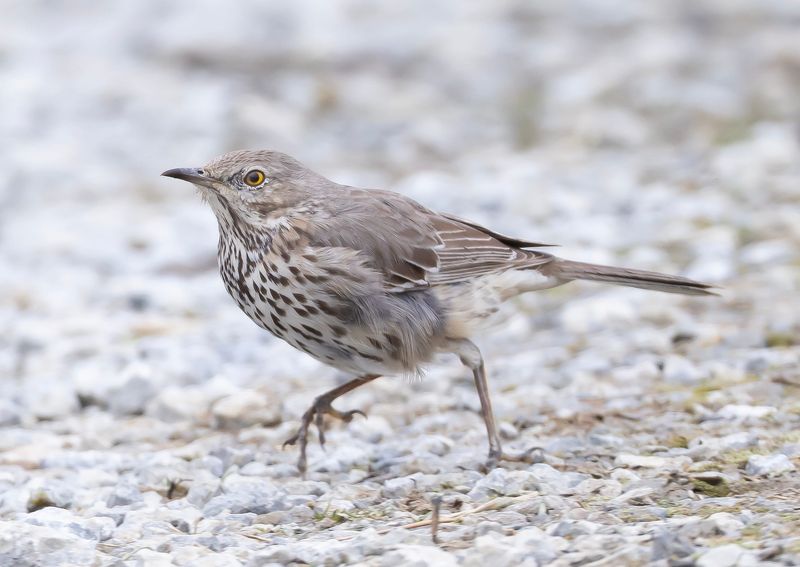
Sunday, March 15, was a momentous day for James Yoder. He and his family were taking an afternoon stroll on their rural Coshocton County property when an odd-looking bird alit atop a fence post.
Yoder’s first thought was that it was a northern mockingbird – a common species in much of Ohio – but in the next moment, he knew that identification was wrong. He whipped out his binoculars, got a good look at the feathered mystery and had the shock of his birding life.

It was a sage thrasher! Yoder recognized the bird from his previous experiences in Colorado, where he had seen this species. He had serendipitously discovered a first state record for Ohio, and a bird sure to stir masses of birders into action.
Yoder wasted no time getting word out to the birding community via Su Snyder, a local bird expert. By day’s end, many binocular-toters had made their way to the scene. Fortunately, the wayward thrasher remained on site, and hundreds of birders visited over the following days.
I visited on March 18, by which time the bird had settled into a routine. The Yoders set out a guest book and around 500 people had checked in by the time of my visit. The sage thrasher was still present as of this writing (March 22) and hundreds of others have paid homage to the thrasher to date.
Yoder offered meal worms to the thrasher, which assured that the bird would frequent the feeding station. That made it easier for birders to view it without disturbance.
When Shauna and I arrived, Yoder informed us that the bird had just departed, but he promised that it’d soon be back. Sure enough, after about 20 minutes, the thrasher reappeared and began gorging on the worms. So did a comparatively bulky male American robin. The thrasher did not care for this interloper and repeatedly drove it away.
Get to know the thrasher
The sage thrasher is well-named, nesting in western sagebrush country. It breeds across much of the western U.S., with the core population in Colorado, Nevada, Utah, and Wyoming.
Why would a bird of western sagebrush habitats be in Ohio? Who knows, but some speculate that recent strong westerly winds may have blown it eastward. Maybe so, but it was the only sage thrasher to blow into the eastern U.S. this winter.
But this is not the first sage thrasher to appear in the east. In years past, Indiana has had a record, and several birds have appeared in Michigan. There are several dozen other records from east of the Mississippi, all the way to the Atlantic coast.
Ornithological prognosticators have long speculated that a sage thrasher would someday appear in Ohio. Even so, its appearance in Ohio was a huge treat for the state’s birders.
There are 15 species of thrashers, but only one, the brown thrasher, is normally found in Ohio. It breeds statewide and is one of the largest thrasher species. The sage thrasher is the smallest species of thrasher.
While subjective, one might argue that the sage thrasher might be the least distinguished of its group in the aesthetics department. What it might lack in showiness is compensated for in song.
Male sage thrashers deliver a long complicated lyrical masterpiece interspersed with imitative sampling of other birds’ songs. One of these arias might go on for several minutes.
Unfortunately, no one has heard the Ohio bird sing, and it may be a female. The sexes look essentially alike and probably cannot be reliably separated in the field. Unless it sings, which only males are known to do.
The sage thrasher is not the only western vagrant in the Coshocton/Holmes County region right now. Joseph Miller has been hosting a lark bunting at his home in Holmes County, and a western meadowlark is also present nearby.
Yoder and Joseph Miller are Amish, and the region is home to the largest Amish population in the world. Many Amish are birders and darn good ones.
Robert Hershberger discovered a rock wren at his place of business near Mt. Hope in 2014. This was one of only four Ohio records. Hershberger runs Time & Optics, the largest optics dealer in the state, and it’s the place to get binoculars and scopes.
Birders often wonder why a disproportionate number of rare birds appear in the Holmes County region. Amish land use practices are a big factor − their agriculture is far more eco-friendly than the industrial agriculture that dominates much of Ohio.
But the biggest reason, in my opinion, is the large concentration of highly skilled birders that spend large amounts of time in the field.
The sage thrasher was bird species No. 456 for Ohio. It wouldn’t surprise me if No. 457 also comes from Amish country. Thanks to James Yoder for finding the thrasher, and his generosity in allowing interested parties to visit.
Naturalist Jim McCormac writes a column for The Dispatch on the first and third Sundays of the month. He also writes about nature at jimmccormac.blogspot.com.
This article originally appeared on The Columbus Dispatch: What bird never before seen in Ohio was spotted in Coshocton County?
Reporting by Jim McCormac, Special to The Columbus Dispatch / The Columbus Dispatch
USA TODAY Network via Reuters Connect