I asked Random.org for a date to see what history a single day’s newspaper had to offer. It gave me July 30, 1932.
The Cincinnati Enquirer’s Saturday edition ran 20 pages and cost 3 cents. A year’s subscription was $15.

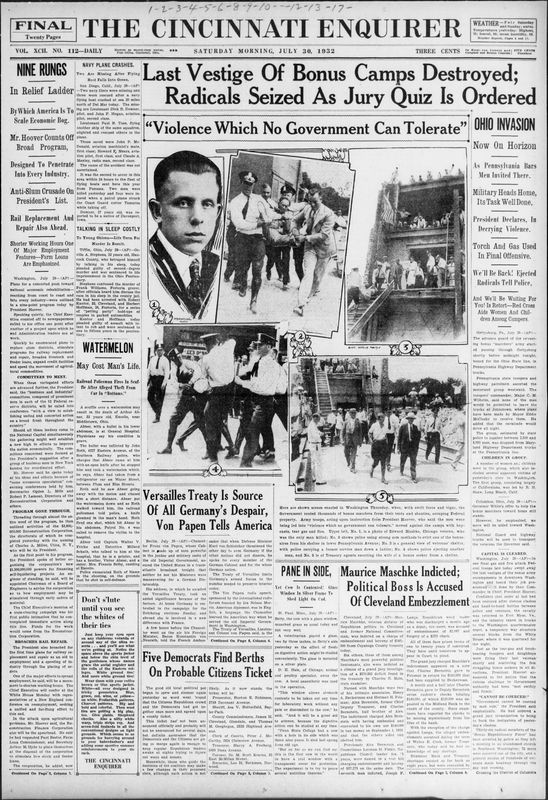
The top story – one of 10 on the front page – concerned the Bonus Expeditionary Forces, a crowd of 17,000 jobless World War I veterans and their families (43,000 in all) that marched into Washington, D.C., and set up camp there to demand early payout of bonuses from their war service.
The veterans needed cash badly during the Great Depression, but the bonuses weren’t due until 1945.
“Government cannot be coerced by mob rule,” President Herbert Hoover said.
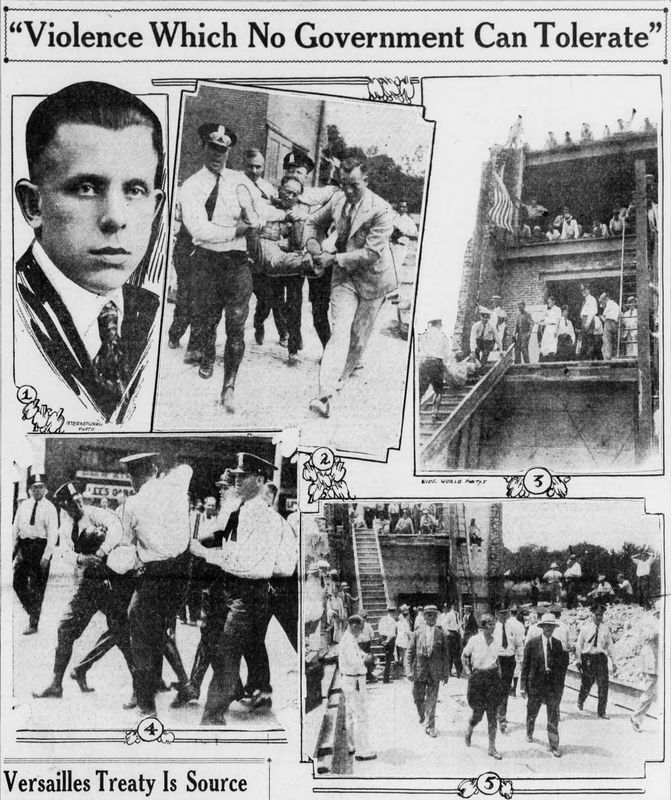
On July 28, Washington police and army troops, under orders from Hoover, rousted thousands of bonus marchers from the camp. The troops wielded bayonets, tear gas and torches, and set fire to the tents and shanties. Two veterans were wounded and later died.
Five dramatic photographs accompanied the story. Action shots were a rarity in the 1930s.
The Enquirer reported newspapers around the country supported the president’s decision. But for another perspective, the Cincinnati Post’s headline read: “Ruthless use of troops to evict vets is roundly scored by public leaders.”
It was a rough period. That day, Hoover also unveiled his nine-part program to rehabilitate the economy during the Depression, as reported on Page 1. Critics asked why it took Hoover two years to come up with a plan.
Hoover’s actions and inaction contributed to him losing the presidential election that November to Franklin D. Roosevelt.
Germany’s despair a sign of things to come
The Associated Press reported from Berlin that Chancellor Franz von Papen of Germany spoke to America in a transatlantic broadcast, assuring he was not maneuvering for a dictatorship. He blamed the harsh conditions of the Treaty of Versailles, which ended World War I, for Germany’s despair and economic crisis.
You can already see the conditions that would allow Adolf Hitler and the Nazi Party to rise to power a few months later.
Top local story: Man shot trying to steal watermelon
Another Depression-era story. Arthur Abner, 32, a printer from Excello, near Middletown, was shot by Southern Railway police officer John Roth after Abner took a watermelon from a refrigerated car parked at Water Street, between Plum and Elm in downtown Cincinnati.
Roth told police “a knife gleamed in the man’s hand,” so he fired a shot, hitting Abner in the abdomen. Police exonerated Roth on grounds of self-defense.
Favorite story: Cow with a window in its stomach
The Associated Press in St. Paul, Minnesota, reported on Betty, a cow with a window in her stomach. A veterinarian placed a glass window, 2 by 3 inches, mounted on a silver plate, into the side of the cow so that scientists could observe her digestion.
“This window allows stomach contents to be taken out any time for laboratory work without any pain or discomfort to the cow,” said D.R. Hale, animal and poultry specialist. “And it will be a great aid to science, because the digestive action can be studied at any time.”
Other cows had portholes fitted into their stomachs, but it was believed Betty was the first cow in the world to have a real window with a transparent cover for protection.
The story says the cow “munched grass as usual today and felt very well.”
In other news …
Hundreds of opera lovers were turned away because of a full house at the Cincinnati Opera performance of Mozart’s “The Magic Flute” at the Cincinnati Zoo. The zoo was the home venue of the opera company from 1920 to 1971, as the singers competed with the growls and hoots of the animals. Gibbon Island replaced the Zoo Opera Pavilion in 1974.
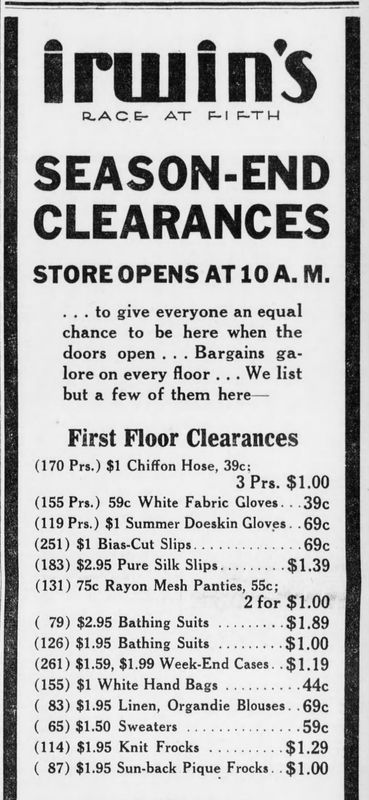
An ad for Irwin’s, a forgotten Cincinnati department store at Fifth and Race streets, had a season-end clearance on coats, frocks and gloves. (A $79.50 fur-trimmed coat for just $18!) Irwin’s, founded by Louis B. Irwin in 1911, merged with Kline’s in 1933.
And a headline you’d only ever see in the 1930s: “Gang bullets snuff out three brothers, long czars of Pittsburgh underworld; fourth, last of clan, is in jail at time.”
This article originally appeared on Cincinnati Enquirer: Watermelon thief, cow with stomach window stole headlines in July 1932
Reporting by Jeff Suess, Cincinnati Enquirer / Cincinnati Enquirer
USA TODAY Network via Reuters Connect
By Jeff Suess, Cincinnati Enquirer | USA TODAY Network