BETHLEHEM TWP. − The soybeans used to make soy milk and tofu can now be used to make firefighting foam that can extinguish a fire threatening your neighborhood.
And several fire departments in Stark and Tuscarawas counties are considering buying SoyFoam.

Its inventor says the product comes without the high cancer risks of “forever chemicals” known as PFAS or per- and polyfluoroakyl substances in traditional firefighting foams.
The chemicals are believed to threaten the health of firefighters and others at fire scenes and accidents, and they can contaminate drinking water or a structure where they’re used.
The Ohio Soybean Council and Erie Valley Fire and Rescue, which covers the township and Navarre, held a demonstration of SoyFoam Sept. 30 at Cedar Crest Farm, a farm off Shepler Church Avenue SW that grows corn, hay and soybeans.
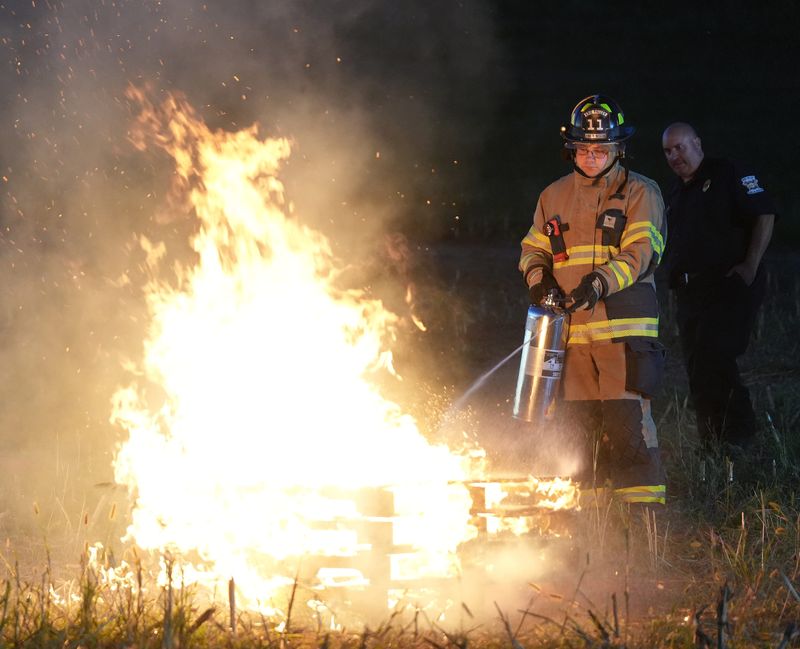
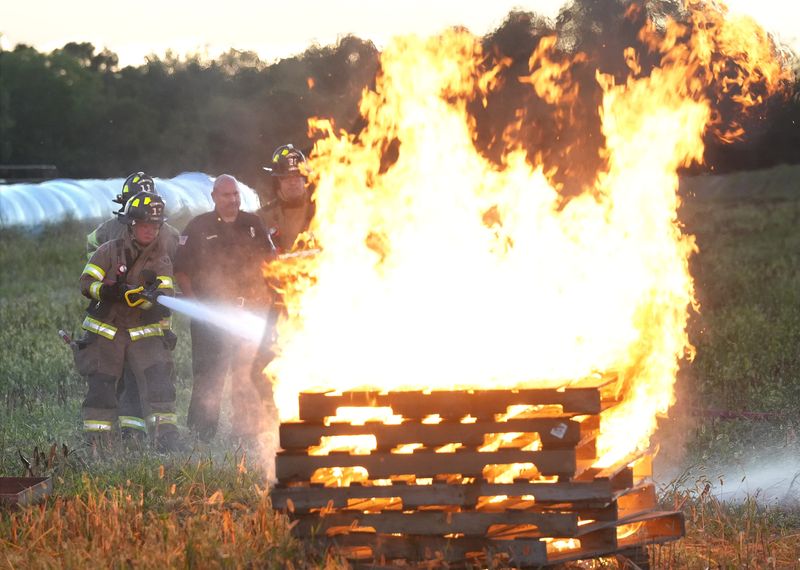
In a harvested corn field, Erie Valley firefighters in their gear deployed a foam made by Georgia-based Cross Plains Solutions from soybeans that was mixed with water.
In three of four demonstration fires where wooden pallets or diesel fuel were set ablaze, the firefighters applied the foam-water mix with a hose. In a fourth demonstration, a firefighter used a handheld extinguisher with the foam-water mix.
In all of the demonstrations, the foam and water mix extinguished the fires within a few seconds.
Why SoyFoam for firefighting?
Erie Valley Fire Capt. Ryan Shanower said his department is considering buying the soybean foam product. Based on the department’s review, SoyFoam appears to be safer to use and safer for the environment than foams the department has used in the past. And it appears to be just as effective in putting out fires as traditional foam, he said.
“The benefits of it far outweigh the use of traditional foam,” Shanower said.
He said firefighters from Jackson Township, Brewster, Strasburg and Bolivar also attended the demonstration.
Firefighting foam works by breaking the surface tension of water, allowing water to more effectively extinguish a fire. The result is less water needed to put out a blaze.
Shanower said chemical foams worked well at putting out fires as well as around leaking vehicles in danger of bursting into flames.
But, “now we have firefighters dying from cancer who use (chemical firefighting foam) so much,” he said. “The problem was it was the best stuff on the market.”
What is SoyFoam?
Chemist David Garlie of Eau Claire, Wisconsin, said it took him about 12 years to develop SoyFoam. He was on hand at the demonstration to answer questions.
He said a friend who was a firefighter challenged him to develop a foam without the cancer risks. Garlie said he started experimenting in 2012. He immediately looked at soybeans but they become rancid when exposed to water.
Garlie said he stepped up his efforts around 2022 to find a foam with a shelf life of 10 years that would be biodegradable. He worked with the fire safety program at Chippewa Technical College, which tested his foam. He said by May 2024, he had a product ready to sell. Working with a partner who had a plant in Dalton, Georgia, they got a trademark for SoyFoam.
Garlie said in the past 17 months, they’ve sold it to about 150 fire departments in Virginia, Kentucky, Missouri, Iowa, Wisconsin, Minnesota, North Dakota and South Dakota. He is eager to break into the Ohio market.
The plant in Georgia, which started with a capacity of 5,000 gallons a day, is now making 22,000 gallons a day. He said his product costs $179 for a five-gallon bucket, less than the $240 to $400 for traditional firefighting foams.
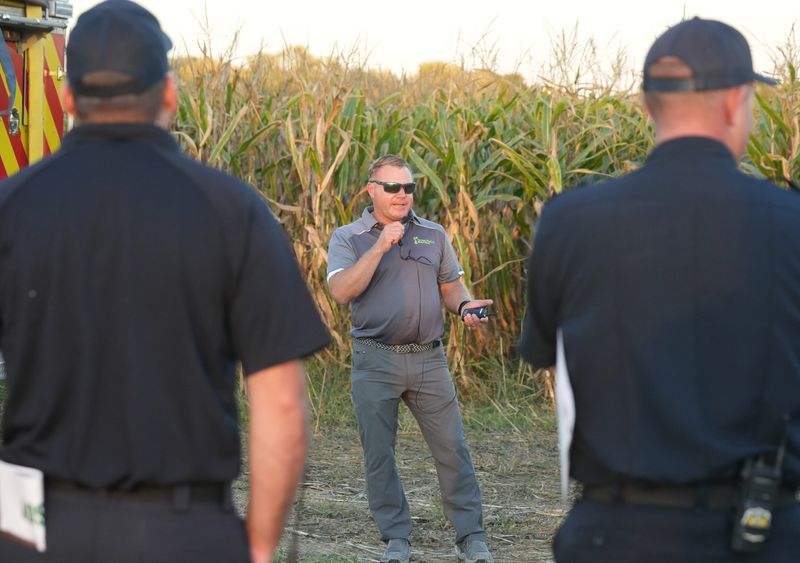
Chuck Stiver of Next Gen Bio Solutions in Medina County has agreed to become a distributor of SoyFoam in Northeast Ohio if it takes off here. He narrated during the demonstration and explained that the foam and water mixed at a ratio of about 1-to-99 for a standard fire where wood was burning.
After the Erie Valley firefighters sprayed a blanket of foam over a pallet that had been ablaze, Garlie dipped his hands into the white foam and held them up to show the crowd. He then allowed people to touch the foam on his hands.
Cathy Habrun’s family has owned Cedar Crest Farm for three generations. As a hospital nurse, she once met a firefighter who blamed his cancer on exposure to traditional firefighting foam.
About two months ago, she was reading an article in a publication by the Ohio Soybean Council about SoyFoam. She contacted Cross Plains Solution and invited the company to hold a demonstration on her family’s farm.
Habrun’s daughter Laura Eckinger, who helps run the farm, was excited about the increased demand for soybeans that would result if a soybean firefighting foam became a popular product.
You can reach Robert at robert.wang@cantonrep.com.
This article originally appeared on The Repository: Using soybeans to fight fires? Area agencies eyeing switch to new SoyFoam
Reporting by Robert Wang, Canton Repository / The Repository
USA TODAY Network via Reuters Connect