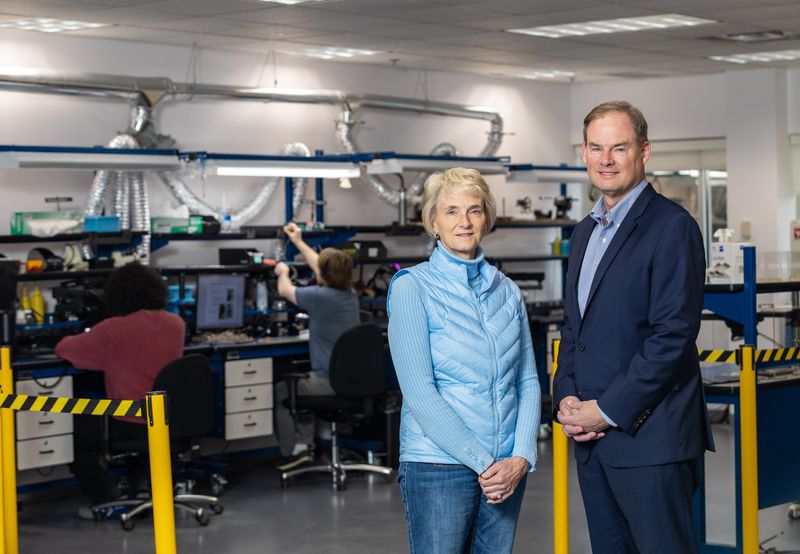
Michael Swartz likes to say his family-owned company began as a basement startup only because it’s too cold in Columbus to run a business in a garage.

In that basement in Minerva Park, John Swartz, a professor of electrical engineering at Ohio State University who studied semiconductor physics, began making devices that could work as cryogenic temperature sensors. His brother, David Swartz, sold the products from his home outside Buffalo, New York. It was 1968, and the venture often required John Swartz to rent time on a PDP-11 computer at Ohio State at 2 or 3 a.m.
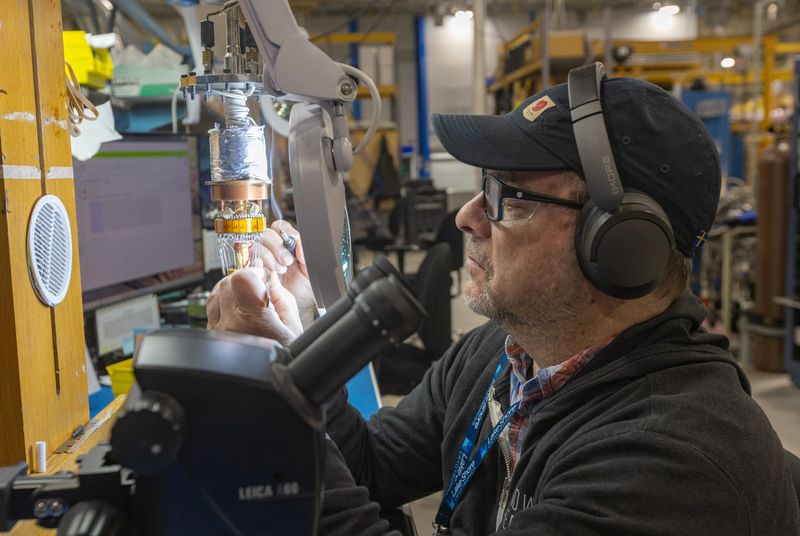
Those were the origins of what would become Lake Shore Cryotronics Inc., which is approaching 60 years providing scientists and engineers with physics and materials science tools and systems. Lake Shore offers cryogenics, magnetics and other solutions that support cutting-edge research, groundbreaking discoveries and scientific advances around the world, with a focus on electronics, clean energy, nanotechnology and more.
John Swartz’s children started working for the company when they were in high school. Michael Swartz began working full time for Lake Shore in 1986 and became president and CEO in 2003. Karen (Swartz) Lint was appointed chief operating officer in 2003.
That family legacy has been the foundation of success for Lake Shore, a 12-time Top Workplaces winner, which has its corporate headquarters and a manufacturing facility in Westerville. It placed in the Midsize Organizations category for companies with 125 to 349 employees.
The company’s approach to workplace culture has long been based on the idea that by investing in its people, Lake Shore can advance science and technology for the betterment of humanity. Michael Swartz says his management and leadership strategy emphasizes employee autonomy, encouraging decision-making at all levels across the organization. No matter their position, employees gain a sense of purpose and feel encouraged to make sound decisions for the good of the organization and all co-workers. The idea that collaboration is vital to decision-making is at the heart of his leadership approach.
“I really value W. Edwards Deming’s management philosophy,” Swartz says. “One of the key points in his management philosophy is to drive out fear. That gives people the comfortability and the confidence to make decisions and go forward and get things done.”
Building a solid company culture also comes from making employees feel valued. Happy hours take place every few months, and during a January event, Swartz recognized employee accomplishments from the past year. For workers celebrating milestone service anniversaries, leaders gave gift cards and created a presentation that highlighted those employees, including photographs of them at company events.
Work-life balance is also important to company leaders. Because of the nature of their hands-on assembly jobs, most employees work on-site, but there is flexibility for remote work when needed. Lint says a number of employees choose to complete more hours on-site Monday through Thursday and work half days on Friday, or remotely if their duties allow.
Lake Shore employees also give back to the community, contributing their time to robotics and STEM program sponsorships, annual food drives, holiday giving trees and support for nonprofit organizations. Paid employee volunteer time is offered to support these efforts.
“I feel what makes our company culture so valuable is that it’s employee driven,” Lint says. “People want to do work that matters. It’s important to create an environment where people can grow and feel valued, and feel listened to, respected and trusted. When everyone connects to that shared purpose, great things can happen.”
Lake Shore didn’t get through 2025 without challenges. The uncertainty around tariffs became an obstacle from an operations standpoint, since about 50 percent of the company’s revenues are international. The uncertainty affected the top line, and paperwork for existing orders had to be redone when the tariffs kicked in. “We learned to roll with the punches,” Lint says.
The future, however, is bright. The company moved its Massachusetts manufacturing operations to Westerville, a shift Lint says will create more local jobs.
Lake Shore also nearly doubled the size of its manufacturing facility, and new product developments have the company poised for growth.
“We’re optimistic because some of our products are in important areas of the future,” Swartz says. “Historically we’ve sold a lot into research, but now we’re selling more in the industry, potentially in supporting fusion. There’s new technology making fusion more practical, and more startups in that area. That’s one area we’re investing in.”
Lake Shore supplies key components for dilution refrigerators, which are needed for quantum computing. That’s also a growth area, even though practical quantum computers might be a few years away from viability, Swartz says. Still, the company is getting ahead of the curve by supplying equipment for product developers—a future-focused decision that’s been the foundation for company growth since Swartz’s father began making devices in his basement.
“I think our employees get behind our mission because we’re developing products to advance science, and our mission statement is focused on supporting research that can improve humanity, both in science and industry,” Swartz says. “A lot of our employees get excited about that.”
About Lake Shore Cryotronics Inc.
lakeshore.com
Business: Cryogenic and magnetic instruments and sensors for scientific applications
Founded: 1968
President and CEO: Michael Swartz
Central Ohio locations: 2
Local employees: 209
2025 revenue: More than $50 million
Shannon Shelton Miller is a freelance writer.
This story is from the Top Workplaces 2026 section in the Spring 2026 issue of Columbus CEO. Subscribe now.
This article originally appeared on Columbus CEO: Top Workplaces 2026 Winner Lake Shore Cryotronics Invests in Innovation
Reporting by Shannon Shelton Miller, Columbus CEO / Columbus CEO
USA TODAY Network via Reuters Connect