It’s 6:30 p.m. on a Monday night in June, and Sweeney’s Walnut Street Tavern in Franklinton is already packed. But the crowd isn’t there to kick back after a long day. They’ve got pens in hand, paper laid out on the bar and are listening attentively, ready to compete. The goal is to come up with the funniest answers to prompts such as, “Take a common street sign and add something to make it rude.”

Welcome to Everybody’s a Comedian, a weekly event hosted by Travis Hoewischer.
Connect with the Columbus you don’t know. Subscribe to Columbus Monthly’s weekly Top Reads newsletter.
“It’s less of a show and it’s more an interactive joke writing night,” Hoewischer says. “Like Cards Against Humanity through a bar trivia format.”
You could call this event a microcosm of the local comedy scene right now: It’s in a venue you might not expect, it’s free to attend and it’s unique in its approach. The crowd is a mix of regulars and newcomers, some—like us—still trying to f igure out the game. And, contrary to many assumptions about the world of comedy, it’s a supportive space to do so.
Even as Hoewischer roasts some of the anonymous answers as he reads them aloud, there’s a certain motivation that comes with less-than-stellar responses. Those he deems the worst in the round are invited to own their failings by identifying themselves and taking a shot of Malört, which undoubtedly helps wouldbe comedians whet their creative whistles for the next round.
If you want to take the game further and use the jokes you walk away with as the start for a larger set at an open mic, you’ve got plenty of options in town. Do you want to be a comedian? Do you want to see more comedy? Take a class in the fine art of funny?
In Columbus, it’s a good time to do these things.
Sketching out the Columbus Comedy Scene
Options abound in local comedy right now, so much so that the first question you might ask is not, “What time is the show?” but instead is, “What type of show do I want to see?”
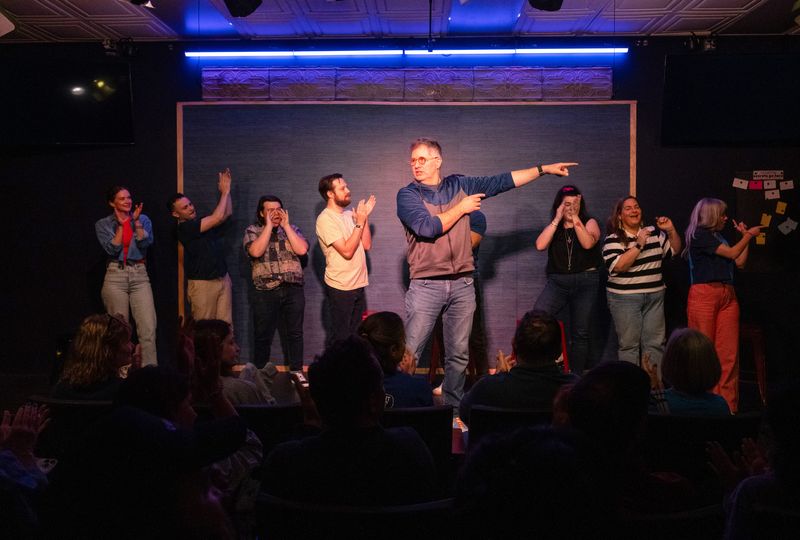
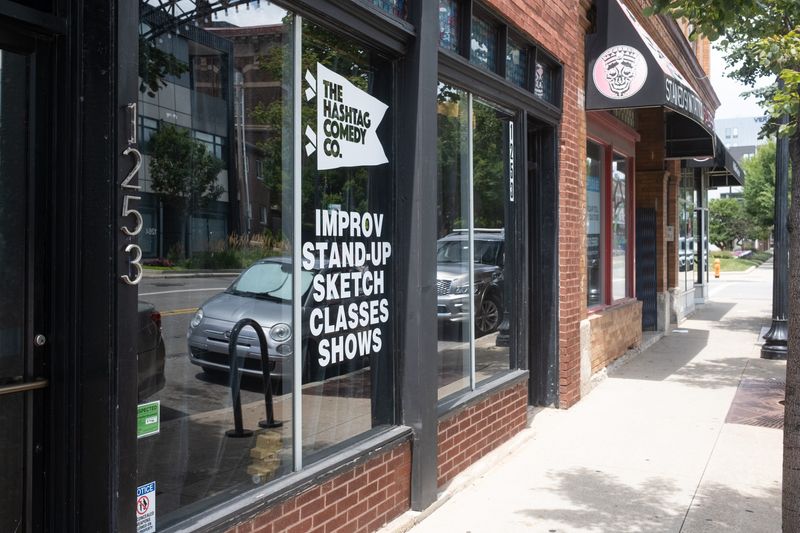
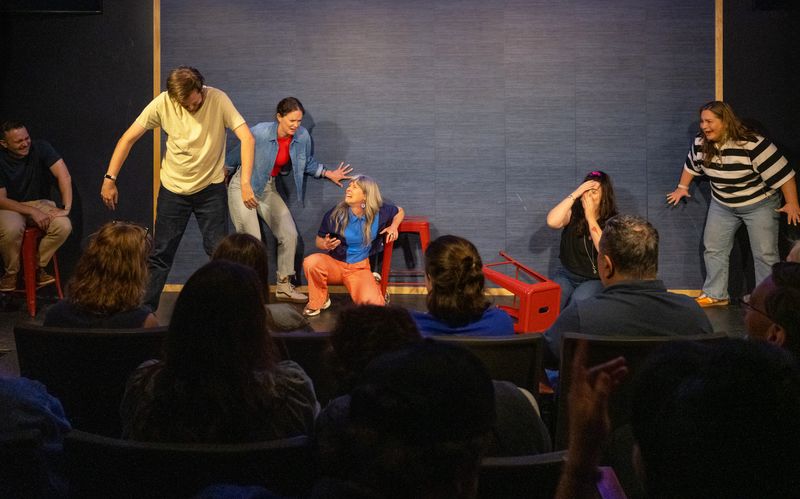
Is it improv? Check out the Nest Theatre or the Hashtag Comedy Co.
Sketch? Shadowbox Live might be the spot for you.
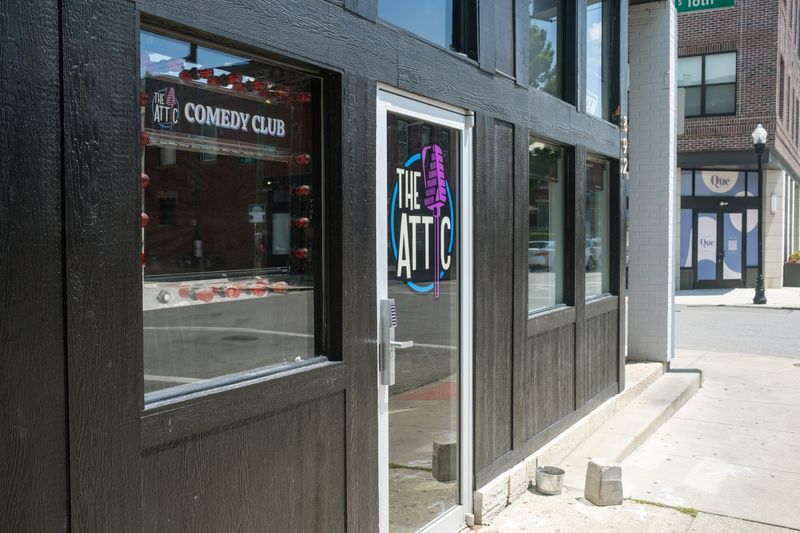
Seeking standup? Consider heading to The Attic Comedy Club in Olde Towne East, or spend a few minutes searching to find open mics all over town at spots like The Spacebar. Or, take a chance on one of the Don’t Tell Comedy shows, which pop up in unusual venues across town, revealed only on the day of the performance.
There are the subgenres to consider as well. Do you prefer long or short form improv—or perhaps an improvised musical? Are you looking for local talent behind the stand-up mic, a national name or the next big thing?
Search a little bit, and you’ll find options for crowd work, talk-show style and character-based performances. And if you don’t want to leave your house, you can catch local comics via podcast and on Instagram.
All told, Hannah Romich, the co-owner at Hashtag, who performs under the stage name Hannah Romes, estimates there are 500 to 600 people who do comedy in Columbus.
“There’s great open mics happening almost every night of the week in Columbus,” says Barack Lesnar, co-manager and co-booker at The Attic. In many other cities, those open mics might have a small crowd—perhaps consisting mainly of other performers—but here, he says, comics are “able to develop in front of hungry audiences that are prime for comedy.”
Lesnar compares the comedy scene now with the city’s longstanding reputation as a test market for food, fashion and technology. “I think if you can build a name, if you can build the brand and you can build your comedy here in Columbus, I think it really travels across the country.”
The annual Columbus Comedy Festival, which will be held for the third time this year Aug. 27-30, celebrates the growth and significance of the local scene. Organized by Columbus Underground, the event unites venues from MadLab to the Columbus Funny Bone and the Southern Theatre in collaborating to showcase local and national talent.
Nickey Winkelman, who regularly hosts at the Funny Bone and has been performing in Columbus for 20 years, says the collaboration among venues for the festival “is really rare and cool to see.” She counts the local scene today as being among the best in the country.
“When I started in 2006, there were a handful of open mics. Now you can get on stage multiple times a night every night of the week. We have more women in the comedy scene than ever before, and tons of opportunities for people to create and produce their own shows,” she says.
Romich says Don’t Tell Comedy, a national brand, has bolstered the visibility of the local scene. “People have seen some of their favorite comedians who are based in LA have a Don’t Tell special,” she says, explaining that when they discover there are Don’t Tell shows in Columbus, they’re eager to attend. And once there, they have a chance to see local talent alongside up-and-coming regional and national acts.
“If you come to a Don’t Tell show, you’re going to see some of the best people in the country that are like in the middle class, maybe about to pop. They open for the names that you’re familiar with. And, you know, they’re kind of the next up,” says Peter Ostapowicz, Midwest regional producer for Don’t Tell Comedy. “Kam Patterson, who’s currently on Saturday Night Live, was doing our [Columbus Don’t Tell] shows before he even moved to Austin, which is how we’ve kind of popped,” he says.
Ostapowicz says Columbus is “one of the stronger Don’t Tell Comedy cities,” hosting close to 150 shows annually and over 200 in 2024.
Lesnar says the city has strong comedy clubs, and he describes a virtuous cycle “It brings big name comedians to the scene. It allows opportunities for those local comedians to get on stage with big names, which allows them to be introduced to local comedy fans. It allows local comedy fans to be introduced to them. But there’s also a lot of independent comedy production that happens in the city,” he says.
How and Where Do Local Comedians Get Started?
The Nest Theatre in Old North Columbus is both a performance space and a training ground for emerging talent. If you’re interested in improv, or you want to get some experience before jumping into an open mic or see some of those independent productions Lesnar refers to, it’s a good place to start.
Founded in 2016 by married couple Tara DeFrancisco and Rance Rizzutto, the Nest offers a four-level core curriculum of improv classes.
“And then after that, we have a bunch of what we call ‘bliss paths,’ ” Rizzutto says. “Once you learn that stuff, we also teach you how to do stand-up or teach you how to do sketch comedy or writing for late night TV, among tons of other things that we have.”
Many of the performers you can see now on local stages got started at the Nest, Lesnar included, who says he “took all their classes” in 2018. Hashtag also has offered classes for a decade, with the brick-and-mortar Short North area club opening in 2023.
And of course, open mics offer many opportunities to get started. While bigger venues like the Funny Bone can fill up quickly, they’re also an important pipeline. The Attic’s website notes that comics who stand out at the weekly Wednesday open mic are considered for paid spots elsewhere in the schedule. But you don’t have to be at a designated comedy club to see comedy: Events are happening at The Spacebar, Café Bourbon Street, Sweeney’s and elsewhere.
As Winkelman notes, the city hasn’t always had the robust options it does today. Collaboration across clubs has helped to grow the scene. “There’s no expected exclusivity to one club where you’re not allowed to work at another,” she says. “Headliners can come in and be on both a club stage and a Don’t Tell show. Everyone wants a thriving scene because that benefits us all.”
More options generally also offer more opportunities for women and others who had difficulty breaking into the scene in the past. Comedian Amber Falter, who has been active in Columbus for over a decade, mentions the women-run weekly Brats open mic at Spacebar as a highlight. “I love that open mic because it’s something I didn’t have when I started. And if I had that when I started, I would have been a totally different person. It’s so inviting. It’s such a safe space,” she says.
A growing scene also means more chances for newcomers. Nef Johnson, Lesnar’s counterpart at The Attic, says prior to the COVID-19 pandemic, there were just a few people who determined your fate as a Columbus comedian. Some established comics “were sort of gatekeeping. And when COVID happened, it just made opportunities for comedy,” Johnson says. With clubs closed, people developed acts at home. When the city reopened, the landscape had changed.
“I went to dive bars, and I had [a] comedy residency at Skully’s, and another comedy residency at Natalie’s,” Johnson says.
That tension between established comics and newer faces is common in a young scene, Rizzutto says. “There’s a high probability that the people running the businesses feel a sense of competition and ‘us versus them,’ ” noting this was something he also witnessed in Portland and Chicago.
Lesnar says it’s an issue that hasn’t completely resolved. But the specialties of the various performance spaces help to differentiate the field. Comedians performing across venues can bring in new audiences as well, as can events like the Columbus Comedy Festival.
DeFrancisco offers an optimistic assessment of the growing landscape, comparing the comedy scene to a healthy music scene with multiple performance venues. After all, many options indicate a scene that’s thriving. “If you see a good concert, you don’t want to not see another concert. … So why would we not help each other out as much as we can?”
This story appeared in the September 2026 issue of Columbus Monthly. Subscribe here.
This article originally appeared on Columbus Monthly: The Mic Drops Here: The Columbus Comedy Scene Is On Fire
Reporting by Linda Lee Baird, Columbus Monthly / Columbus Monthly
USA TODAY Network via Reuters Connect
By Linda Lee Baird, Columbus Monthly | USA TODAY Network