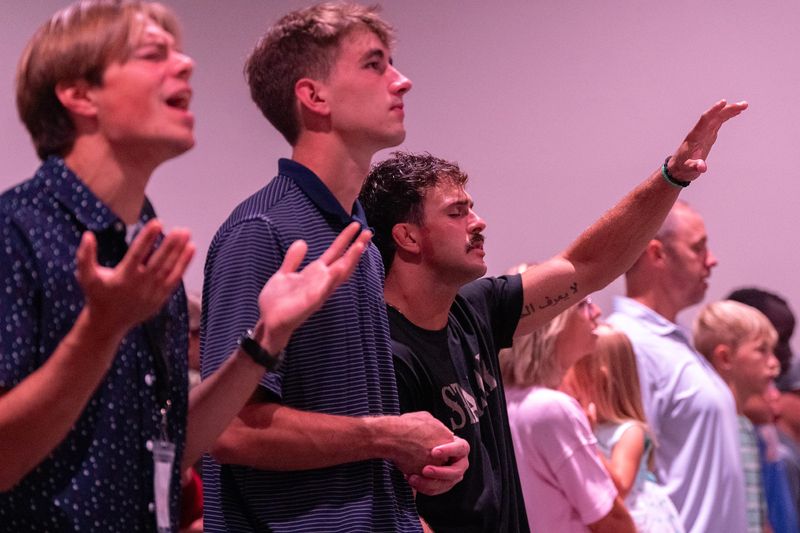
At Cornerstone Church on Ames’ eastern edge, worshippers arriving for services can spend 25 or 30 minutes waiting to turn off U.S. 30 onto the frontage road leading to the parking lot.
It’s a weekly reminder of the church’s growth, a 60% spike in attendance to about 4,000 adults since 2022, said Mark Vance, Cornerstone’s lead pastor.

“Every year, we’ve seen at least 10% year-over-year attendance growth,” he said.
That’s across all of 32-year-old Cornerstone’s sister churches, now totaling over 40 located in university cities in 28 states. They’re part of the Salt Network, started in 2016 to grow evangelical churches across the country. Cornerstone and the Salt Network spun out of an Iowa State University campus ministry started by Grand Avenue Baptist Church in Ames.
“We find that demographic, 18 to 25, is wildly open… to Christianity and the gospel,” Vance said, adding that many young members didn’t grow up inside a traditional church. “They’re curious, they’re asking questions,” looking to bring deeper meaning to their lives, he said.
It’s not just college towns that are bringing new members to the church.
“We see people driving to Cornerstone from 40, 50, 60 minutes away” as traditional churches close in rural Iowa, Vance said, adding that rural residents also are watching services online.
“You think of rural Iowa as having community churches… but many of them are dying,” Vance said. “They’re closing their doors in huge numbers because they can’t economically and functionally sustain” their operations.
With the loss of nearly 300 Iowa churches over the past decade, Cornerstone is putting together a plan to ”plant or replant churches” in rural Iowa. It’s hoping that other, growing congregations will join the effort.
With schools, businesses and civic organizations disappearing, “I think the loss of rural churches in Iowa will be profound,” Vance said, adding that churches often are the last “human threads” holding communities together.
They’re where communities celebrate events like holidays, marriages and births — or help each other through difficulties like deaths, job loss and financial struggles.
“It doesn’t just have eternal, soul-level, spiritual ramifications,” he said. “It has human-suffering ramifications for a community.”
And government’s ability to step in and help struggling Iowans is limited, Vance said. “We have to look at the problems in a community and say, ‘Those are our problems. Those are our people,’” he said.
Baptizing people in yard, pastor realizes home gathering is a new church
In northeast Iowa, Shane Rothlisberger had no intention of starting a new church.
In 2022, Rothlisberger, his wife and nine children had moved back to his hometown of West Union, population about 2,500, when his father became ill. After struggling to find a new church home, Rothlisberger’s family and a friend’s began gathering weekly to livestream Cornerstone’s service, discuss the week’s Bible teachings, sing hymns and share lunch.
“We were homesick and felt like we needed to hear from our pastors” at Cornerstone, said Rothlisberger, who was a pastor there for 12 years.
Through word-of-mouth, the gathering grew to 50 people within a few months, then 95. Rothlisberger said he was baptizing three people on his front lawn when he realized “it was time to call this what it is — a church planting.”
The new Acreage Church now has about 140 members, many of whom hadn’t been part of a church for a long time — or ever, said Rothlisberger, who has rejoined Cornerstone as a church planter. “We’re just a bunch of people, with a ton of baggage, who are in need of a lot of grace that Jesus provides in abundance,” he said.
They meet in a renovated room in a private events center and continue to watch Cornerstone’s Bible teachings online, sing and share a meal. Rothlisberger said the church likely will add a second service soon. “It’s just a beautiful, messy, organic thing that… is growing rapidly,” he said.
Growing church says new members hungry ‘for the truth’
Vance said the new West Union church is a “trial run” for planting rural churches.
“Our hope is that maybe over the next 10 to 20 years we can see more of those churches started and sustained,” he said. “The driver for us is we want people to have access to the good news of Jesus Christ.”
How can Cornerstone succeed in rural Iowa and other states where many churches are pulling back, struggling with a declining and aging population? Nearly 23% of rural Iowa’s population is 65 or older, compared with 16% in Iowa’s large urban areas.
Vance said many rural pastors are overwhelmed. As other churches have closed, they’ve become the “chaplain for the whole town,” he said. “They’re absorbing all the care needed in the community.”
And with older congregations, “they’re doing a huge number of funerals,” visiting people who are sick and providing counseling, Vance said. “It’s very hard to keep a talented pastor who can preach the Bible faithfully.”
Rothlisberger said working with Cornerstone, tapping into the weekly Bible teaching, can help lift the burden on rural pastors, giving them more time to work with church members.
Vance said he also see people coming to Cornerstone and other growing conservative churches because of their firm stance on what they believe the Bible teaches in a time of artificial intelligence, deepfakes and the spread of misinformation on social media.
”There’s a hunger for truth,” he said.
Donnelle Eller covers agriculture, the environment and energy for the Register. Reach her at deller@registermedia.com.
This article originally appeared on Des Moines Register: As some churches are closing, this one seeks ‘replanting’ across Iowa
Reporting by Donnelle Eller, Des Moines Register / Des Moines Register
USA TODAY Network via Reuters Connect
By Donnelle Eller, Des Moines Register | USA TODAY Network