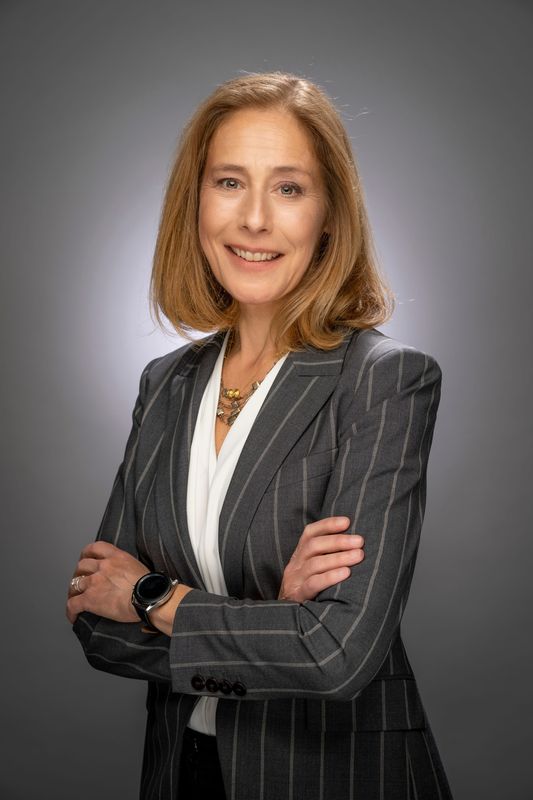
Vanderbilt University Provost C. Cybele Raver is set to be the next president of the University of Michigan, according to two sources familiar with the selection, making her the second woman in history to lead the school and marking the second time this year the university has chosen a leader at a private university to lead one of the top public schools in the nation.
Raver would become the second female president in Michigan’s history after Mary Sue Coleman, who led the university from 2002 to 2014 and as an interim president in 2022 after the Board of Regents fired President Mark Schlissel for having an inappropriate relationship with a subordinate. She is a nationally recognized leader in higher education, developmental social science and university strategy, according to her biography on Vanderbilt’s website.

Raver would replace Domenico Grasso, who was named president after Syracuse University Chancellor and prior President-elect Kent Syverud stepped down after being diagnosed with brain cancer.
University of Michigan’s timeline for Raver
The university officially announced Raver’s expected appointment at 10 a.m. Tuesday morning. The board is expected to hold a special meeting at 11 a.m. Sept. 1 to take a formal vote. If approved, her appointment would take effect Dec. 1.
Grasso will continue to lead the university through Nov. 30 and will work closely with Raver to ensure continuity in academic and research leadership through the transition, the university said in its announcement.
“It will be an honor to welcome Dr. Raver as the university’s next president,” Grasso said in the announcement. “Michigan is a remarkable institution, and I look forward to working with her in the weeks ahead to ensure a smooth and successful transition.”
Scheduling a special meeting a couple of weeks after a presidential announcement breaks with the university’s previous appointments, like that of Syverud and former President Santa Ono, where a special meeting was scheduled the day of the announcement.
Raver’s academic career
Raver began as Vanderbilt’s provost in July 2021 after serving as deputy provost at New York University, where she also served as the inaugural director of NYU’s Institute of Human Development and Social Change, according to a National Academy of Education biography.
As provost, she advanced several initiatives across Vanderbilt, including launching the College of Connected Computing, recruiting five new deans, strengthening research infrastructure and leading “Discovery Vanderbilt” that invested in resources that increased faculty, student and staff engagement and pursued new research, Vanderbilt said.
Also under her leadership, the university expanded to New York City and West Palm Beach, approved a new interdisciplinary science building and surpassed $1 billion in annual research expenditures, Vanderbilt said. The university is expected to have students at its satellite New York campus starting this fall.
Raver is a fellow of the American Association for the Advancement of Science and the Cornelius Vanderbilt Professor of Psychology and Human Development at Peabody College, Vanderbilt said. Her research on children’s development, education policy and poverty has garnered more than $24 million from the National Institutes of Health, National Science Foundation, MacArthur Foundation and Spencer Foundation.
As a researcher at New York University, Raver focused on improving early learning for children living in poverty. One such effort was a federally financed study of the short- and long-term effects of preschool intervention for Chicago’s low-income children, according to the National Academy of Education. Raver’s research resulted in “prestigious awards” from groups such as the American Psychological Association and the William T. Grant Foundation, according to the academy.
Prior to joining Vanderbilt and her time at NYU, she held faculty roles at the University of Chicago’s Harris School of Public Policy Studies and Cornell University’s Department of Human Development. She earned her Ph.D. in developmental psychology from Yale University.
Raver’s husband, Clarence “Clancy” Blair, died in 2024 at the age of 63 after being diagnosed with frontotemporal dementia and primary progressive aphasia, a language disorder. He was acknowledged as an influential developmental psychologist at Penn State University and New York University.
Vanderbilt has dealt with pro-Palestinian protests
Raver has been serving as part of the leadership team of Vanderbilt Chancellor Daniel Diermeier, whom the university has trumpeted as “a leading national voice in support of free expression, institutional neutrality and civil discourse on college campuses.”
Raver was part of an administration that dealt with a March 2024 pro-Palestinian sit-in at Vanderbilt that led to several student arrests and the suspension of 30 students, sparking controversy and backlash over free speech. Diermeier said the university later expelled some students and put others on long-term probation.
But the Anti-Defamation League ranked Vanderbilt among the top eight universities nationwide in effectively addressing antisemitism in 2025 — due, in part, to its actions following the 2024 sit-in.
In March 2025, the University of Michigan was among 60 higher education institutions sent a letter by an official in President Donald Trump’s U.S. Department of Education that warned them of “potential enforcement actions if they do not … protect Jewish students on campus.” Michigan and the other institutions were being investigated for potentially violating Title VI of the Civil Rights Act, prohibiting discrimination among institutions receiving federal funds on the basis of race, color, and national origin, including Jewish ancestry, federal officials said.
satwood@detroitnews.com
This article originally appeared on The Detroit News: University of Michigan chooses second woman in its history as next president
Reporting by Sarah Atwood, The Detroit News / The Detroit News
USA TODAY Network via Reuters Connect
By Sarah Atwood, The Detroit News | USA TODAY Network