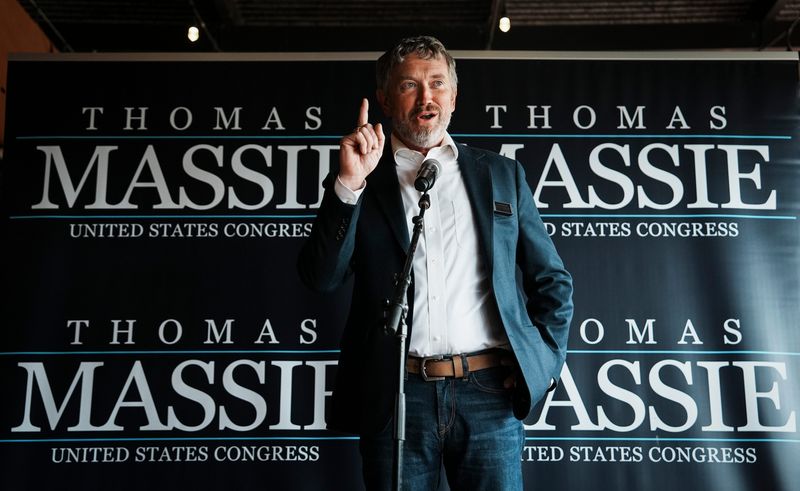
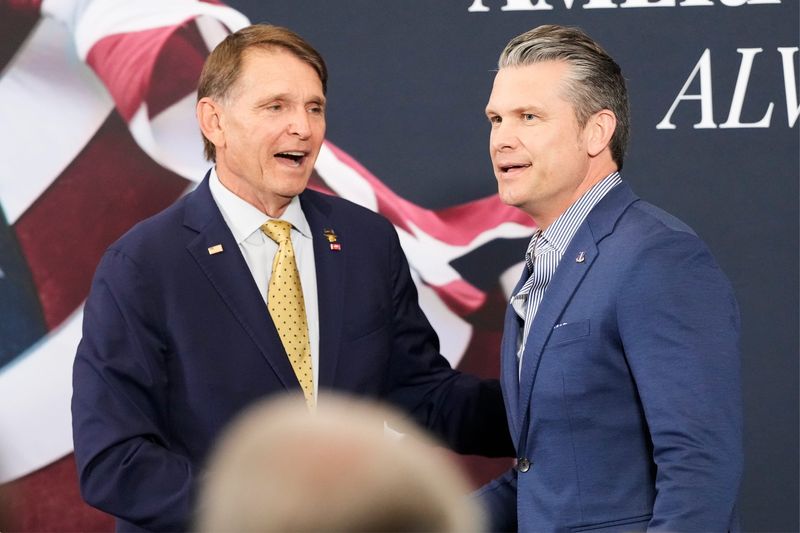
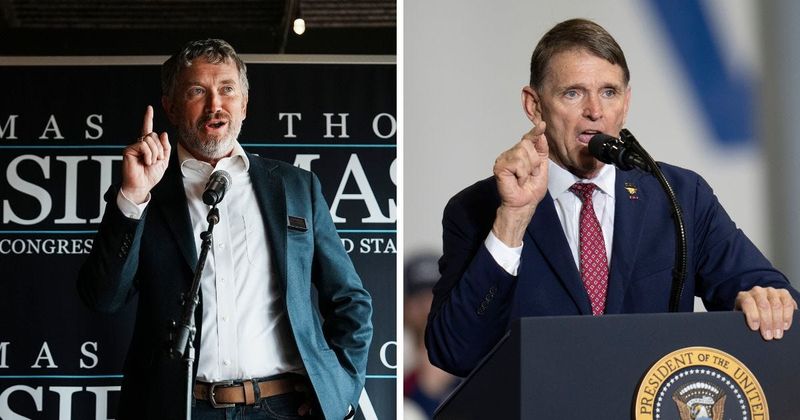
There was something almost comical about watching Trump-backed Republican Ed Gallrein attempt to weaponize a “hush money” allegation against incumbent U.S. Rep. Thomas Massie in Kentucky’s Republican primary.
Not because the allegation itself was funny. It wasn’t.

But because the candidate backing the attack − and the president endorsing him − comes from a political movement that long ago decided morality is negotiable so long as the policy outcomes are favorable.
That’s what made the irony so rich.
Gallrein threw this political grenade just days before one of the nation’s most closely watched primary elections, accusing Massie of offering a former girlfriend $5,000 cash to “just walk away” from Washington, D.C. It was clearly designed to inflict maximum damage at the most vulnerable time.
And maybe it will.
Negative campaigning still works in America. Even weak scandals can matter when dropped at the right moment.
But let’s not pretend this race is really about morality. Not in modern politics.
The death of political shame
There was a time in America when scandals could end political careers almost overnight. Public shame mattered. Party leaders cared about appearances. Politicians who embarrassed their side were pressured to resign for the greater good.
That era feels ancient now.
Today’s politicians don’t retreat from controversy. They survive it. Endure it. Outlast it.
Or, in many cases, ignore it altogether.
Mack Mariani, a political science professor at Xavier University and former Enquirer contributor, believes part of the shift traces back to Democratic President Bill Clinton and the Monica Lewinsky scandal.
“Part of it is politicians used to have a little bit of shame,” Mariani told me. “But Clinton called everyone’s bluff and realized there was a template for these sorts of things: You just kind of need to outlast it.”
That template has since been refined and perfected in the Trump era.
Donald Trump has survived two impeachments, 34 felony convictions, multiple allegations of misconduct, the Jan. 6 Capitol attack, multiple failed marriages and a hush-money case involving a porn star. Yet he remains the dominant figure in Republican politics and possibly the most powerful political figure in America.
At this point, political survival is no longer about innocence. It’s about endurance.
To be fair, Massie has acknowledged giving his former girlfriend, Cynthia West, somewhere between $5,000 and $10,000 during their relationship, though he has denied it was for anything nefarious. Voters will ultimately decide what they believe and what they are willing to overlook.
Mariani suggested some voters may be less bothered by allegations of hush money or bizarre bedroom behavior than by the perception that Massie moved on to another woman too quickly after the death of his wife. In today’s politics, personal morality often becomes less about objective standards and more about which behaviors voters personally find forgivable.
Policy over principle
Mariani made another point that I think gets to the heart of America’s political dysfunction: Morality matters less than policy.
Especially in partisan elections.
“A Democrat will always go for the flawed Democrat over the perfect Republican, and vice versa,” Mariani said. “Once you put your partisan lenses on, morality is irrelevant.”
That’s harsh. But it’s also hard to argue with.
We’ve become a country where many voters openly admit they’re willing to tolerate dishonesty, corruption, cruelty, or personal misconduct so long as the candidate delivers on the issues they care about.
Conservative commentator Ann Coulter recently publicly called Trump the “most corrupt president in U.S. history,” yet still supported him because of his immigration policies and border wall agenda.
Think about that for a moment.
The argument wasn’t that Trump was moral. Or decent. Or honest.
The argument was essentially: “Yes, he’s corrupt. But he’s my corrupt guy.”
And honestly, that mentality exists on both sides of the aisle.
Many voters no longer evaluate politicians as moral leaders. They evaluate them as political weapons. That shift has poisoned our civic culture.
Tribalism protects bad behavior
One of the great flaws in modern American politics is that voters often refuse to hold “their side” accountable. Bad politicians survive because tribalism protects them.
Parties excuse the behavior of their own candidates that they would loudly condemn in opponents. Voters notice the hypocrisy, grow cynical and eventually stop believing any outrage is sincere.
Mariani said many voters now see morality attacks as little more than strategic power plays.
“You don’t really care about Massie’s morality,” Mariani said of how skeptical voters may interpret Gallrein’s attack. “You just want power. You want the seat. This is not really about morality.”
That cynicism becomes self-reinforcing.
If voters conclude all politicians are fundamentally unethical anyway, many decide they’d rather elect the unethical candidate who supports their policies.
“There’s a certain rationality to it,” Mariani said. “As a voter, you kind of tune it out because nobody really believes the sincerity of any of it.”
And that may be the saddest part of all.
What Tuesday night may really tell us
The irony in the Massie-Gallrein race isn’t simply the hush-money allegation itself. It’s that the attack is being launched in a political movement led by a man who normalized surviving scandals through defiance, denial and sheer political force.
Trump didn’t invent hypocrisy in politics. But he fundamentally changed how politicians respond to it. The old formula was apology, shame and resignation. The new formula is deny, attack, survive and wait for the outrage cycle to move on.
And usually it works. Maybe that’s why so many Americans have stopped expecting morality from politicians in the first place.
Still, I’d like to believe character matters. I’d like to believe decency still matters. I’d like to believe voters are capable of demanding both sound policy and ethical leadership from the people asking to govern them. Because when voters stop caring about character entirely, politicians eventually come to believe they can get away with anything.
History suggests many of them are right.
We’ll find out Tuesday night whether morality still has any measurable political value left at all.
Opinion and Engagement Editor Kevin S. Aldridge can be reached at kaldridge@enquirer.com. On X: @kevaldrid.
This article originally appeared on Cincinnati Enquirer: The Massie-Gallrein race isn’t really about morality | Opinion
Reporting by Kevin S. Aldridge, Cincinnati Enquirer / Cincinnati Enquirer
USA TODAY Network via Reuters Connect