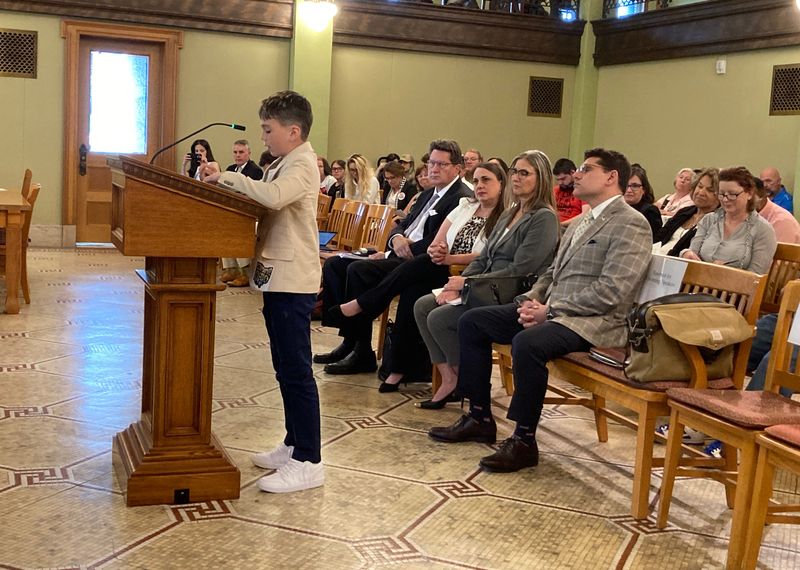
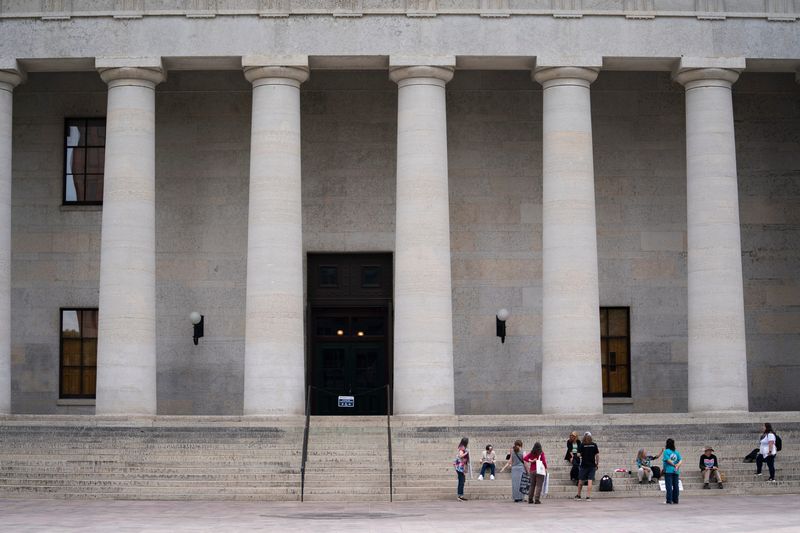
As data centers continue to pop up over the Buckeye State, Ohioans flooded an Ohio Statehouse committee room on June 1 to air their grievances as the pushback to the industry grows.
More than 35 residents signed up to speak, and another 70 submitted written testimony to a newly formed, bipartisan committee to study data centers and their economic, environmental, and security impacts on Ohio – from water and energy use to tax breaks and everything in between.

Residents shared their concerns with the Select Committee on Data Centers about water and energy usage, lack of regulations and transparency, the loss of rural land and more. Several speakers urged legislators to consider a statewide moratorium while data center impacts are fully studied.
Jessica Baker, one of the organizers behind the grassroots effort for a constitutional amendment that would ban large data centers, said the movement against data centers is made up of ordinary Ohioans printing petitions at home, using coupon codes to purchase banners, driving county-to-county on their own dime, and standing outside in every kind of Ohio weather to collect petition signatures because they care about the future of their communities.
Baker said the surprising part of the movement is that it is bringing different groups together: Republicans, Democrats, Libertarians, farmers, environmentalists and small business owners.
“People who normally would never agree on anything are suddenly working together because they started seeing the same things happening all over Ohio,” she said.
Samuel Menges, a 12-year-old from Lorain County in northeast Ohio, and his mother, Leslie, drove to Columbus after Samuel’s May 31 baseball game and stayed overnight to be at the noon hearing.
Menges said he didn’t even know what a data center was a year ago, but heard a neighboring farmer tell his dad about a hyperscale site that was planned just miles down the road from their home. Since then, Menges has spoken out against the 1,000-acre development at local government meetings and even met with a county commissioner.
“Data centers might not seem a problem now, especially to the companies that want to build them, but what happens 50 years from now when the natural waterways have dried up, millions of acres of farmland has been destroyed, and the communities have health problems from contaminated water or from other unforeseen problems?” he said.
Ohio has already lost 1 million acres of farmland, and Menges said he doesn’t want the state to lose any more as someone who wants to be a farmer when he grows up.
“If Ohio keeps allowing data centers to be built, the remaining 13.5 million [acres of farmland] will soon be gone,” he said. If farmland is destroyed, this creates a loss of food for the future generations.”
State Rep. Adam Holmes, R-Jefferson, co-chair of the committee, said during a break in testimony that the committee will take the concerns residents shared and ask Amazon, Meta, Google and Microsoft officials about them when they appear before the committee later this week.
Ohio has the sixth most data centers in the country – 232 throughout the state – with 137 of those in central Ohio, according to a list of all current and under-development listings provided by Data Center Map, a global data center directory. Some are small enough to fit inside office buildings. Meta’s New Albany data center, which the company is expanding, is built on 766 acres ‒ more than one square mile.
Data centers house servers that are the backbone of the artificial intelligence boom. But they have faced criticism about their drain on local resources, including the amount of power and water they require. Residents all over the state are pushing back against data center developments in their communities, and a growing number of local governments have enacted moratoriums to pause data center developments.
A grassroots group is collecting signatures for a constitutional amendment that would ban large data centers, although advocates face a long road to the ballot.
Last week, Gov. Mike DeWine paused a controversial tax break for data centers that cost nearly $1.6 billion last year.
June 1 was the second meeting for the Select Committee on Data Centers, which previously met May 27 to hear from the Ohio Environmental Protection Agency, Ohio Department of Natural Resources, Ohio Department of Development, the Public Utilities Commission of Ohio and the data center trade association Data Center Coalition.
The committee is set to meet again on June 4, when it will hear from representatives from tech giants including Amazon, Meta, Google Microsoft, that have invested billions in building and expanding data centers in Ohio. On June 8, local government officials, including representatives from the epicenter of central Ohio’s data center boom, New Albany, will speak before the committee.
Delaware County and eastern Columbus suburbs reporter Maria DeVito can be reached at mdevito@dispatch.com and @mariadevito13.dispatch.com on Bluesky and @MariaDeVito13 on X.
This article originally appeared on The Columbus Dispatch: Ohioans urge statewide moratorium as data center boom sparks pushback
Reporting by Maria DeVito, Columbus Dispatch / The Columbus Dispatch
USA TODAY Network via Reuters Connect