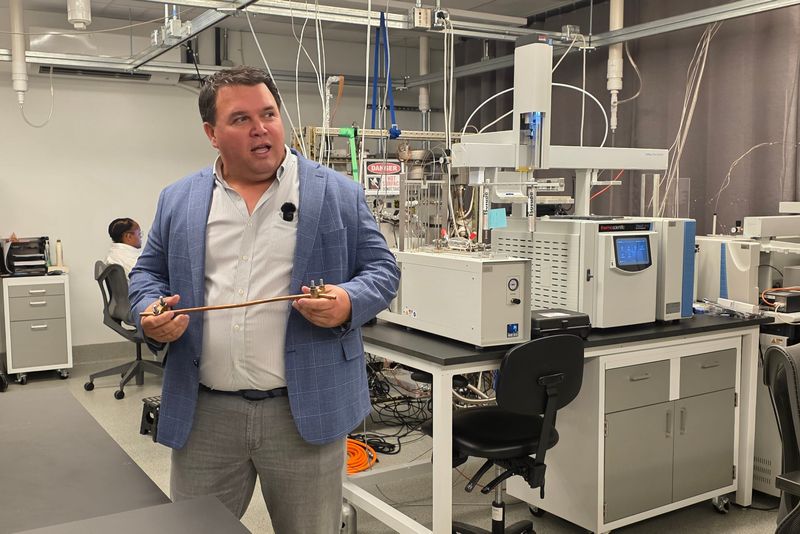
A company seeking to develop natural hydrogen exploration techniques has opened a new laboratory on the Ohio State University campus, aiming to enable large-scale production of a gas that can be used as a clean energy source.
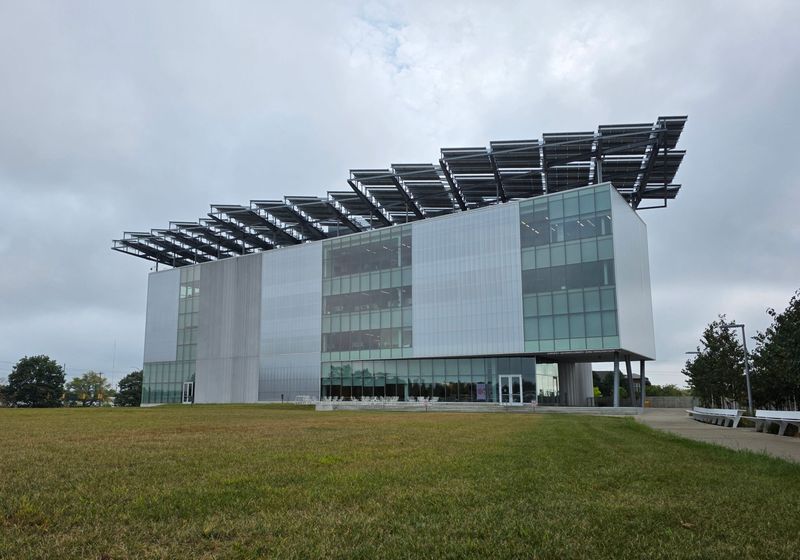
Koloma, housed in Ohio State’s Energy Advancement and Innovation Center, held its grand opening on Sept. 25 for the state-of-the-art laboratories that will help the company identify and work toward extracting underground hydrogen gas repositories, which could be used as a power source and in chemical and industrial applications.

Tom Darrah, Koloma’s chief technology officer, said that hydrogen as a resource has been overlooked for decades, and the company’s goal is to “explore for and commercialize” the gas and offer a clean fuel source for the future.
“The Earth did the work of making this resource for us, so us being successful at bringing that to market provides the greatest energy density to the lowest carbon footprint,” Darrah said. “And if we’re successful — the best economics you’re going to find for hydrogen.”
Hydrogen is used in industrial processes as a rocket fuel and in fuel cells for electricity, as well as producing ammonia for fertilizer, according to the U.S. Energy Information Administration. Hydrogen is also used to power some experimental and commercial vehicles.
Currently, to produce hydrogen, it must be separated from the other elements in the molecules where it occurs in nature, according to the Energy Information Administration. Koloma seeks to tap into what it believes are vast reserves of underground hydrogen that can be harvested in a manner similar to how natural gas is extracted.
Susan Olesik, OSU dean of natural and mathematical sciences, said there could be as much as trillions of tons of natural hydrogen that could be extracted.
“If Kaloma leads this industry and we only get a very tiny fraction of that, we will have reached net-zero carbon emissions for over 200 years,” Olesik said.
Darrah and his team have spent their careers studying the fundamentals of hydrogen, working out of an OSU laboratory toward the phase where they can innovate the field. At the Energy Advancement and Innovation Center, the company pays a market rate to the university for its laboratory and offices.
Darrah said that finding naturally occurring hydrogen will offer the United States energy security and lower the cost of hydrogen’s chemical applications. He said hydrogen is like a “Swiss army knife” in the chemicals industry.
“It’s about finding large quantities at low cost,” Darrah said.
To do that, the company employs scientists in its Columbus laboratory who test rock samples obtained through surveying to see if there is evidence that there may be hydrogen gas trapped below the surface.
Ravi Bellamkonda, OSU executive vice president and provost, said Koloma was special because it put years of research at the university into practical application.
“It’s not real, in my world, until it helps a patient. It’s not real until it helps the state and the economy and creates jobs and addresses things worth doing,” Bellamkonda said.
Cole Behrens covers K-12 education and school districts in central Ohio. Have a tip? Contact Cole at cbehrens@dispatch.com or connect with him on X at @Colebehr_report.
This article originally appeared on The Columbus Dispatch: Ohio State lab seeks to help unlock hydrogen gas as clean fuel for the future with Koloma
Reporting by Cole Behrens, Columbus Dispatch / The Columbus Dispatch
USA TODAY Network via Reuters Connect