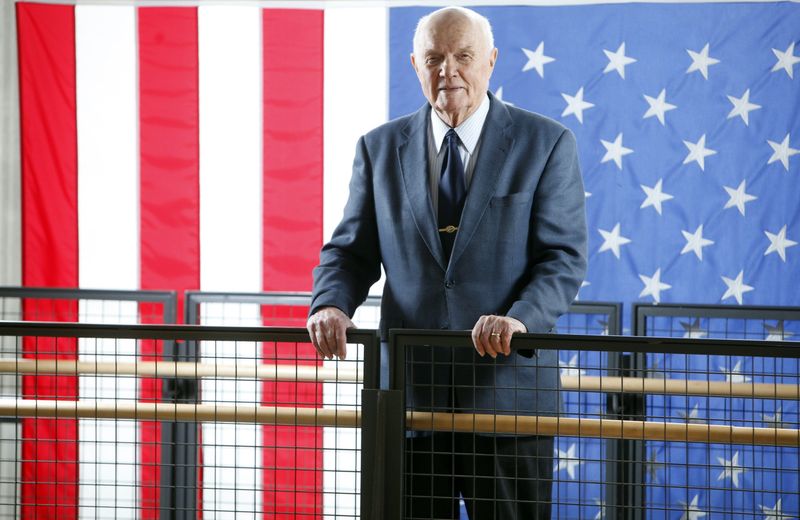
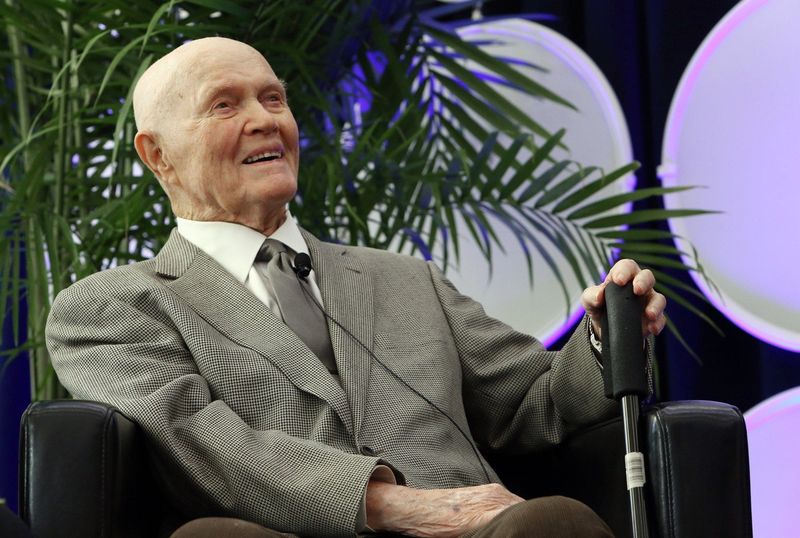
Editor’s note: Each month, Dispatch reporters will profile astronauts from Ohio, culminating in a larger story toward the end of the year about all Ohioans who became astronauts.
“Zero G and I feel fine,” U.S. astronaut John Glenn said during his historic voyage to space in 1962.

Glenn, a small-town Ohio boy who later became one of the state’s longest-serving U.S. senators, is remembered as the first American to orbit Earth in one of the opening legs of the space race that spanned the 1950s and ’60s.
Glenn lived a life almost beyond belief. As a Marine Corps pilot, he broke the transcontinental flight speed record before being the first American to orbit the Earth in 1962. And 36 years later, at age 77 in 1998, he became the oldest man in space as a member of the seven-astronaut crew of the shuttle Discovery.
He spent 24 years as a Democrat in the U.S. Senate and launched a short-lived presidential campaign in 1984. Glenn was also well-known for his love for his wife of 73 years, Annie Glenn, who was core to his life and a driving inspiration in his work.
Glenn died at age 95 in 2016 in Columbus, surrounded by his loved ones.
From small-town Muskingum County to the stars
Glenn was born on July 18, 1921, in Cambridge, Ohio, a small town of around 10,000 people in Guernsey County, near Zanesville. He eventually lived in and attended school in New Concord, is in Muskingum County.
He grew up during the peak of the Great Depression, where he saw the community come together amidst the travails and trials of economic downturn. Hope Neal, assistant director of operations at the John & Annie Glenn Museum in New Concord, told The Dispatch that this experience was formative in his life.
“There’s only about 2,000 people here; you know almost everybody,” Neal said. Glenn believed that “as long as these people back him, he is sort of unstoppable.”
Glenn, who received his pilot’s license in 1941, was at home in the sky. After the Japanese attacked Pearl Harbor, he left Muskingum College to enlist in the Marine Air Corps, according to his Dispatch obituary. In the Pacific, he flew 59 missions over the Marshall Islands. After World War II, he became an instructor and eventually applied for combat duty in Korea during the Korean War.
Glenn later became a test pilot. He set a coast-to-coast speed record in 1957, piloting a Navy fighter jet from California to New York in 3 hours and 23 minutes. In 1959, he was selected as one of the country’s first seven astronauts.
Glenn’s selection as an astronaut came at the dawn of the space race between the United States and the Soviet Union. The Soviets struck first, launching Sputnik, the first satellite, and sending cosmonaut Yuri Gagarin, who became the first human to orbit the planet from space.
Before his 4-hour, 55-minute flight in the Friendship 7 capsule, Glenn had served as backup pilot for astronauts Alan Shepard, the first American in space, who flew on May 5, 1961, and Virgil “Gus” Grissom, who followed Shepard on a suborbital flight of his own, according to NASA.
Crammed into the 7-foot-wide Friendship 7 space capsule atop a 100-foot-tall Atlas rocket, Glenn launched 160 miles into space, orbiting the world three times at 17,500 miles per hour.
“I don’t know what you can say about a day when you see four beautiful sunsets… This is a little unusual, I think,” Glenn said during his voyage aboard Friendship 7 in 1962.
As the capsule descended for a watery landing, mission control feared that its heat shield was peeling off. Well past four hours into the flight, Glenn was told of the problem and knew he could be burned alive in an instant, but the astronaut stayed focused, even as fiery pieces of his spacecraft flew by his window.
Reflecting many years later, Glenn said that computers were the greatest technological achievement during his life, according to his obituary. There were no computers on Friendship 7, and deep into the flight, he had to take manual control of the capsule when systems malfunctioned.
Neal said that Glenn’s orbit around the Earth leveled the playing field in the race against the Soviets. Americans eventually put men on the moon in July 1969.
“So he is like a breath of fresh air to the Americans that were holding their breath,” Neal said.
Glenn resigned as an astronaut on Jan. 16, 1964. He was promoted to colonel in October 1964 and retired from the Marine Corps on Jan. 1, 1965.
In 1998, Glenn returned to space, flying on the shuttle Discovery for a 9-day mission, becoming the oldest person in space.
“To look out at this kind of creation out here and not believe in God is, to me, impossible,” Glenn said during that flight.
Glenn led a storied career in public service
In 1964, only two years after his famous flight on Friendship 7, Glenn ran in the Democratic U.S. Senate primary against incumbent Sen. Stephen M. Young, according to his obituary. He dropped out of the race six weeks in after an injury that caused severe dizziness and balance problems. He recovered eight months later.
Glenn ran for the U.S. Senate again in 1970, but lost in the Democratic primary to Howard M. Metzenbaum. In a rematch four years later, he defeated Metzenbaum. He won election that fall over Republican Cleveland Mayor Ralph Perk and won reelection by huge margins in 1980 and 1986.
As a U.S. Senator, Glenn focused on nuclear nonproliferation and pushed for more funding for space exploration, education and scientific research.
Neal said Glenn’s career was marked by bipartisanship, and he cared about protecting people.
“John was really big about finding a middle ground, being able to not trade off your values but find a place where both parties felt that they were being heard and got something out of it,” Neal said.
After winning reelection in 1980 by the largest margin in Ohio history at that time, Glenn entered the 1984 presidential race, but he failed to gain traction in the early primaries. He eventually withdrew.
In 1997, Glenn announced he would be retiring from the Senate at the end of his term, marking him as one of the longest-serving U.S. senators from Ohio.
After politics, Glenn remained a fixture in Ohio public life for the remainder of his life. In 2005, he helped convert the century-old Page Hall at Ohio State University into the John Glenn Institute for Public Service and Public Policy and the School of Public Policy and Management. It is now the John Glenn College of Public Affairs.
In one of his last public appearances, Glenn, with Annie by his side, sat in the Port Columbus airport terminal on June 28, 2016, as officials renamed it the John Glenn Columbus International Airport in his honor.
Glenn began encountering health problems in 2013, when he had a pacemaker implanted. He died Dec. 8, 2016, at age 95. Annie Glenn, died May 19, 2020, of COVID-19 at age 100.
“He believed really truly in the ability to work really hard and get good returns from what you’re doing and not that he was just uniquely picked for this,” Neal said of his legacy.
“He wasn’t concerned about his legacy. He was concerned about doing the best he could while he was alive.”
Cole Behrens covers K-12 education and school districts in central Ohio. Have a tip? Contact Cole at cbehrens@dispatch.com or connect with him on X at @Colebehr_report.
This article originally appeared on The Columbus Dispatch: Ohio native John Glenn was hero of American aeronautics
Reporting by Cole Behrens, Columbus Dispatch / The Columbus Dispatch
USA TODAY Network via Reuters Connect