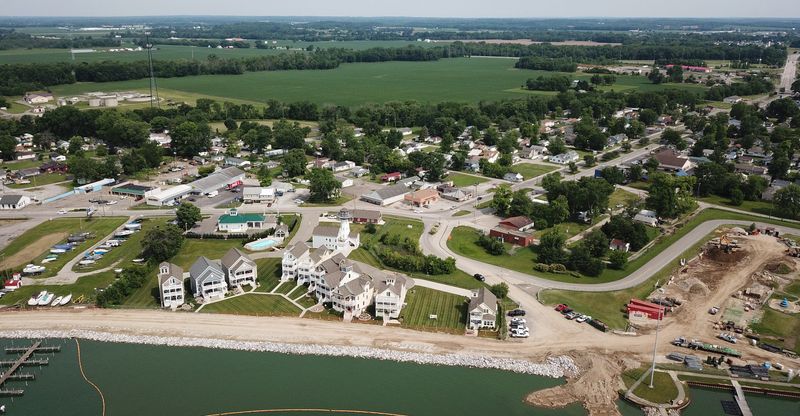
Buckeye Lake originated from Ohio’s canal system. A consistent supply of water was needed for canal traffic, and the Licking Summit Reservoir was created to provide that supply.
But as railroads replaced the canal system, the reservoir was no longer needed for transportation, so the state of Ohio turned the Licking Summit Reservoir into Buckeye Lake in 1894. It became a popular park, particularly with the addition of an interurban line, which brought visitors from Columbus to enjoy the amusement park, dancing pavilions, music, restaurants and other leisure activities.

The lake was also well known for boating and fishing. The Buckeye Lake Yacht Club was founded in 1906, and it continues to operate to this day. In 1949, Buckeye Lake became the first state park in Ohio. Islands in the lake have hosted wealthy Ohio families for generations; Journal Island, long owned by the Wolfe family, former owners of the Columbus Dispatch, was only recently sold.
Buckeye Lake hasn’t always been welcoming to all its visitors. Initially, African Americans were allowed only one day each year to visit the lake. The Zanesville Elks Lodge number 82, a Black fraternal organization, would organize an annual picnic, usually in early August. The group invited central Ohio’s Black community to a day of fun.
A 1924 diary noted that “everyone who is anyone” went to the Elks’ event. Unfortunately, it was twice marred by tragedy. First, in 1913, a boat struck an underwater log and quickly sank. Most of the 21 people on board, mostly members of the Baptist Sunday School Association of Columbus, were saved, but eight lives were lost. Nine years later, in 1924, a dance pavilion collapsed into the lake’s waters, and seven people died.
Discrimination wasn’t limited to Buckeye Lake: Ohio wasn’t always welcoming to African Americans in the 1920s during a statewide resurgence of the Ku Klux Klan. Leaders of the racist organization held two well-attended events at Buckeye Lake, bringing in visitors from across Ohio and some neighboring states.
Building at Buckeye Lake has frequently led to safety issues. Two major storms in 1922 and 1928 destroyed many of the homes and cottages there. Many more homes were built directly onto the dam along the northwest side of the lake. Their foundations were dug into the dam, which weakened it, as did the passage of time.
A dam failure would be catastrophic, but the Army Corps of Engineers, the state of Ohio, and lake residents struggled for decades to find a solution to reinforce necessary structures without damaging residential properties. Leaders added spillways, but these weren’t considered enough in the event of an unusually severe flood.
Finally, in 2015, with 3,000 lives potentially endangered by the almost 200-year-old dam, work began to stabilize the existing dam and build a new one. The project was completed in 2018, bringing Columbus tourism back to Buckeye Lake Park.
Megan Sheeran is a librarian with the Columbus Metropolitan Library.
This article originally appeared on The Columbus Dispatch: New dam at Buckeye Lake restored tourism, though not all visitors in 1920s were welcome
Reporting by Megan Sheeran / The Columbus Dispatch
USA TODAY Network via Reuters Connect