My apologies to the dickcissel, the protagonist of this column. Somehow, I’ve neglected to write about this charismatic little member of the cardinal family, until now.
Dickcissels included, the primary reason that Ohio provides so much fodder for a nature column is that the state is a melting pot of biodiversity. Political boundaries have nothing to do with plant or animal distribution; they are artifacts of geography and the politics of the time.

In the case of Ohio, when our state boundaries were set in 1803, they happened to fall where four major biomes confluence. Boreal forests nipped into the state from the north, Appalachian Mountains roughen eastern Ohio and the mighty Ohio River forms 451 miles of our southern border. And perhaps most interesting, the great Midwestern prairies reached their eastern terminus in Ohio.
At the time of European settlement, perhaps 5% of the state was prairie. Dickcissels are showy relicts of that prairie legacy. This species’ core breeding range defines the great prairies that stretched from the Dakotas and Texas east to Alabama and Michigan.
In one of the greatest global conservation failures, over 99% of Midwestern prairies have been destroyed, largely victims of John Deere and the steel chisel plow that he inflicted on the world in 1837.
Most prairies have been converted to a nonnative botanical triumvirate of beans, corn and wheat; America’s breadbasket. Thus, protection and restoration of prairies and their denizens should be a conservation priority. And it is, in many circles: Various conservation agencies, metro parks, The Nature Conservancy, private land trusts, conservation-minded landowners and others are putting prairies back on the landscape.
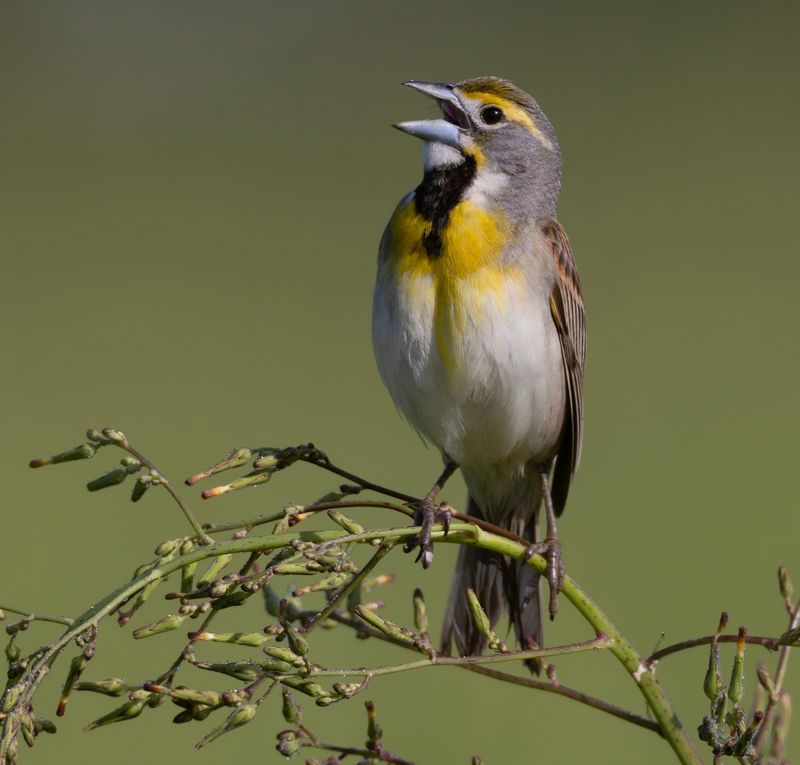
I made the accompanying dickcissel photo at a restored Ross County prairie known as Junction Earthworks, a 266-acre preserve owned and managed by the Arc of Appalachia. The core prairie at this site is dubbed, appropriately, Dickcissel Prairie.
Upon arrival on June 21, I heard the feathered chatterboxes as soon as I stepped from my vehicle. The odd English name of Spiza americana is an onomatopoeia of its song: dik-dik-cis-cis-cis!
While bright and cheery, the tune is a bit robotic and mechanical, and very distinctive. A performing male dickcissel wants to be seen and will mount the tallest plants in the prairie to deliver its chattering aria.
I spent a half hour watching the bird in my photo make the rounds of various singing perches, including the wild lettuce plant that he’s atop in the photo. Several other dickcissels had staked out turfs nearby, and their songs serve as warnings to the others as to where the invisible fences lay.
While breeding dickcissels were – and are – very much prairie birds, they have proven a bit more adaptable than some of their prairie brethren. The prairie cardinals persist along roadsides, grassland and meadow fragments, and scraps of relict habitat. But virtually, all of them are in areas of former prairie; an avian echo effect of the legions of birds that populated our pre-settlement prairies.
Dickcissels part ways with northern climes after nesting, and travel far south for the winter. In late summer and early fall, they head for the Pacific coast of Mexico and Central America. Even more of dickcissels venture further south, to northern South America. Brazil, Colombia and Venezuela are the major wintering grounds.
In winter, dickcissels shed their territorialism that was so prevalent on the breeding grounds. In favored haunts, they can form massive flocks. Up to 3 million birds have been estimated at the largest roosts. More typical are wintering flocks between 10,000 and a few hundred thousand birds. Dickcissels have formed enormous winter flocks for millennia, far longer than humans have been in the Americas.
We finally arrived in dickcissel wintering country about 20,000 years ago and set about modifying the landscape. Eventually came massive sugar cane, rice and sorghum plantations, which the dickcissels took a shine to – the cane to roost in at night, and the latter two to eat. Because dickcissels will eat these crops, they have been slaughtered at some wintering sites.
The Bay Journal reported that one Venezuelan farmer estimated he had killed over 1 million birds on his finca alone. That’s just the tip of the persecution iceberg. But we can help the prairie cardinal here, where they nest, as has the Arc of Appalachia with its Junction Earthworks restoration.
Closer to home, Columbus and Franklin County Metro Parks has done an incredible job of prairie restoration, perhaps most notably at Battelle Darby Metro Park. Dickcissels breed here annually, and hiking the trails through the prairie restoration area should produce sightings.
Naturalist Jim McCormac writes a column for The Dispatch on the first and third Sundays of the month. He also writes about nature at jimmccormac.blogspot.com.
This article originally appeared on The Columbus Dispatch: Meet the dickcissel thriving in Ohio fields
Reporting by Jim McCormac, Special to The Columbus Dispatch / The Columbus Dispatch
USA TODAY Network via Reuters Connect
By Jim McCormac, Special to The Columbus Dispatch | USA TODAY Network