A few weeks ago Steve McKee told me the high point of our Algonquin canoe trip was meeting Marilynne Keyser on Ragged Lake. For me, the high point was meeting a woman we didn’t meet.
I finally met her last week. Every night since — before drifting off to sleep — I’ve curled up with Esther S. Keyser and gotten to know her better. So far, I’m on the fourth chapter.

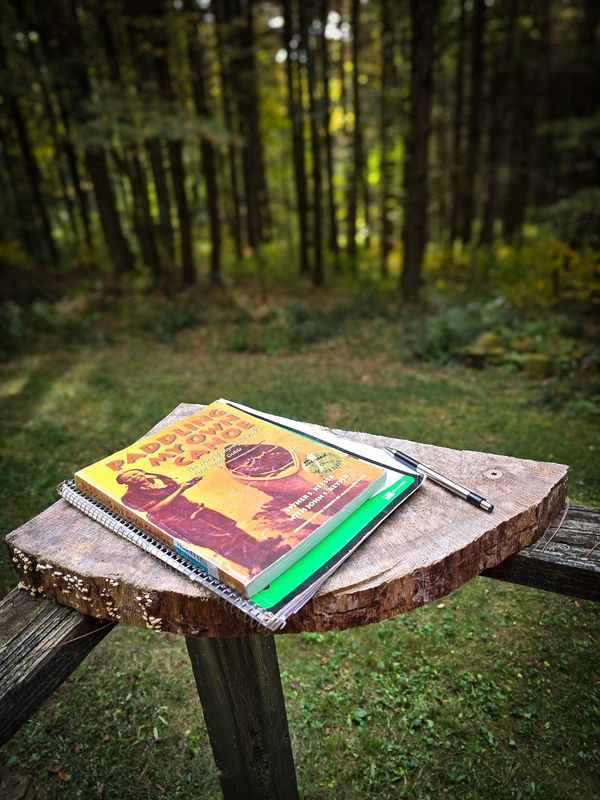
On Marilynne’s suggestion, I bought her mother-in-law’s book “Paddling My Own Canoe: The Story of Algonquin Park’s First Female Guide.” Two copies, in fact. I gave one to Steve.
I bought them used and now I feel guilty. Had I purchased new copies — which I mistakenly thought were unavailable — the money would have gone directly to The Friends of Algonquin Park. During our meeting on Ragged Lake, Marilynne told us that proceeds from the book have brought in $200,000.
To atone for my sins, I’ll buy a new copy as a gift for someone who’d appreciate Esther’s book. Which would be anyone who loves nature and admires strong-willed, independent women. Especially ones who can hold their own on the portage trail.
One of my favorite photos in the book shows Esther with a huge portage pack on her back, loaded with camping gear and a baby.
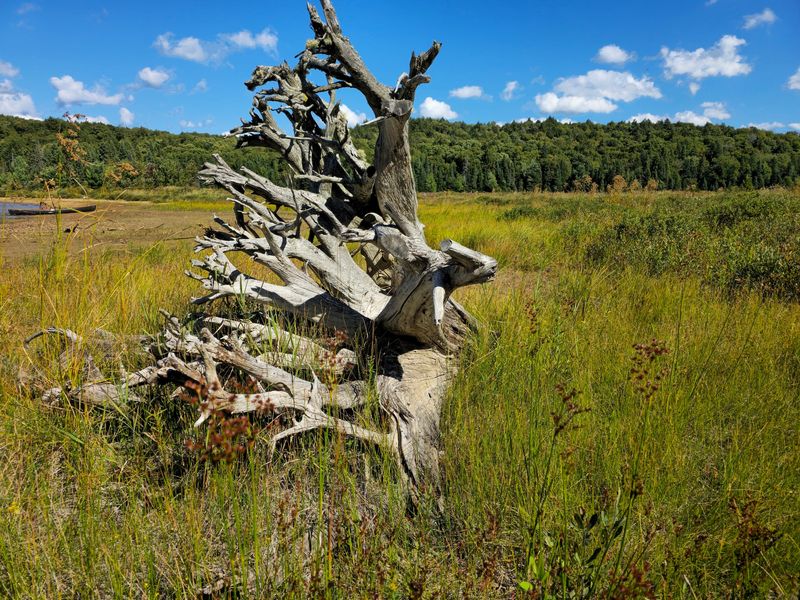
Marilynne seems to have inherited her mother-in-law’s traits. She spotted Steve, Ken Arthur, and me getting ready to pile into Steve’s canoe after exploring a floodplain. Marilynne marched about 100 yards down the beach and introduced herself. During the conversation that followed — mostly about the wonders of nature and Algonquin — she mentioned the book.
I’m a slow reader. I expect it’ll take me till Thanksgiving to finish “Paddling My Own Canoe.” So, I’ll do what I did in high school; write a book report before I’ve read the whole thing.
Maybe I’ll write a follow-up book report in December. Or thereabouts.
Born in western New York State, Esther was not what you’d call a late bloomer. In life, she hit the water paddling. She also was ahead of her time, yet very much a product of it. She took the values of the early 20th century — the good ones, things like determination, respect, resourcefulness and hard work — and blended them with a vision of society as it should be, where women are valued as equals.
In her formative years, she took her inspiration from those who championed those values.
No pun intended, but here’s a case in point — Fannie Case, founder of Northway Lodge, the first youth camp and first camp for girls in Algonquin. This was at a time when the park was transitioning from 3,000 square miles of logging land to a wilderness recreation mecca. There were no highways into Algonquin; visitors accessed it by railroad.
Esther recalled that — at the age of 12, during her first summer at Northway in 1927 — she asked Miss Case, as she called her, permission to paddle off and camp on her own. She said yes without hesitation, with a hint that Esther should invite her to breakfast.
“It didn’t occur to me that this was her subtle way of checking to make sure I was okay,” Esther wrote in her book.
That’s the true definition of a camp counselor.
Esther’s reflections of her early wilderness experiences in Algonquin reminded me of my first Mohican River canoe trip 45 years ago — at the age of 29.
“As I took some time to relax and contemplate, I had an almost mystical experience,” she wrote. “Gazing out at the expanse of water and the forested hills, a sense of destiny seemed to envelop me. This was where I belonged. This was where I wanted to be for as long and often as I could.”
Seven years later, Esther launched her career as an Algonquin Park guide. She was 19 years old.
Esther died in 2005 at the age of 90. In the first chapter of “Paddling My Own Canoe,” she described canoe tripping well into her 80s and reflects on her love for her late husband Joseph and their beloved Algonquin. The family still stays at their cabin on Smoke Lake, the same lake where Steve, Ken and I started our canoe trip on Labor Day.
It was fitting that, on our last day — after paddling back to our vehicle through fierce winds and punishing waves — we saw a woman and her young daughter cheerfully loading their gear into a canoe to set out on a weekend trip. Clearly, the prospect of a difficult paddle ahead and rain in the forecast didn’t faze them.
If Esther were around today, I’d tell her the same thing I told her daughter-in-law: “I envy you.” One of my few regrets in life is that I didn’t discover Algonquin earlier. Thank you, Esther, — and you, Marilynne — for giving me a taste of what I’ve missed.
This article originally appeared on The Daily Record: Kindred spirits – After nearly 100 years, Algonquin’s first female guide continues to inspire
Reporting by Irv Oslin/Special to Ashland Times-Gazette / The Daily Record
USA TODAY Network via Reuters Connect