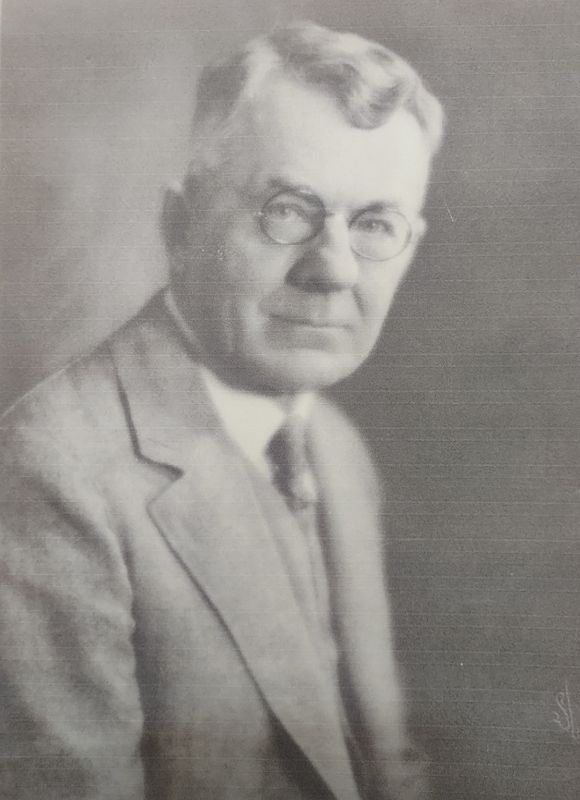
Charles David Stewart was born in Zanesville on March 18, 1868. He lived at the corner of Ridge Avenue and Brighton Boulevard, along with his parents, Andrew Stewart and Sarah Jane Emery Stewart, and a sister, Estella.
According to local historian Norris F. Schneider, the family moved to Milwaukee, Wisconsin, when Charles was only 5. Another source indicates they left town in 1881, which would have made Charles 12 or 13. Although he left here as a youngster, he did, however, periodically return to visit his grandparents.

At his mother’s insistence, Charles attended the Wayland Academy in Beaver Dam, Wisconsin, intending to become a minister. However, after saving some money, he dropped out of school and began working on riverboats plying their trade up and down the Missouri and Mississippi rivers.
Later, back in Milwaukee, Charles became a book engraver. By his mid-20s, he became a reporter and columnist for the Chicago Daily News. In 1905, his first novel, “The Fugitive Blacksmith,” was published. Charles also wrote non-fiction books, several magazine articles, short stories and poems. In addition, he became a Shakespearean expert.
Some of his more popular books included “Five Points in Faith” (1896), “The Fugitive Blacksmith” (1905), “Partners in Providence” (1907), “Essays on the Spot” (1910), “The Wrong Woman” (1912), “Finerty of the Sand – House” (1913), “Some Textual Difficulties in Shakespeare” (1914), “Buck: Being Some Account of his Rise in the Great City of Chicago” (1919). and “Valley Waters” (1922).
More on ‘Valley Waters’
In “Valley Waters,” Charles wrote a fictional account about the kidnapping of a 5-year-old Zanesville boy who lived at the corner of Brighton Boulevard and Ridge Avenue. In reality, as has been mentioned, that is where the author had lived before he and his family moved to Wisconsin.
Later in life, while serving in World War I, the main character in the book, Gilbert Orr, suffers from amnesia. While at a Chicago hotel, his mind is stimulated by hearing the words “Zanesville” and “Lorena.”
When Orr asks the desk clerk where Zanesville is, he is told he is standing on it. The tile under Orr’s feet had been manufactured in Zanesville. Eventually, he comes to this Ohio city and finds his mother and, as a bonus, falls in love with his childhood friend.
Zanesville as the tile capital
It’s not surprising the hero of the story was standing on tile made in Zanesville. In 1922, the year the novel was published, this city was the tile capital of the world. In fact, a Times Recorder article dated June 1, 2024 said for many years, Zanesville had the two most prosperous tile companies on the planet. The older manufacturer, the American Encaustic Tiling Company, made one of its first important sales to Muskingum County officials.
According to Thomas W. Lewis, in his three-volume set, “Zanesville and Muskingum County,” “In 1877, they furnished the tile for the floor of Muskingum’s new courthouse, charging the contractor $1 per square foot. Foreign tile would have cost…$1.25.” This tile still covers the courthouse floors and is in remarkably good condition.
The article continued: “Large as their market and production were, progress was too slow….So they became contractors as well as makers, laying tile all over the country and guaranteeing its durability. This was a masterstroke. The plan and the tile won their way. Orders poured in.”
The Times Recorder’s book, “Zanesville: 200 Years,” explained how the second local tile company was formed: “The Mosaic Tile Company was incorporated in September (1894) by chemist Karl Langenbeck and artist Herman C. Mueller, who had left A. E. Tiling Company and persuaded a group of investors to back the new company.”
The story of the ‘Lorena’ song
The song “Lorena” has its origins in Zanesville. A local minister, Henry De Lafayette Webster, was deeply in love with Miss Ella Blocksom, a member of his church. Ella’s wealthy sister and brother-in-law pressured her to end the romance because a minister would probably never become wealthy. So the two lovers parted ways and never saw each other again.
However, according to a Times Recorder article dated May 2, 1015, “The minister never got over this tragedy. He resigned his post and left the city. In 1856, he met Joseph Webster (no relation), a songwriter. Henry had written the lyrics about his lost love affair, originally naming the lady in the poem ‘Bertha.’ He changed the name to ‘Lorena’ because the other Mr. Webster needed a three-syllable name to better fit the song.”
In “Zanesville and Muskingum County,” Charles is quoted in a letter to a Zanesville friend in which he explains why the Lorena tale was important to his book: “’Lorena’ was probably the greatest and most popular song that ever lived and died in this country. ‘Valley Waters,’ as you will soon find, is not primarily concerned with the story of ‘Lorena,’ but this song and the story behind it are woven into the larger story in such a way that it is an essential part of the plot. And it helps to breathe into it the story of the Muskingum hills.”
The close of Stewart’s life
Charles married a lady named Emily in 1898. She died in 1938 and is buried in Hartford, Wisconsin. Charles died at the age of 92 on Oct. 27, 1960. He is buried in Mountain View Cemetery in Centralia, Washington, the town where his widowed sister lived.
Several of his books are still available at certain libraries and universities. Perhaps some Zanesvillians would like to read the works of a now practically forgotten, but talented local author.
Lewis LeMaster is a retired teacher of the Zanesville area.
This article originally appeared on Zanesville Times Recorder: How Zanesville shaped the novels of her native son Charles Stewart
Reporting by Lewis LeMaster, Zanesville Times Recorder / Zanesville Times Recorder
USA TODAY Network via Reuters Connect