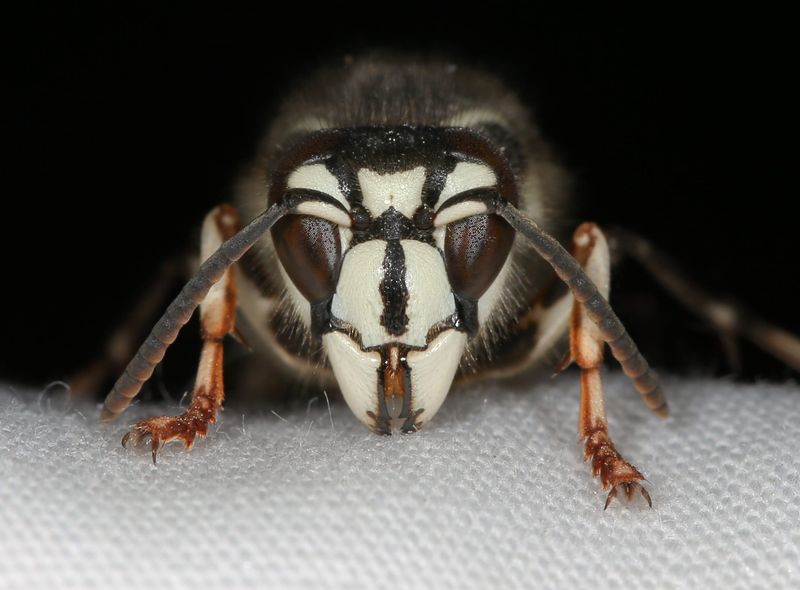
While pain can be somewhat of an abstract thing, those of us who have been stung by a bald-faced hornet, such as the one pictured with this column, know that it hurts. I’ve been stung by the burly hornets several times. The shock is instant and electric.
One time, I came across one of their football-sized paper nests hanging at eye level in a tree. Ah, thought I – a rare chance to photograph these interesting hornets at close range. Normally, the big nests are much higher in trees. I crept ever closer, firing away at the insects as they came and went.

Suddenly – WHAM! An intense pain! A hornet had stung me on the hand in a drive-by stinging. I quickly retreated to my vehicle but soon grew irritated that a bunch of insects made me back down. Back I went, moving ever closer, capturing the hornets as they entered and exited the nest.
WHAM! Another electric shock by another drive-by stinger and I decided to leave them be. The warriors’ powerful venom had served its purpose – driving off potential enemies.
Incredibly, the sting of the bald-faced hornet is only Level 2 out of 4 (4 being the most painful) on the Schmidt Sting Pain Index. Here’s how the index’s author, Justin Schmidt, describes the sting of this hornet: “Rich, heart, slightly crunchy. Similar to getting your hand mashed in a revolving door.”
If a 2 is equivalent to having your hand smashed in a door, what the heck would a Level 3 or 4 feel like?! We shall see.
Schmidt (1947-2023) was an academic entomologist who specialized in the order of insects known as Hymenoptera. Ants, bees, sawflies and wasps make up its ranks, and as many of us know, the females of many species can sting, often inflicting significant pain.
Ever the analytical academic, Schmidt wanted to objectively measure this pain, and rate it by species. And what better way to do so than to intentionally get stung by as many bees, wasps and their allies as possible, then place the pain levels somewhere on a scale from 1 to 4. During his long career, Schmidt was stung over 1,000 times, by approximately 100 species of Hymenoptera. That’s dedication.
Level 1’s are the mildest stings, such as from tiny bees known as sweat bees. Many species occur in Ohio, and they are important pollinators. Schmidt’s description of a typical sweat bee sting: “Light and ephemeral, almost fruity. A tiny spark has singed a single hair on your arm.”
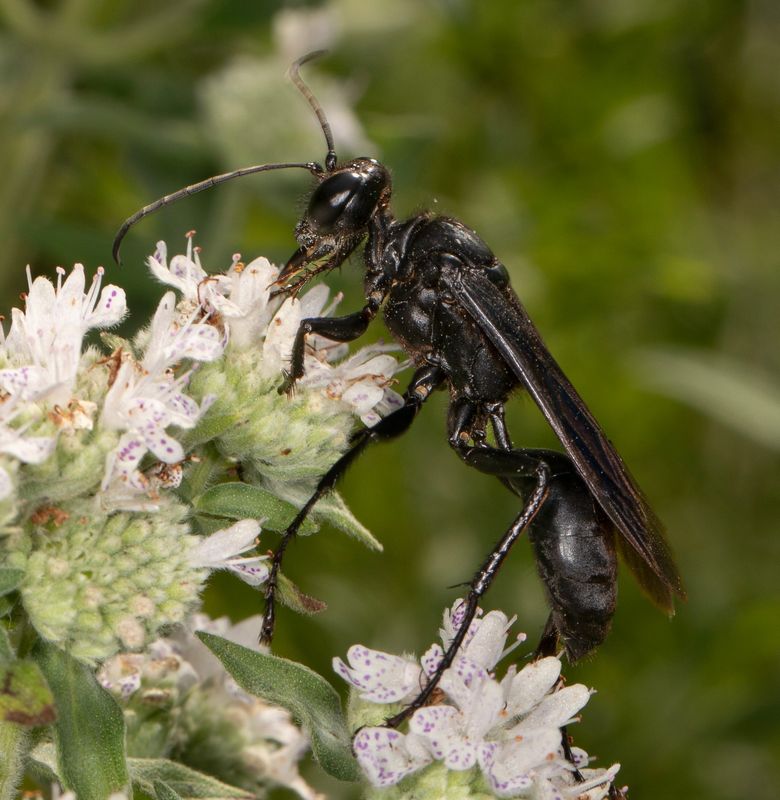
Some Level 1’s, like the great black wasp, look ferocious but pack no punch. Here’s Schmidt’s sting assessment: “Simple and presumptuous. Your younger sibling just nipped at your pinkie finger.”
The sting pain increases dramatically with each level, as in the Level 2 bald-faced hornet mentioned above. Another common Level 2 in Ohio are western yellowjackets. They’re the ones that can put picnickers in a tizzy when they try to drink from soda cans.
Schmidt: “Hot and smoky, almost irreverent. Imagine W.C Fields extinguishing a cigar on your tongue.”
I am unaware of any Level 3 or 4 stinging insects in Ohio, and for that, I suppose we can be grateful. We do have an interesting and beautiful species of velvet ant (a type of wasp) known as the “cow killer.” That sounds ominous but is the stuff of urban legend. Schmidt only rated its sting a 1.5.
A western species, Klug’s velvet ant, is a legitimate 3, and Schmidt describes its sting thusly: “Explosive and long-lasting, you sound insane as you scream. Hot oil from the deep fryer spilling all over your hand.”
How could a sting get any worse than that?! Only a handful of species achieves Level 4, including the tarantula hawks of the southern and southwest U.S., the bullet ants of the tropics and the warrior wasp of California and South America.
Here’s Schmidt’s flowery prose regarding a tarantula hawk sting: ”Blinding, fierce, shockingly electric. A running hair dryer has just been dropped into your bubble bath.”
I have seen many bullet ants in the Central American tropics, and we always alert the group to their presence, and with good reason, once one reads Schmidt’s description of their sting: “Pure, intense, brilliant pain. Like walking over flaming charcoal with a 3-inch nail embedded in your heel.”
Fortunately for us, most stinging insects do not sting unless there is no other resort. The production of venom is biologically costly, and it does not behoove them to waste it. And unless one has dangerous anaphylactic reactions to stings, none of the Ohio stingers are any more than a mild, short-term annoyance.
Next time a yellowjacket nails you, be grateful it wasn’t a bullet ant or tarantula hawk.
Naturalist Jim McCormac writes a column for The Dispatch on the first and third Sundays of the month. He also writes about nature at jimmccormac.blogspot.com.
This article originally appeared on The Columbus Dispatch: How to rank the world’s most painful insect stings
Reporting by Jim McCormac, Special to The Columbus Dispatch / The Columbus Dispatch
USA TODAY Network via Reuters Connect
By Jim McCormac, Special to The Columbus Dispatch | USA TODAY Network