Lyme disease cases are rising in some states, such as Michigan, where Lyme-disease-carrying ticks are spreading to more suburban and urban areas of the state.
Like Michigan, Ohio has also seen an uptick in Lyme disease reports in recent years, rising from fewer than 40 cases in 2010 to more than 1,700 by 2024, according to Ohio’s infectious diseases dashboard.

Although tick bites are often painless, the insects can transmit Lyme disease, viruses and other infections to people and animals. As tick populations and species have expanded in Ohio, reported Lyme disease cases have risen alongside them.
Here’s what to know about ticks in Ohio and how to prevent bites when outdoors.
How bad are the ticks in Ohio? See number of Lyme disease cases
So far in 2026, Ohio has reported 161 cases of Lyme disease, according to the state’s summary of infectious diseases dashboard. Belmont County reported the highest number of cases at 27, followed by Jefferson County at 16 and Licking County at 14.
The dashboard also shows that Ohio cases rose, going from 1,805 in 2024 up to 2,831 in 2025, a roughly 56% increase.
Lyme disease was once rare in the Buckeye State, according to the Ohio Department of Health. In the early 1990s, the Health Department reported one to two dozen cases in Ohio residents annually. Since then, the number of reported cases has increased and is now common to see hundreds or thousands of confirmed cases each year.
Ohio has Lyme‑disease‑carrying blacklegged ticks year‑round
The Ohio Department of Natural Resources says that blacklegged ticks, also known as deer ticks (responsible for most cases of Lyme disease) are active throughout the year in Ohio. “The onset of human Lyme disease cases occurs year-round in Ohio but peaks in summer following the emergence of nymphs,” ODNR writes.
Blacklegged ticks that carry Lyme disease are most commonly found in the eastern and southern areas of the state, but are likely to occur in suitable wooded habitat throughout most or all of Ohio, ODH notes.
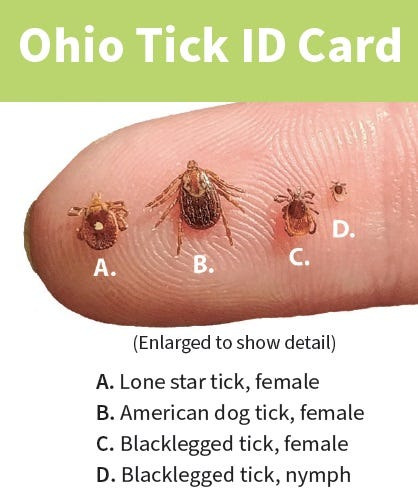
American dog ticks and lone star ticks are also present in Ohio and can carry disease risks. Here’s what they look like:
Ohio State’s Tick Testing Lab helps you identify ticks
Ohio State University’s Tick Testing Lab service allows residents to submit ticks found on people or animals for pathogen testing.
For non-urgent medical or veterinary tick concerns, Ohioans can submit ticks to the tick testing program by mail and receive results within 72 hours. The cost of the service is $49.99 per tick. Alternatively, ODNR says that your local health department can also identify ticks.
How can you safely remove a tick?
If a tick bites you, ODNR recommends carefully removing it from your skin using tweezers. The Ohio Department of Health provides additional guidance:
The CDC also provides an interactive tool for tick removal.
How to prevent tick bites
To avoid tick bites, the Ohio Department of Health recommends the following tips:
How to prevent Lyme disease
ODH says the best way to prevent Lyme disease is to prevent tick bites by removing a tick quickly to reduce the risk of contracting Lyme disease.
What are the symptoms of Lyme disease?
According to Cleveland Clinic, the infection can cause a range of symptoms, including a bullseye rash, joint pain and nerve issues. Early symptoms of Lyme disease typically begin three to 30 days after a tick bite. Common early symptoms include:
This article originally appeared on The Repository: How bad are ticks in Ohio? Lyme disease cases rise, symptoms
Reporting by Alex Perry, Canton Repository / The Repository
USA TODAY Network via Reuters Connect