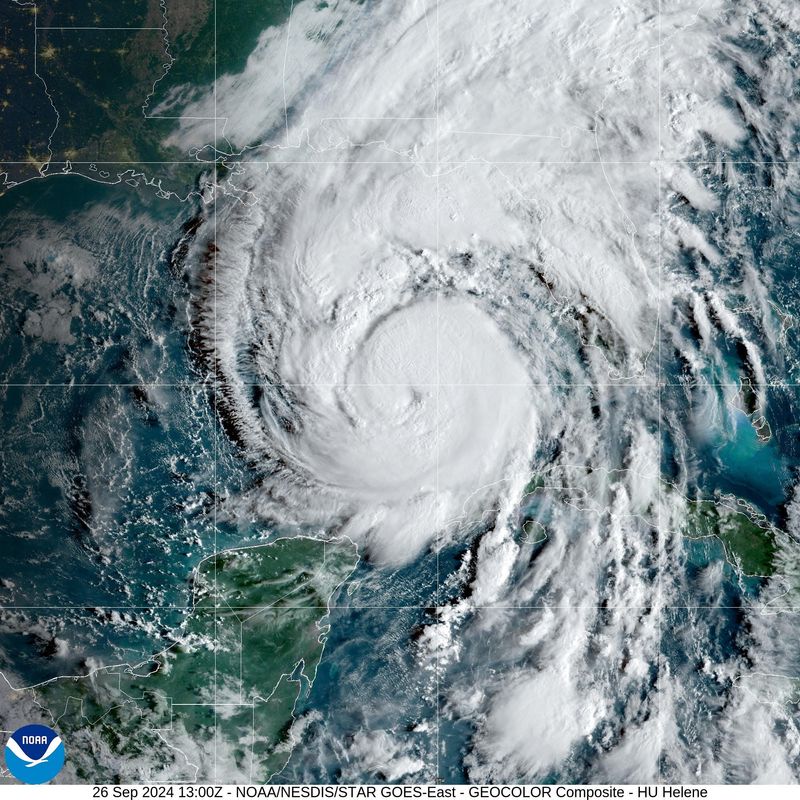
Ohioans, do you plan to head to Florida in August for a getaway before school starts? Then you might want to take a look at the weather forecast.
According to USA TODAY, Florida’s hurricane map may be blank now, but activity in the Atlantic Ocean is expected to increase based on several signs.

Will Florida’s hurricane season begin in August? How long is it expected to be active? Here’s what to know.
What meteorologists are saying about Florida’s hurricane season
“The tropical environment should become more conducive for Atlantic hurricane activity in the next few weeks,” said Colorado State University meteorologist Phil Klotzbach in a July 24 email to USA TODAY.
WPLG-TV hurricane expert Michael Lowry agreed, telling USA TODAY that “we’re already seeing longer-range forecast models start to perk up… July 24’s long-range forecast models jumped from a generally quiet next 15 days to a much busier look for the first part of August.”
What’s the forecast for the first couple of weeks of August?
Hazelton explained that “large-scale conditions should become a little more favorable as a Madden-Julian Oscillation pulse crosses the Pacific and moves into the Atlantic, enhancing large-scale rising motion and reducing shear. Conditions should especially become more favorable in the second to third week of August, which aligns pretty well with the long-term climatology of when the Atlantic starts to become more active.”
Has it been a slow start to hurricane season?
With three named tropical storms (Andrea, Barry and Chantal) so far, the number of storms is actually above average for this time of year. “Currently, we’re above-normal for named storms but below normal for all other metrics,” Klotzbach said.
One of those metrics is Accumulated Cyclone Energy (ACE), a key measurement of the severity of a hurricane season. ACE measures the total wind energy produced by a season of tropical storms and hurricanes. It measures the intensity and duration of storms, and gives a better indication of overall activity than simply counting the number of storms, according to the National Oceanic and Atmospheric Administration.
By that measurement, this is the slowest start to an Atlantic season since 2009, as the three storms that formed were all rather weak, though Chantal did cause some deadly flooding in North Carolina.
The 2009 hurricane season produced three hurricanes and several tropical storms, per NWS.
‘Approaching a pivot point’ to hurricane season
The season is about to heat up, Lowry said, as August is the month when activity usually ramps up.
Lowry said that “despite the slow start, we’re approaching a pivot point in the Atlantic. Hurricanes aren’t common in June and July. They happen, of course, but there are usually tall hurdles to overcome to get there.”
However, he added, “that’s not the case in August, September, and the first part of October. Those hurdles are a lot shorter, so the right window can get you a big hurricane in a hurry,” he said.
This article originally appeared on The Columbus Dispatch: Heading from Ohio to Florida in August? Hurricane season warning signs are piling up
Reporting by Mariyam Muhammad and Doyle Rice, Columbus Dispatch / The Columbus Dispatch
USA TODAY Network via Reuters Connect