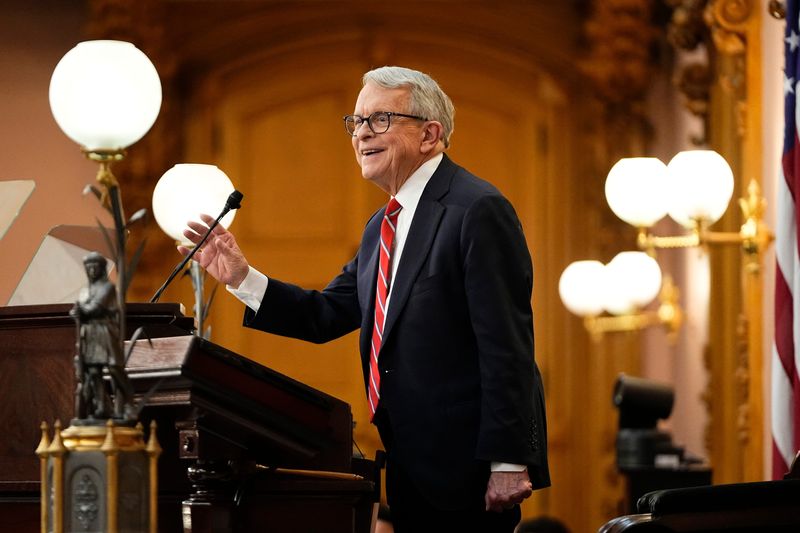
Gov. Mike DeWine is urging lawmakers to repeal the death penalty more than four decades after he helped bring capital punishment back to Ohio.
In a June 16 news conference, DeWine said he no longer believes the death penalty is a deterrent for violent crime − which was the sole moral justification for his previous support. The cases move too slowly and come with too much uncertainty to prevent others from killing, he argued.

DeWine declined to say whether he’ll consider clemency for people on death row before he leaves office.
“For the state to take a human life, there must be evidence that in doing so, it will help protect the public,” DeWine said.
DeWine’s comments marked the end of a long journey for a Catholic who co-sponsored the 1981 death penalty law, then represented the state in capital cases as attorney general.
DeWine paused executions in 2019 after a federal judge deemed Ohio’s three-drug lethal injection protocol cruel and unusual. Over time, he issued more reprieves − including six this year − and said pharmaceutical companies wouldn’t sell the necessary drugs to states with the death penalty.
Meanwhile, he signed legislation in 2021 that prevents people with a serious mental illness from being sentenced to death.
Some Republicans have pushed for an alternative execution method to get around problems with the drug supply. House Bill 36 would allow the state to suffocate people on death row with nitrogen gas. Former Attorney General Dave Yost asked the Trump administration for help accessing lethal injection drugs.
“Pathways do exist for Ohio to fulfill the justice it promised,” Yost wrote in his final report on Ohio death penalty cases. “Those on death row have had more than their fair share of due process − and second and third helpings of overdue process. It is past time that we do right by the victims and punish the monsters who killed them.”
DeWine isn’t alone in his criticisms. Opponents of the death penalty contend it’s expensive and applied unevenly across 88 counties. More than half of the people on Ohio’s death row are Black, even though Black people make up 12% of the state’s population, according to 2020 U.S. Census data.
A recent report from Ohioans to Stop Executions also found that for every five people Ohio executed since 1981, one person was exonerated from death row.
“Gov. DeWine’s evolution on the death penalty is exactly what we’ve seen in communities across Ohio from MAGA Republicans, Democrats and Independents,” said Kevin Werner, executive director of Ohioans to Stop Executions. “Nobody supports a system that harms victim families, convicts innocent people and wastes millions of dollars without a shred of improved public safety.”
DeWine joins former Govs. Bob Taft, a Republican, and Ted Strickland, a Democrat, in shifting against the death penalty. A group of former lawmakers who served in 1981 urged the Legislature to end the practice and make the harshest sentence life in prison without the possibility of parole.
“We understand this broken death penalty system’s grievous flaws, its unintended consequences and its failure to achieve the benefits we had intended,” they wrote in an October 2025 letter.
Will Ohio end the death penalty?
It’s unclear whether DeWine’s change of heart will spur lawmakers into action. There is bipartisan support to end the death penalty, but that legislation has been introduced multiple times with no success.
House Speaker Matt Huffman, R-Lima, told reporters in February that he’s “vigorously opposed” to eliminating the death penalty in Ohio. Huffman noted that DeWine issued a reprieve in January for Cleveland Jackson, one of two men sentenced to death for killing a 3-year-old and 17-year-old in Lima in 2002.
“We’ve all heard the phrase, ‘Justice delayed is justice denied,'” Huffman said. “That individual should be executed for what he did.”
Another factor is the next governor of Ohio. GOP candidate Vivek Ramaswamy supports the death penalty only in the “most egregious cases” when the outcome is certain, according to his campaign. His Democratic opponent Amy Acton, previously said she would keep executions on hold until lawmakers change Ohio’s system.
In May, more than 500 faith leaders across Ohio urged lawmakers to end the death penalty. Rev. Dr. Jack Sullivan Jr., who served as executive director for the Ohio Council of Churches, said capital punishment exacerbates the cycle of violence and forces the state to “surrender its moral and ethical high ground.”
“This is our moment here in Ohio to lead the charge in calling our legislators to drop their stones,” he said, “and to walk away from executions, state-sponsored homicide, and embrace non-lethal, restorative paths in accountability.”
This story will be updated.
State government reporter Jessie Balmert contributed to this report.
State government reporter Haley BeMiller can be reached at hbemiller@usatodayco.com or @haleybemiller on X.
Tell us what you think
This article originally appeared on The Columbus Dispatch: Gov. Mike DeWine calls for end to Ohio death penalty
Reporting by Haley BeMiller, Columbus Dispatch / The Columbus Dispatch
USA TODAY Network via Reuters Connect
By Haley BeMiller, Columbus Dispatch | USA TODAY Network