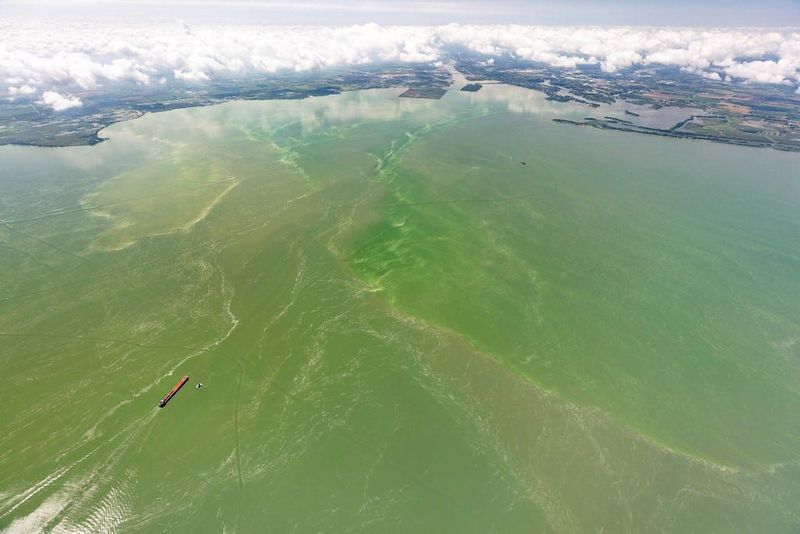
Warnings for you, your pets and children continue with the 2026 harmful algal bloom, which is expected to be mild, similar to the last few years.
The annual HAB forecast was hosted by the Ohio Sea Grant and Stone Laboratory for the National Oceanic and Atmospheric Administration on June 25 at Gibraltar Island in Lake Erie.

“I cannot emphasize enough that the scum has phenomenally high toxicity levels,” NOAA’s Richard Stumpf said. “Keep your kids, your pets, your dogs and yourself out of the scum. People think their dogs are indestructible, but they are not. Enjoy the lake. The bloom is not everywhere. It’s not all the time. There are plenty of places to swim and go boating in Lake Erie.”
The bloom is expected to hit 3.5 on the severity index and is expected to begin in early July, also similar to recent years. Expect to see patchy scum when the waters are calm.
The bloom is likely to intensify in the western Lake Erie basin in August and may continue into September. It is not expected in the central basin.
Continued research into lake water aerosols is showing the related toxins can be harmful to internal organs without jumping in the bright green slime.
“What we are forecasting with this bloom is a 3.5, with a potential for 3 to 4.5 for severity. This puts it in the moderate bloom range. This is due to the slightly above-normal [rainfall] from spring. This does account for the normal July rainfall, and some accounting for a slightly higher elevation on the rainfall. If we do get that extra rain, we could be in the 4 to 4.5 range,” Stumpf said. “This puts us at a little more extreme than 2025, and less than 2024.”
“This area missed something that would have been historically bad,” he said in reference to heavy rains in southern and central Ohio, some of which brought significant flooding. “We were very fortunate with that.”
This year, the heavy April 5 rains resulted in a high discharge of the phosphorous that precedes the bloom events, and that level remained higher than usual for the month.
Lake Erie blooms of blue-green algae, also called cyanobacteria, are capable of producing the liver toxin microcystin. Algal blooms pose risks to people and animals. Presence of the toxin prevents people from fishing, swimming, boating and visiting the shoreline, and can harm the region’s summer tourism economy.
Researchers track phosphorous levels in rainwater runoff from farms as one of the primary indicators of future algae bloom growth. They referenced the extremely heavy rainfall from the April 5 storm as the leading indicator. However, similar storms have happened at similar times over the last four years.
The toxicity level of the 2014 harmful algal bloom shut down the Toledo water system for more than 400,000 people during two days at the peak of the bloom, resulting in an estimated $65 million economic loss. Almost 50,000 of those water customers were from northern Wood County, also adjacent to Ottawa County.
Future research in algal bloom toxins and prevention
Researchers stressed that the size of a bloom is not necessarily an indication of the level of toxicity. NOAA researchers know that nitrogen levels are more predictive of toxicity than phosphorous levels, but local communities that treat water also need to remove biomass, which is part of the annual prediction. Researchers continue to develop new tools to detect and predict how toxic blooms will be.
“Blooms don’t exist just in isolation,” said Grace Young, researcher with the University of Michigan. “Our largest source of aerosols in the atmosphere comes from bubbles in oceans and bodies of water.”
Her research looks at the transport of the blue-green algae toxins through the air. She has found that aerosolized particles can get into a person’s lungs.
“Both course and fine particles are linked with cardiovascular diseases,” she said.
The researchers believe that wetland restoration through H2Ohio is generally effective. They have found that the designs of the wetlands made some more effective than others. It was noted that the Ohio Department of Natural Resources has started a monitoring program, which should help with future development.
NOAA will issue a seasonal forecast update in late July based on observed nutrient loads from the Maumee River watershed into the western basin.
Contact Roger LaPointe at 419-332-2674.
This article originally appeared on Port Clinton News Herald: For this year’s harmful algal bloom, NOAA predicts a moderate range
Reporting by Roger LaPointe, Port Clinton News Herald / Port Clinton News Herald
USA TODAY Network via Reuters Connect
By Roger LaPointe, Port Clinton News Herald | USA TODAY Network