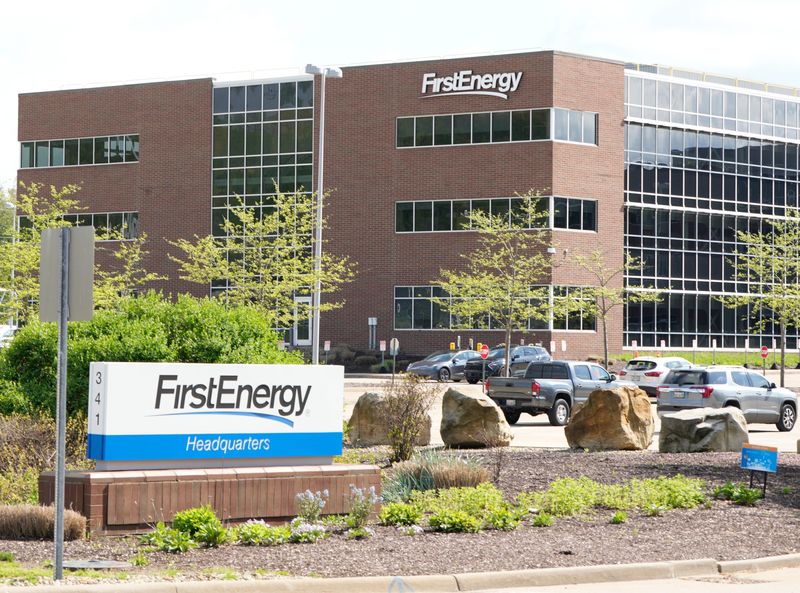
Responding to a data center boom, Akron-based FirstEnergy says it plans to increase its system peak load by nearly 50% over the next decade without that expansion hitting its customer base in the wallet.
The utility’s current system peak load is 33.5 gigawatts, President and CEO Brian Tierney said on the company’s Oct. 23 third-quarter earnings call. He said he expects the load to increase to 48.5 gigawatts in 2035.

Tierney, who is also chair of FirstEnergy’s board of directors, said the goal is to not pass the cost onto residential customers and other business customers.
“We think that we can enter into terms and conditions that make the data center developers responsible for the incremental investment that we’re making and protect our existing customers,” Tierney said.
Why is my electricity bill higher than before?
Akron-area customers are already paying more to have their electricity supplied to them. Customers of FirstEnergy’s Ohio Edison subsidiary — which operates within Summit and Portage counties and other parts of Northeast Ohio — and chose the standard service offer, or price to compare, saw their rates June 1.
Many communities’ aggregation programs with electricity suppliers have also passed higher rates onto customers.
The supply rate increases largely track back to a 2024 auction hosted by PJM Interconnection, a regional transmission organization with a 13-state territory that includes Ohio.
Is FirstEnergy still seeking higher costs for consumers?
FirstEnergy is requesting approval from regulator the Public Utilities Commission of Ohio (PUCO) for a distribution rate increase. FirstEnergy spokesperson Hannah Catlett said in April that if approved, the company would use the increased costs paid by customers to modernize the electrical grid and make it more safe and reliable as energy demand surges and severe weather becomes more the norm.
If FirstEnergy’s proposal is approved by PUCO, Ohio Edison’s residential “non-shopping” customers using the typical 1,000 kilowatt-hours per month would pay $7.17 more on their monthly bills, Catlett previously said. Those customers’ bills are currently about $166.05 and would increase to about $173.22, she said.
Tierney said on the Oct. 23 earnings call that he expects a decision from PUCO by year’s end.
How is FirstEnergy performing financially?
FirstEnergy released third-quarter financial results following the close of the stock trading day Oct. 22.
The utility reported Generally Accepted Accounting Principles (GAAP) earnings of $441 million on $4.1 billion in revenue for the third quarter, up from GAAP earnings of $419 million on $3.7 billion in revenue for the third quarter of 2024. The 2025 third-quarter GAAP earnings come out to 76 cents per basic and diluted share, up year over year from 73 cents per basic and diluted share.
Reported core (non-GAAP) earnings for the third quarter of 2025 were 83 cents per share, up 9% from core earnings of 76 cents per share for the third quarter of 2024.
The third-quarter 2025 core earnings of 83 cents per share beat the Zacks Consensus Estimate of 76 cents per share.
FirstEnergy stock closed at $46.64 on Oct. 24, up 12 cents (0.25%).
Patrick Williams covers growth and development for the Akron Beacon Journal. He can be reached by email at pwilliams@gannett.com or on X, formerly known as Twitter, @pwilliamsOH. Sign up for the Beacon Journal’s business and consumer newsletter, “What’s The Deal?”
This article originally appeared on Akron Beacon Journal: FirstEnergy plans to add capacity for data centers, but shield customers from costs
Reporting by Patrick Williams, Akron Beacon Journal / Akron Beacon Journal
USA TODAY Network via Reuters Connect