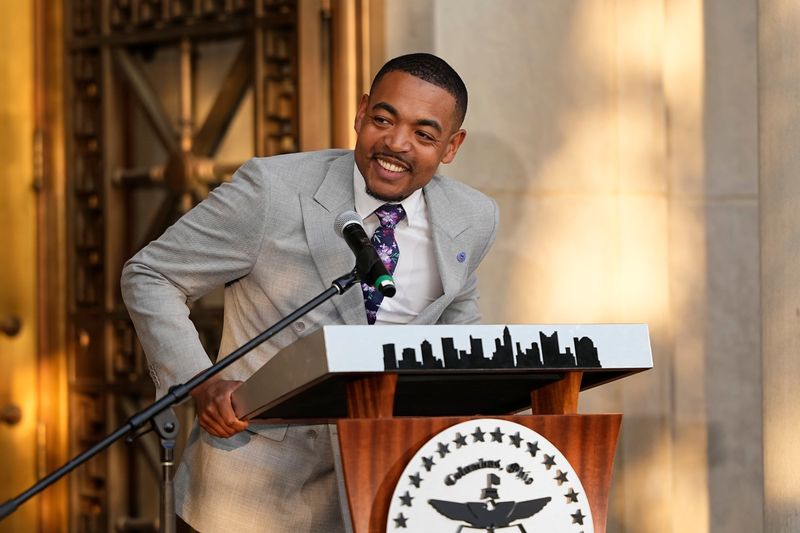
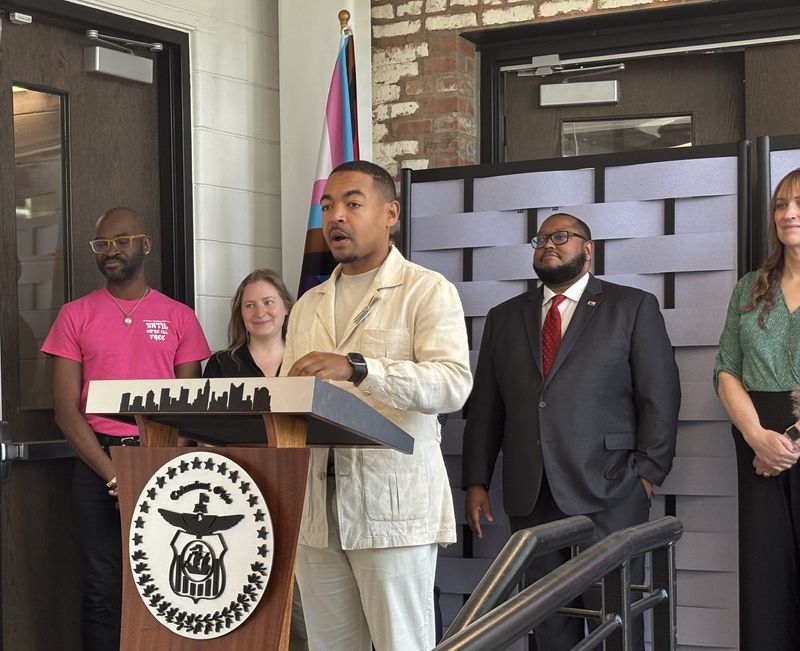
The day before the Columbus Pride March – which this year also happened to be on Juneteenth – Columbus City Council President Shannon Hardin annually gathers LGBTQ+ officials from Columbus and across Ohio to talk policy before the parade and party the next day.
The gathering this year also marked the one-year anniversary of the announcement of a LGBTQ+ Affairs Commission, which Hardin vowed to create at the pre-Pride luncheon in 2025.

Hardin has held the pre-Pride luncheon four years in a row before Columbus’ Pride Day parade, one of the largest pride celebrations in the Midwest and the country, scheduled this year on June 20.
“I want to make sure that we are standing in solidarity with our out elected officials who might have a little tougher time as they advocate and move forward their policy,” said Hardin, who is Black and openly gay. “I want them to know that they are not alone, that we stand ready and willing to partner, to make sure that we can share in this fight because the fight certainly is not over. So for me, that is one of the values I see in bringing together, statewide, our elected officials and advocacy groups. We get to stack hands.”
Nearly 40 elected officials from across the state, as well as advocates and advocacy groups, participated in the event, Hardin said.
Because this year’s pre-Pride luncheon fell on Juneteenth, Black LGBTQ+ individuals raised conversations about identity intersectionality.
“Today is especially meaningful for me that we’re celebrating Pride hand in hand with Juneteenth. Because Juneteenth is not simply a celebration of freedom, it is also a challenge – a challenge to ask whether America has fulfilled its promise, not just for Black people, but for those who stand at the intersection of blackness and queerness,” said Dwayne Steward, CEO and eEquality Ohio CEO, Executive Director.
“As a gay Black man, I do not experience racism on Monday and homophobia on Tuesday. I experience it together,” Steward said. “My identity is not divided into categories. It is whole and so must be our struggle for justice.”
LGBTQ+ Affairs Commission
The LGBTQ+ Affairs Commission, which didn’t formally begin work until January, serves primarily as an advisory organization to the mayor’s office and Columbus City Council with the city’s LGBTQ+ residents, according to Thomas Savage of the LGBTQ+ Affairs Commission.
The commission is focused on connecting with members of the Columbus community. They will host a listening session on June 25 from 6 to 8 p.m. at City Hall. Savage said the commission hopes to learn what the priorities of the community are and where they should focus their attention.
“That also looks like realizing that the work of the LGBTQ+ Commission and our community does not live Downtown, does not live at City Hall,” Savage said. “We intend in the months to come to connect with communities in the various neighborhoods of the city of Columbus. What we really aim to do with this commission as time moves forward is find ways to give folks an authentic voice in our local government.”
The commission aims to use a diverse range of voices and perspectives to continue its work, according to Savage.
“We are living in a time where queer individuals in our community feel like they have less of a voice,” Hardin said. “They are hearing conversations from the federal and state government saying that, in many ways, their rights, even their history, should be erased. And to have a positive step forward where we codified that their voices actually belong at the policymaking table, I think is a huge advancement.”
Hardin also said that he is excited to see how the direct advocacy from the LGBTQ+ community going directly to the Mayor and to City Council will move and evolve policy going forward.
Current Legislation
State Representative Christine Cockley, D-Columbus, spoke of the ongoing fights at the Republican-controlled Statehouse to protect LGBTQ+ rights.
Cockley spoke out against House Bill 249, which, if enacted, would create misdemeanor and felony infractions for drag performers if a minor is in the audience, and against House Bill 190, which prevents teachers from using a student’s preferred name unless parental consent is given.
Ohio House Democrats have consistently fought for protections to support LGBTQ+ rights, Cockley said. She specifically cited the introduction of House Bill 300 to ban conversion therapy, House Bill 306 to create penalties for hate crimes, and House Bill 136 to add sexual orientation and gender identity to Ohio’s protective class.
Dispatch reporter Ella Diehl can be reached at ediehl@dispatch.com
This article originally appeared on The Columbus Dispatch: Elected officials, advocates discuss LGBTQ+ issues before Columbus Pride
Reporting by Ella Diehl, Columbus Dispatch / The Columbus Dispatch
USA TODAY Network via Reuters Connect
By Ella Diehl, Columbus Dispatch | USA TODAY Network