An Immigration and Customs Enforcement surge in December dubbed “Operation Buckeye” has abated, but ICE agents remain in Columbus detaining residents.
Advocates and people who spoke with The Dispatch said that many who live in immigrant communities within Columbus remain concerned and scared.

ICE agents who came through Columbus in December appear to have flocked to Minneapolis, where one agent shot and killed a woman on Jan. 7, triggering protests there, in Columbus and around the nation.
“The community is in fear,” Maqueli Eldredge, a paralegal at Legal Immigration Services in Dublin, said of Columbus-area immigrants.
Eldredge said that before the December surge ended around Christmas, she would hear of 10-20 reports of ICE arrests per day. This week, she’s been counting 3-5 per day.
The Ohio Immigrant Alliance said in a Jan. 9 new release that the organization identified at least 214 people arrested during “Operation Buckeye.” The organization said in an analysis of publicly available jail rosters that 80 percent of the people detained were Latino, and less than 10 percent were African.
The organization emphasized this was likely an undercount of ICE detentions.
The Department of Homeland Security said in a news release Jan. 9 that more than 280 immigrants were arrested in Ohio from Dec. 18 to Dec. 21. The agency did not answer whether “Operation Buckeye” had ended or if an increased ICE presence remained in Columbus.
Columbus police Chief Elaine Bryant told the Dispatch that ICE does not communicate enforcement plans with her or the Columbus Division of Police, but to the best of her knowledge, only the ICE agents based in the city remain in Columbus.
Eldredge disputed the chief, saying that she is familiar with the small staff of Columbus-based ICE agents and that the current scope and methods of enforcement efforts show a large number of agents from out of town remain active in Columbus.
Eldredge said she’s spoken with immigrants, especially those who are undocumented, in the process of securing citizenship or applying for asylum, who are afraid to leave their homes. They do not want to go to work, go out to eat, or shop for groceries because they fear contact with ICE, detention or deportation.
Kelly Escobar, a community activist who says most of her friends are Hispanic immigrants, said some people who went into hiding during the December surge have started to come out of their homes, but their fear persists.
“I’ve got a friend who owns a [local business],” Escobar said. “She’s terrified constantly. I was talking to her right after Christmas, and she was like, ‘I’m scared to be open, but I’ve got to pay rent.’”
Escobar said the woman’s customers are still scared to come out to buy food. Eldredge said she’s seen restaurants that are usually popular with immigrant communities almost empty.
During the December surge, some restaurants and grocery stores offered food delivery. Volunteers, especially white citizen volunteers, brought food to people scared to leave their homes. Eldredge said that has died down.
December ICE enforcement caught community off guard
Eldredge said the ICE surge in December came with no warning. She thought something was amiss when a Brazilian woman called her to say her husband had not come home.
The woman said she drove around the neighborhood and found his vehicle abandoned with the doors open and a broken window. She asked Eldredge to help her figure out if ICE had taken him.
Eldredge started seeing reports of ICE activity emerge across Facebook and Instagram. Word spread in immigrant social media groups that ICE had come to Columbus in force.
The same day, one of Eldredge’s clients reported to an ICE check-in appointment in Westerville.
“She was telling us, you know, some people are going inside the big office and not coming back,” she said. “I tried to keep her calm. I said, sometimes it takes a little longer.”
The woman told Eldredge she saw an attorney leave the office with only a child, and both were crying.
Eldredge said her client was detained at the appointment and remains in ICE custody. In a hearing, the prosecutor said the woman, a 25-year-old asylum seeker from Brazil, could face deportation to Ecuador, Eldredge added. The woman has no ties to Ecuador.
Representatives from Eldredge’s law firm have been escorting clients to ICE check-ins to try to prevent them from being captured. Other clients haven’t been taken from appointments. Eldredge said she doesn’t know why the 25-year-old woman was detained at her appointment when others weren’t.
Eldredge said some clients have been detained for months in crowded conditions with little access to food and hygiene. She said U.S. citizens have been detained and have had to prove their identities. She said sometimes, after clients have been detained, officials have seemed not to know who they were.
“I happen to be white, but if I were brown-skinned, I also would be afraid of going out on the streets,” Eldredge, herself a Brazilian immigrant, said. “I still take my passport with me everywhere, because I know the minute I open my mouth, I have an accent.”
ICE has not responded to Dispatch requests to detail the scope of its operations in Columbus. The agency published a news release celebrating “Operation Buckeye” in Ohio on Dec. 20, announcing that 10 men it called “the worst of the worst” criminals had been detained in Ohio.
ICE has not answered how many people were arrested in the operation. The Dispatch has not been able to verify the charges stated in the news release against the men through local and federal court systems or legal databases. ICE has not responded to a request from the Dispatch to disclose where and when those charges were filed to further search for them.
Eldredge said most of the arrests she knows about involved people with no criminal histories beyond immigration-related charges.
Columbus reacts as ICE shoots, kills woman in Minneapolis
On Jan. 7, a federal agent in Minneapolis shot and killed 37-year-old Renee Nicole Good.
According to reports, Good was operating as a “legal observer” who arrived on the Minneapolis street along with other citizens responding to ICE agents who were conducting an operation when federal officials say their vehicle became stuck in the snow.
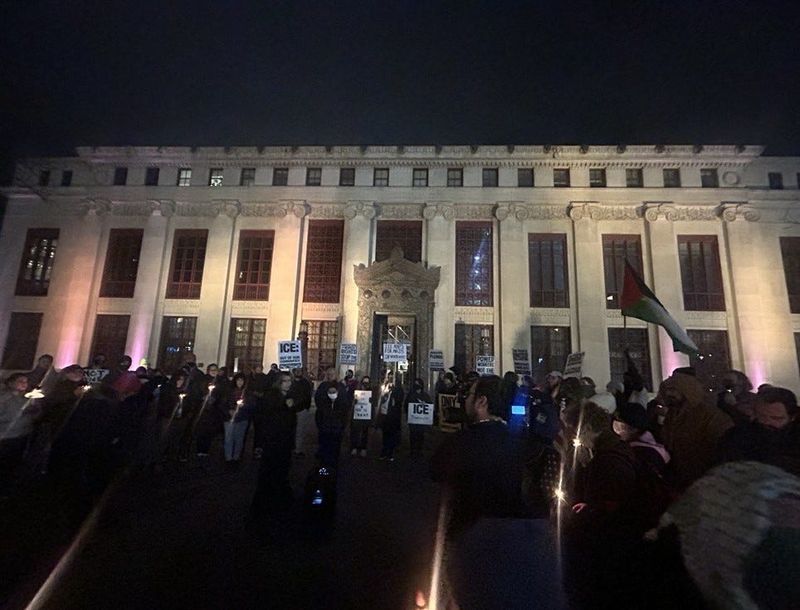
More than 150 people gathered outside Columbus City Hall the evening of Jan. 7 to honor Good.
Multiple anti-ICE protests were held on Jan. 8, including a rally outside Westerville City Hall at 4:30 p.m. and another outside the Ohio Statehouse at 6 p.m. that drew hundreds.
Escobar said she was not surprised by the shooting because of the aggressive behavior she saw from agents in Columbus.
“It makes me nervous, and it’s tragic,” Escobar said. “We also knew it was a matter of time.”
Eldredge said she fears something similar could happen in Columbus, as ICE agents continue to make arrests.
“That’s what I always tell my husband,” Eldredge said. “Something bad will happen here.”
Public Safety and Breaking News Reporter Bailey Gallion can be reached at bagallion@dispatch.com.
This story has been updated to include additional context about the presence of ICE and federal immigration agents in Columbus.
This article originally appeared on The Columbus Dispatch: Did ICE leave Columbus? The feds’ Operation Buckeye enters quieter phase
Reporting by Bailey Gallion, Columbus Dispatch / The Columbus Dispatch
USA TODAY Network via Reuters Connect