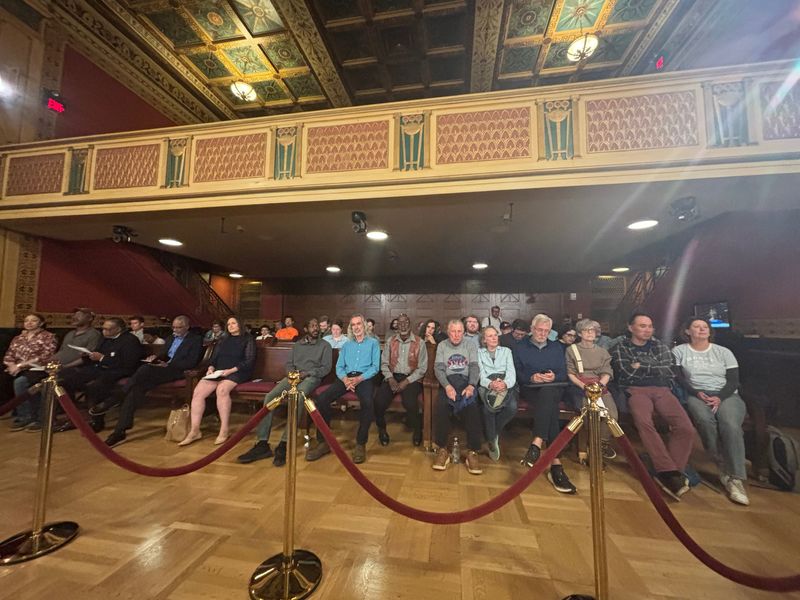
The system for how Columbus elects city council members is the wrong one, dozens of residents packing a May 4 public hearing at City Hall largely agreed.
Several said the current at-large system implemented in 2023, which allows voters from across the city to vote for a council district with residency requirements, is “stupid.”

They disagreed, however, on the solution.
Council President Pro Tempore Rob Dorans convened a hearing after two different citizen groups submitted charter amendments to move Columbus to a true council district system. One group, Our City, Our Say, is gathering signatures to put a simple measure on the ballot that would turn the current council districts into voting districts.
Dorans said he is concerned about a ward or district-only model obstructing housing construction, and he wishes to preserve some at-large seats. He wants City Council to consider putting forward its own ballot initiative. To make it on the ballot this November, the council would have to vote by the end of June, before their summer recess in July.
Dorans said he did not vote for the current system voters approved in 2018 when he was just a voter and not on council.
“I believed it was confusing and did not adequately address long-standing concerns regarding neighborhood representation,” Dorans said. “I’m hoping that this body can be engaged in honest dialogue starting tonight about what reform might look like.”
Activists with Our City, Our Say accused the council of co-opting their movement with the hearing. Chris Tavenor, a petition committee member, asked the council to support their measure.
“Regardless of what other democracy reforms the council members might want, this first step should be an easy thing to do,” Tavenor said. “Everyone deserves a representative from their district elected only by their district. … Don’t introduce conflicting reforms that would delay or dilute change and potentially confuse voters.”
Councilmember Christopher Wyche said he signed the Our City, Our Say petition.
Columbus residents testify in support of true districts
Many of the speakers testified in support of Our City, Our Say. Proponents of a true district system testified that different neighborhoods have different issues, and residents should know who represents them. It’s expensive to run for city-wide office, proponents said, arguing that districts could level the playing field for grassroots candidates and minority candidates who represent minority residents’ interests.
Several residents expressed anger, accusing the council of being bought by billionaires. They pointed to the council’s unpopular 5-3 decision to give the use of McCoy Park to rich investors behind a professional women’s soccer team for the creation of a training facility.
Other speakers testified in support of a hybrid system with a couple of at-large seats. They pointed to research that shows ward systems lead council members to quash affordable housing construction in their districts when they get pushback from residents.
“I do not believe that we have to fall victim to an all-or-nothing system,” Mindy Justice said. “Over and over again, one of our biggest challenges continues to be housing. We have done so much good work, so much really difficult work, and that progress cannot be pulled back.”
Joe Motil, a previous unsuccessful candidate for mayor, called the rhetoric around housing disingenuous while testifying in support of Our City, Our Say. Proponents of a true district system said that the council has to do the hard work to win over residents opposing a housing project.
Others took issue with how Our City, Our Say keeps existing district maps, which were not designed as voting districts. Jonathan Beard, who previously led failed citizen initiatives to create a district system in Columbus, said the Our City, Our Say fix is too simple and leaves Black residents behind.
“The (Our City, Our Say proposal) that’s on the table is not good for Black Columbus,” Beard said.
Beard was among a group of Black residents who’ve submitted a ballot measures this year, but he told The Dispatch they have no plans to collect signatures. Their submitted proposal would replace the current district map with one they drafted. Beard said they were trying to show Our City, Our Say activists that a charter amendment could improve the voting map to keep neighborhoods together and include majority-Black districts.
“Yes, we need district representation, but we need a fair map,” said Pastor Kevin Dudley, who’s part of Beard’s coalition. “They are using a gerrymandered map.”
Beard encouraged City Council to put forward its own amendment with new maps.
The history of Columbus City Council
Columbus has had an at-large council system since voters first approved a city charter in 1914. Before that, in the 1800s, Columbus had a ward system.
Columbus replaced its seven-member, at-large council with a hybrid system in 2023. Today, City Council has nine seats elected at-large, with each member required to live in their district. Voters approved the change in 2018 after a city charter commission proposed it as a compromise to frustration with the at-large system. The City Hall-led move followed failed citizen-led efforts by Beard and others in 2016 and 2017 to adopt a true district-based council and enact other reforms, including public campaign finance.
The debate around the council system was reignited after the 2025 District 7 election, when Jesse Vogel dominated the district vote but lost the city-wide vote to Councilmember Tiara Ross.
Government and politics reporter Jordan Laird can be reached at jlaird@dispatch.com. Follow her on X, Instagram and Bluesky at @LairdWrites.
This article originally appeared on The Columbus Dispatch: Columbus weighs new council election system amid public backlash
Reporting by Jordan Laird, Columbus Dispatch / The Columbus Dispatch
USA TODAY Network via Reuters Connect