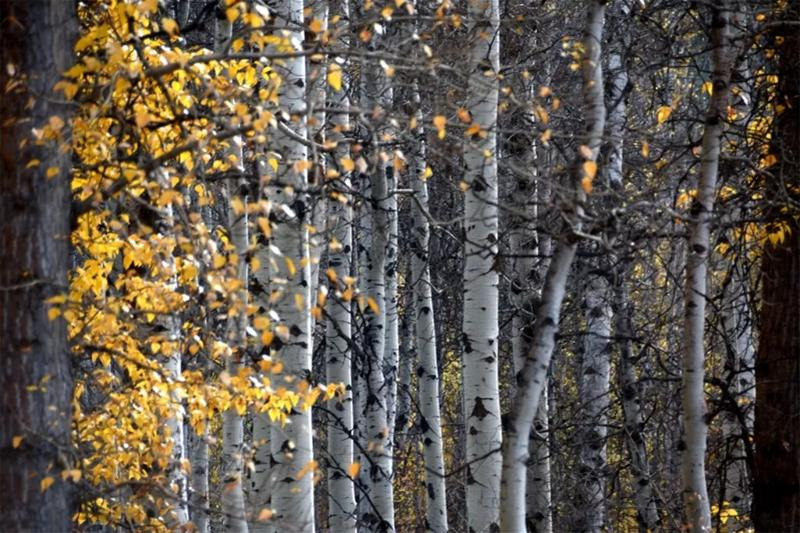
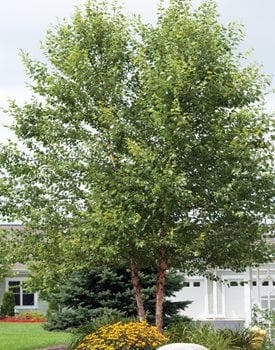
Few shade trees are as distinctive in the home landscape as birch trees. Their unique bark characteristics, distinctive growth form and graceful delicate foliage are reason alone to feature one or more birch trees in your landscape. Some varieties of birches grow in shrub-like clusters and others grow as single-trunk trees. Mature birch trees can grow from 25 feet tall to up to 70 feet tall depending upon the variety.
Unfortunately, birch trees in many landscapes in central Ohio can begin to decline within a few years after installation and some die well before reaching maturity. By choosing the most appropriate species of birch and the right place to plant it in your landscape this autumn, you can enjoy the beauty of birch trees for many years.

Selecting the proper site
In the forest, birch trees thrive in cool, moist soils. Their shallow root system makes them sensitive to hot, dry soil conditions, the exact type of conditions we have experienced in central Ohio the past several weeks!
When choosing a site to plant a birch tree in the landscape, look for a location which receives afternoon shade, such as east and north sides of the home where the building provides some afternoon shade. The goal is to select a growing site where the soil will remain cool and moist, but the foliage will receive full sunshine for much of the day.
Other areas in the landscape which receive dappled or filtered sunshine due to other large trees growing to the west of the potential planting site for a birch tree are also suitable. Areas in the landscape which receive shade for the majority of the day are likely not the perfect location for most birch trees.
Birch trees thrive in slightly acidic soils with a pH between 5.0 and 6.5. Native soils in many local locations are more alkaline, so planting sites should be amended with peat moss or other acidic soil amendment when planting birch trees.
Selecting the right birch tree for your landscape
Birch trees are in the genus Betula and are classified as part of the Betulaceae family, and there are a few types of birch trees which are appropriate for landscapes in central Ohio. When choosing a birch tree to plant in a landscape here, I look for those varieties which are more heat-tolerant and less susceptible to the bronze birch borer, a commonly occurring insect which can kill birch trees by boring through the bark to feed on the vascular tissue of the tree.
I consider these three birches the best choices for landscapes in central Ohio:
Proper care for birches
Sufficient soil moisture is probably the single most important factor to maintain the health of a birch tree. We often don’t give a lot of thought to frequent irrigation of trees in the landscape, except for young trees that have been planted recently. Unlike vegetables, annual flowers and herbaceous perennials, many gardeners and homeowners tend to ignore the soil moisture needs of shade trees in the landscape.
The dry weather conditions which we have experienced both this summer and last summer have taken a cumulative toll on many trees in the landscape, and not just young trees planted in the last few years. Recently we have seen the decline of many trees in the region that do not have insect or disease damage, or other obvious plant stressors.
When dry weather occurs, trees in the landscape will need supplemental irrigation. Trees of any age or size need approximately one inch of water each week, sometimes more when air temperatures are above 90 degrees for extended periods of time. If rainfall does not provide one inch of water each week, the root zone of the tree should be watered deeply to maintain the health of the tree.
The best way to deeply water trees is to use a tree water bag, which can be purchased at a garden center. These bags provide a deep, slow and consistent watering for the roots of trees. Simply spraying the ground over the root zone of a tree with a spray nozzle attached to a garden hose rarely results in a deep watering.
Alternatively, you can punch a couple of holes in a plastic five-gallon bucket with a scratch awl or tenpenny nail to make your own tree watering system. After punching holes in the bucket, place it over the root zone of a tree and fill it with water. The water will leak out slowly, providing a deep watering. Refill the bucket and move it around the root zone of the tree.
Mike Hogan is Extension Educator, Agriculture & Natural Resources and associate professor with Ohio State University Extension.
hogan.1@osu.edu
This article originally appeared on The Columbus Dispatch: Birch trees can make a beautiful addition to your landscape this season
Reporting by Mike Hogan / The Columbus Dispatch
USA TODAY Network via Reuters Connect