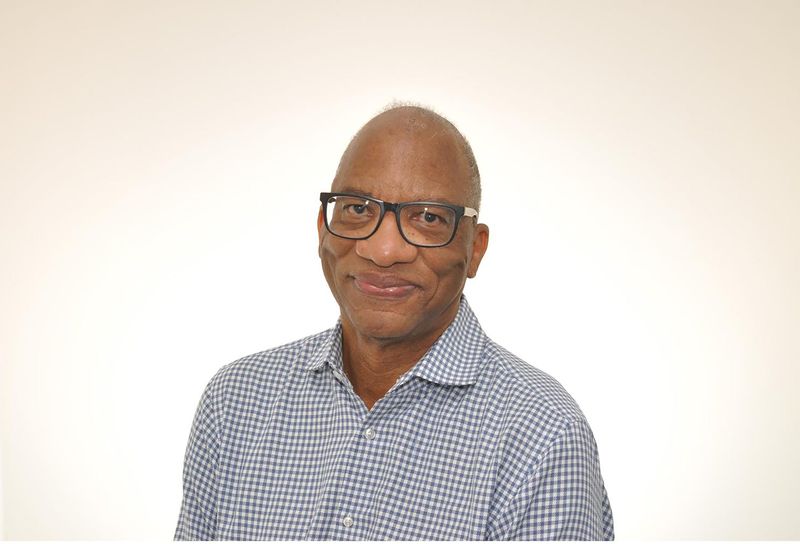
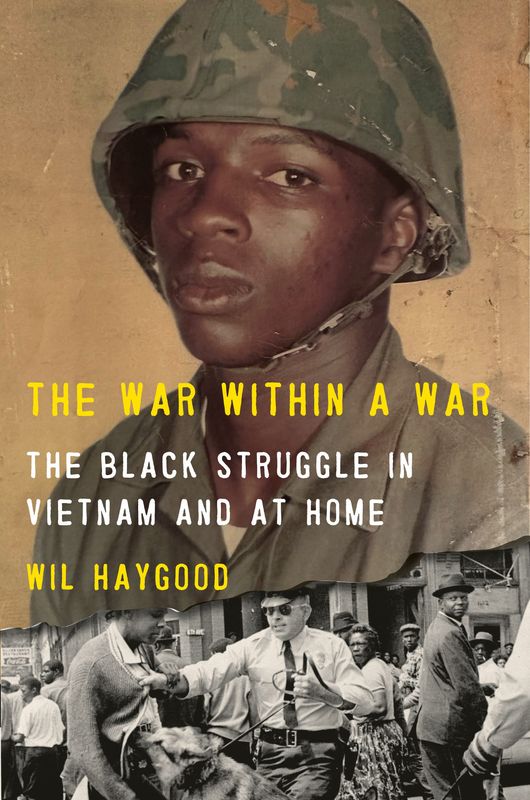
Acclaimed author Wil Haygood, a Columbus native and a former Columbus Call & Post, Washington Post and Boston Globe journalist, recently launched his book, “The War Within a War: The Black Struggle in Vietnam and at Home.”
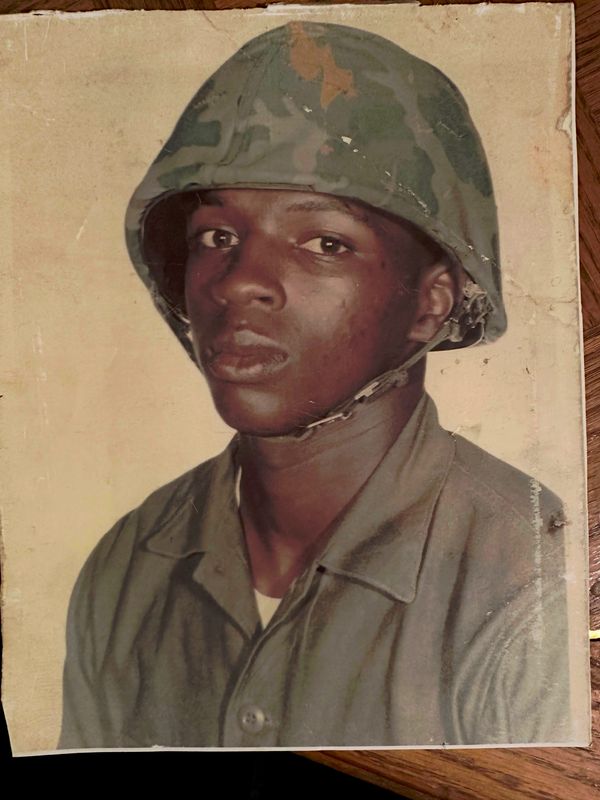
The Franklin Heights High School graduate was inspired to write the book partly by teens he watched as a child growing up on the East Side of Columbus. Those young men include Skip Dunn, who joined the Marines to fight in the Vietnam War in the late 1960s. A photo of Dunn in his uniform graces the cover of The War Within a War.

Haygood, a Miami University alumnus and scholar-in-residence, authored “The Butler: A Witness to History,” “Tigerland: 1968–1969: A City Divided, A Nation Torn Apart, And A Magical Season Of Healing,” “Showdown: Thurgood Marshall and the Supreme Court Nomination that Changed America,” and several other books.
He discussed The War Within a War, with Dispatch Opinion and Community Engagement Editor Amelia Robinson. Excerpts are below.
How six Columbus teens and the Capitol Riot inspired book
Haygood: I have always been fascinated that the country seems addicted to war — to blood and guts — starting with the (Revolutionary) War. That war was staged over freedom. Here we are again, 200-plus years later, still having racial battles and political battles about our rights as a people in a nation.
When I was a foreign correspondent at the Boston Globe, I enjoyed going into foreign countries and watching U.S. soldiers land in those places and be on the side of expanding freedoms for people by helping that host government. So I saw up close the meaning of the U.S. flag on foreign soil. We’ve so often been on the side of freedom fighters.
And yet, in my own country in 2021, we had an assault on the U.S. Capitol from within. That made me wonder about the hypocrisy of us espousing and fighting for freedom in other countries and not waging a fight for our own freedoms. One of the Founding Fathers, of course, said, “It is a republic, if you can keep it.”
All of that came together when I started thinking about the Vietnam War and freedom. And that freedom in such a sharp way, was connected back in the states to the Civil Rights Movement. There were six teenagers who lived on my street and the next street over when I was a kid growing up in Columbus, Ohio.
As I started doing research into the Vietnam War, I found that there was a huge gap: How did the Black soldier react to coming out of segregation and being dropped into a war zone and asked to fight for somebody else’s freedom, when just over their shoulder, back home, their mothers and aunts and uncles weren’t being treated with the full impact of the Bill of Rights and the civil rights bills? They were actually fighting a war within a war – which, of course, is the title of the book.
Black soldiers, Black patriotism, and book banning
Haygood: After all of the wars in the country – the Civil War, the Spanish-American War, World War I, World War II, and the Korean War – there were explosive racial riots throughout this country because there was a fear that Black soldiers had learned how to use weapons and that they were going to bring those skills back to defend their communities and not take abuse and civil rights murders sitting down.
Of course, most of the protests – so many of the Martin Luther King Jr.–led protests – were nonviolent. Blacks never met the white resistance with the type of violence that whites extended toward Black people.
It was always a fear among much of mainstream society that Blackness in soldiering was something for them to worry about. When actually, it took a lot of patriotism for Blacks who had been scarred and beat down in their own home country to go abroad and fight for that very country that has done terrible things to them.
I don’t understand how the (Donald) Trump–(Pete) Hegseth regime is going to expect Brown and Black people to be enthusiastic about joining the military when Trump and Hegseth have heaped scorn upon Black and Brown people. They’ve attempted to erase history, and that history is something that Black and Brown families are very proud of.
Many of the veterans who I spoke with around the country while doing research for my book – and I’m talking Black and white veterans – are appalled that Black heroes and female heroes have been verbally maligned by this administration. These are facts. This is not fake news. These stories have been in the newspapers. They’ve been on the nightly news. And people are shocked that various markers extolling Black heroism have been taken down by this administration.
And a nation needs to ask itself, why? Why has this been done? I had a book that was banned by the Trump–Hegseth administration at the U.S. Naval Academy. That book is called “Colorization: 100 Years of Black Films in a White World.” It was banned along with many other books that, for some strange and bizarre reason, they thought sailors and soldiers shouldn’t read these books. They banned books by Toni Morrison and Wil Haygood and Ta-Nehisi Coates and several other writers. This was all in the news. I think now many of those books have been put back, but there was an outcry. This nation should not be banning books.
The Vietnam War and the Iran War
Haygood: We are at war again. People are very confused by it. They don’t know why we started this war. Soldiers have died. Many people overseas have died.
It used to be a mantra: “Walk softly and carry a big stick.” Now that seems to have morphed into “Talk loud, threaten, and carry a super-gigantic stick.” And we know it’s hard to start these wars; it’s hard to end them. We were in Vietnam for 12-plus years.
Sometimes I ask some of my students at Miami of Ohio, where I teach, how long they think the Vietnam War lasted. Of course, this is a war that their parents and their parents’ parents lived through. They will answer and say three years, five years. And when I finally tell them that it was actually 12-plus years, they are stunned.
They are shocked that a nation could have gone into a foreign country at a time when 10% of the population was Black in America, (40% to 45% of the frontline) combat troops were Black. So, proportionately, it was Black soldiers who carried the heavy end of the log during the Vietnam War. And for some reason, we don’t teach those facts in school, because it is a chilling angle of military statistics.
This is a leader of the free world who has no military experience himself. I’m not saying that you have to have military experience, but it seems absurd for someone in the White House without military experience to say so many boastful, aggressive things about war.
I’ve been a foreign correspondent. I have been in war zones. I have been shot at. And it’s nothing to take lightly. It’s bloody, it’s scary, it’s painful. And you see people die right in front of you.
You cannot scare the world and make the world love you as a superpower. Eventually, that will come back to haunt you.
What Columbus should take from the book
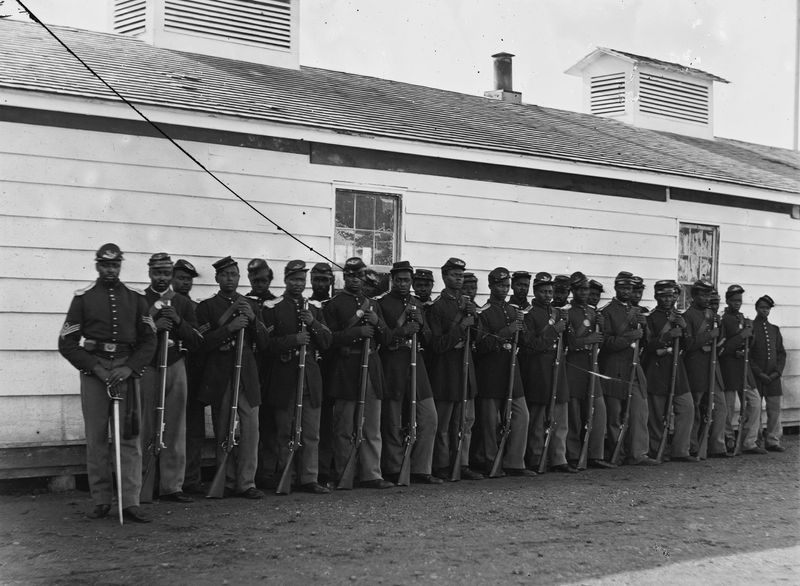
Haygood: I think this book is a true and vivid example of the love that Black soldiers from my Columbus neighborhood, from my Columbus hometown, from my state of Ohio showed for this nation. Skip Dunn, who lived right across the street from me on North Fifth Street when I was a kid, volunteered for the Marines as an 18-year-old. He went to serve his mission without being asked, just like the 200,000 soldiers whom Frederick Douglass convinced to join the Union during the Civil War to save this nation.
Those 200,000 soldiers collectively said: If you give me the musket, if you give me the rifle, I will fight to the death to save our nation. It brings a tear to my eye to recall that. Skip Dunn came out of that lineage. And when our U.S. Capitol is attacked, the bones of those 200,000 Black soldiers who fought to save this nation are rattling because of what happened in January of 2021.
The war within the war and America’s 250th birthday
Haygood: You can clearly say that the Black soldier was fighting two wars – which meant they had to survive two wars – which, in a way, meant that they set another layer of the moral tone of the fight for freedom. And also, it was the first example of what you might call forced brotherhood between the Black soldier and the white soldier.
There is a line in my book in which I write: “In Vietnam, Black couldn’t survive without white, and white couldn’t survive without Black.” That’s true. That was the first example of seeing photographs of Black and white soldiers carrying each other to safety in war zones. We didn’t see those kinds of pictures in World War I, World War II, or in the Korean War.
It was a shock – a visual shock – to see Blacks and whites together in a war zone, knowing they were not together on the streets of our nation as neighbors because of Jim Crow segregation. But where there was blood and death and dying, you saw them together.
I don’t know if I hadn’t been a foreign correspondent, and if I hadn’t lived on a street with several young guys who I looked up to as a kid, and if I hadn’t had a chance to travel as much as I have as a reporter, that I would have written this book. But I’m certainly glad that I did.
I think it has come out at a very auspicious time in this nation’s history. I don’t know if it’s my most important book, but I certainly know it’s my most timely book.
This article originally appeared on The Columbus Dispatch: America’s hypocrisy and addiction to ‘blood and guts’ didn’t just start | Opinion
Reporting by Amelia Robinson, Columbus Dispatch / The Columbus Dispatch
USA TODAY Network via Reuters Connect