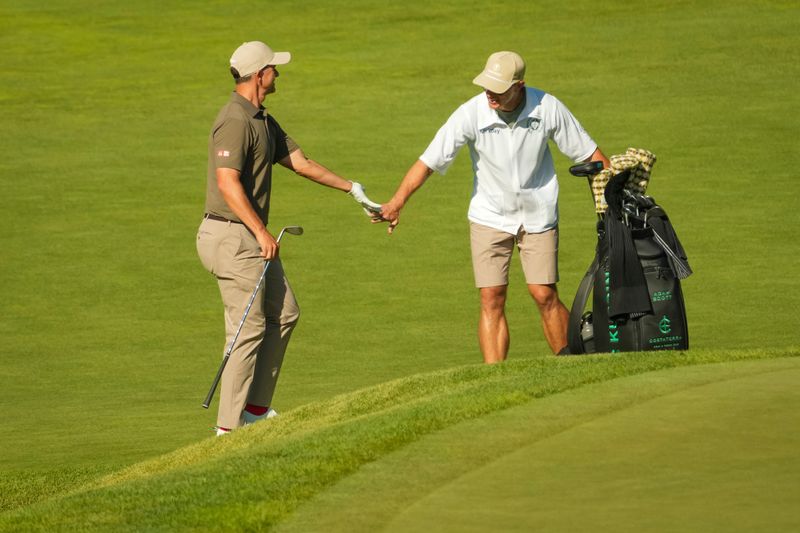
When looking for a golfer to root for during the U.S. Open, may I sentimentally suggest Adam Scott, the Australian gentleman who represents everything good about the game?
Two names keep surfacing this week at Shinnecock Hills Golf Club, the wind-swept beast of a course located on the eastern end of Long Island that is hosting the June 18-21 national championship.

Scott is one of the two players being discussed, not because the 45-year-old is favored to win, but because this will be his 100th consecutive major championship, dating to the 2001 British Open at Royal Lytham & St. Annes Golf Club. Only Jack Nicklaus, with 146 straight appearances, has more. The active player with the second-highest total is Jordan Spieth with 53.
Scott’s streak, like Nicklaus’ before him, has been built on a combination of impressive play, fortunate good health and luck. No children’s graduations to attend. No family weddings. No funerals or serious injuries. The closest calls came in 2008, when Scott played the U.S. Open at Torrey Pines with a broken bone in his hand, and in 2024, when he was 61st in the world at the entry deadline and needed to play in the U.S. Open qualifier at Springfield Country Club. He lost in a playoff and was relegated to first alternate, but slipped into the field at Pinehurst when the USGA removed Grayson Murray, who had died a month earlier, from the top 60.
“It’s not something you set out to do, but I take a lot of pride in my game and everything I put into it,” Scott said June 4 during the Memorial Tournament. “The fact that Jack is the only other one to pass 100. … I told him he doesn’t have to worry about [getting passed]. He didn’t look worried, either.”
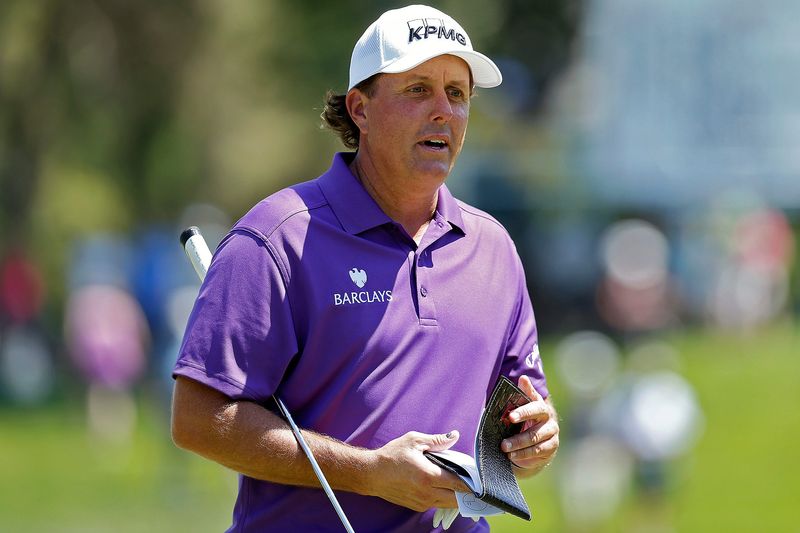
The second golfer being talked about this week in Southampton, New York, is Phil Mickelson. He was not eligible for the U.S. Open, his five-year exemption for winning the 2021 PGA Championship having expired. Lefty could have attempted to get in via qualifying, but chose not to. The LIV player has pulled back from golf, citing a family medical situation.
Given that Mickelson is embroiled in controversy over accusations of inappropriate behavior toward a staffer at the San Diego country club where he used to belong (the club kicked him out after the allegations surfaced), it’s probably a good thing he won’t be subjecting himself to the traditionally vociferous New York galleries.
Mickelson also is being mentioned in media circles because of his last two visits to Shinnecock Hills, where in 2004 he went to the 17th hole tied for the final-round lead with Retief Goosen, only to stumble to the finish; the U.S. Open remains the only major Mickelson has not won.
In 2018, the left-hander infamously hit a moving ball on the ultra-slippery 13th green, a violation of rules and middle finger to the USGA that damaged his reputation among purists and exposed him for not being the ambassador of the game he often claimed to be. His beef with the USGA hit its high point during the one major that has eluded him.
Scott and Mickelson. Two golfers who could not be more different on and off the course. It is a rich irony that they are the shining and fallen stars of the 126th U.S. Open.
Phil Mickelson makes news for wrong reasons
Of the two, Mickelson is much more the newsmaker, often to his detriment. The one-time boy wonder, who won the 1991 Northern Telecom Open as a 20-year-old college junior, one of only seven amateurs to win a PGA Tour event, has petrified into a crusty 56-year-old. Yet, being ever conscious of his image, he would have you believe he is no older than 45. And, being the ultimate “smartest guy in the room,” he would attempt to convince any gullible golf fan that his body actually has been preserved by drinking coffee or, in his case, the performance coffee supplement he endorses. Good old Phil, angling for self-justification and opportunity with every word out of his mouth.
For the best insider look at Lefty, check out Pablo Torre’s podcast “What the Hell Happened to Phil Mickelson” from 2025, when sports reporter/author Alan Shipnuck outlines what makes Mickelson tick.
My own experience with Mickelson is mixed. I find him entertaining in a phony-balony kind of way, but his lack of sincerity also does not sit well. I remain amazed by his arrogance in believing he is never wrong and his obsession with action and beating the system.
Mickelson’s gambling habit is well documented, as is the insider trading investigation that sent his former friend, Billy Walters, to jail. Mickelson mostly dodged the bullet by only having to repay $1 million earned from suspect trades.
In the 18th century, northern fur trappers would dip knife blades in the blood of their quarry and bury the weapons blade side up in the ground. Wolves would wander in and begin ravenously licking the frozen blades until their own blood mixed with what was already on the knife. The feeding frenzy increased until each wolf bled itself to death.
That is Mickelson, who has made a life out of self-inflicted injury.
Adam Scott quietly goes about his business
Scott is the antithesis of his more brazen golf contemporary. Unlike Mickelson, Scott’s goal has never been to embarrass the USGA or ridicule the PGA Tour with the hope of both governing bodies bending to his wishes. When neither organization gave in to him, Mickelson left for LIV. Scott could have bolted, but did not. That doesn’t make the Aussie a saint, but it speaks to him being grateful for what the tour has done for him, not antagonistic over what it has not done.
That is not to suggest Scott is strictly a company man. It is more that his disagreements are handled with class.
Consider comments about how he anticipates the USGA will set up Shinnecock Hills, which in the past has been a house of horrors that bordered on being an unfair test of golf.
“Shinnecock is probably my favorite course on the East Coast, but my record there is pretty poor,” Scott said, showing the humility he is known for, without apologizing for his performance. “I have high expectations that we’re going to have a great week.”
Pause.
“I’m trying not to be a cynical old pro,” he added.
You know, like Mickelson.
FOR BETTER SEARCHES: Prefer The Dispatch on Google
“It’s a hard track, but a great track,” Scott continued. “Hopefully, they get the balance right and it’s not contrived.”
Scott can be pointed about the way the USGA sets up courses for the U.S. Open.
“I don’t know what to believe with them,” he said, regarding whether the USGA is always genuine with its insistence that the organization is out to identify the best players, not embarrass them.
But Scott does not put on the boxing gloves and go 10 rounds with the USGA just to prove he is smarter.
After the USGA failed to suspend last year’s U.S. Open at Oakmont early enough, forcing a handful of players, including Scott, to hit approach irons from waterlogged fairways, Scott said the organization messaged him.
“They reached out, were checking my temperature that I wasn’t steaming,” he said. “I didn’t reply.”
Didn’t reply? Mickelson would have called a press conference to share his displeasure and distrust. But Scott feels no need to show everyone how intelligent he is. Yet he is as discerning as anyone on tour.
Assessing his 100 straight appearances in majors, Scott wondered if career longevity might decrease as today’s players increase their training.
“The whole longevity thing is going to be interesting to watch over the next decade,” he said. “We push our bodies a lot harder, generally. To get players to reach the highest heights, they have to push really hard. But does that shorten their careers? Do their bodies break down? The extreme example I would use is Tiger. He pushed really hard to get to 14 majors really quickly, then it all broke down a little bit and he couldn’t quite get to [the Nicklaus record of 18 majors] we all thought he was going to cruise past. It’s a tip for everybody else that if you push really hard …”
Mickelson pushed hard in a different way, but the result is similar. His career, which includes six major championships, has taken a dark turn.
Scott, who has one major, can be proud of a steady career that remains bright and shining. And easy to cheer for.
Sports columnist Rob Oller can be reached at roller@dispatch.com and on X.com at @rollerCD.
This article originally appeared on The Columbus Dispatch: Adam Scott, Phil Mickelson represent opposite ends of golf greatness
Reporting by Rob Oller, Columbus Dispatch / The Columbus Dispatch
USA TODAY Network via Reuters Connect
By Rob Oller, Columbus Dispatch | USA TODAY Network