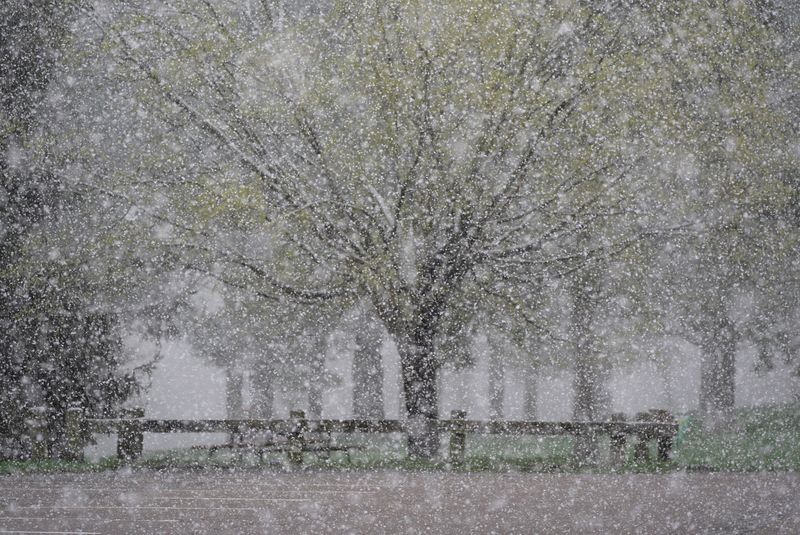
If winter feels like it’s running long in western New York this year, there’s a reason it’s not just perception — but it’s also not outside normal bounds.
In Buffalo, the average date for the last measurable snowfall is April 15. This year, snow has stretched a bit beyond that, landing about a week later than typical.

That doesn’t mean winter is breaking records. It does mean the region is on the tail end of its usual snow season, where small late-season systems can still move through even as spring gradually takes hold.
So is winter actually lasting longer?
Climatology doesn’t show a clear trend of the snow season lengthening year to year in western New York. Instead, what changes is timing and clustering.
Some years, the last measurable snow comes in late March. Other years, it slips into mid- or even late April, especially in areas influenced by lake-effect patterns off Lake Erie and Lake Ontario.
This year simply landed on the later side of the typical window.
What the forecast says now
The snow that fell earlier this week could mark the final winter weather event of the season, as the broader pattern shifts away from sustained winter conditions.
While isolated systems can still bring flurries or brief bursts of snow, forecasters are not seeing a setup that supports repeated or long-duration snowfall in the near term.
As temperatures trend warmer overall, precipitation is also more likely to fall as rain rather than snow.
At least through the next two weeks, snow is not in the forecast for the region.
Why it still feels like winter won’t let go
A few things tend to stretch out the perception of winter in western New York:Even though this year’s timing is not much later than normal, several factors are stretching the perception of winter in western New York.
Lake-effect snow can linger later into the season than many inland regions typically expect, keeping flurries and light accumulations in play well into spring.
Back-to-back weak systems can also create the sense of a persistent pattern, even when individual events are minor and short-lived.
Frequent temperature swings between mild and colder air further complicate the transition, often resetting expectations of “spring” before they fully take hold.
Even small accumulations can reinforce the feeling that winter is still active, even as the broader seasonal pattern fades.
This year also had a more active winter overall, with multiple clipper systems, brief polar air intrusions and several stronger snow events beginning earlier than usual and stretching back into the fall season.
Together, those swings can make the season feel longer than what the calendar or averages suggest.
Could an El Niño mean another snowy winter in 2026–27?
Right now, forecasters are watching a likely shift toward El Niño conditions developing later in 2026. National outlooks suggest a transition from neutral conditions into El Niño by summer, with the pattern potentially lasting into the 2026–27 winter season.
That’s important — but it doesn’t automatically translate into a snowier winter for western New York.
El Niño winters tend to reshape storm tracks across the U.S., but the impacts vary by region. In general, El Niño is more strongly linked to wetter and cooler conditions across parts of the southern U.S., while the northern tier — including the Great Lakes — can end up warmer and less consistently snowy, depending on how the pattern sets up.
Meteorologists also stress that other patterns matter just as much — especially the North Atlantic Oscillation and short-term atmospheric blocking patterns, which can override broader ENSO signals week to week.
New York weather watches and warnings
Stay informed. Get weather alerts via text
Brandi D. Addison covers weather across the United States as the Weather Connect Reporter for the USA TODAY Network. She can be reached at baddison@gannett.com. Find her on Facebook here.
This article originally appeared on Rochester Democrat and Chronicle: Why winter feels longer in NY this year. Is more snow is coming?
Reporting by Brandi D. Addison, USA TODAY NETWORK / Rochester Democrat and Chronicle
USA TODAY Network via Reuters Connect